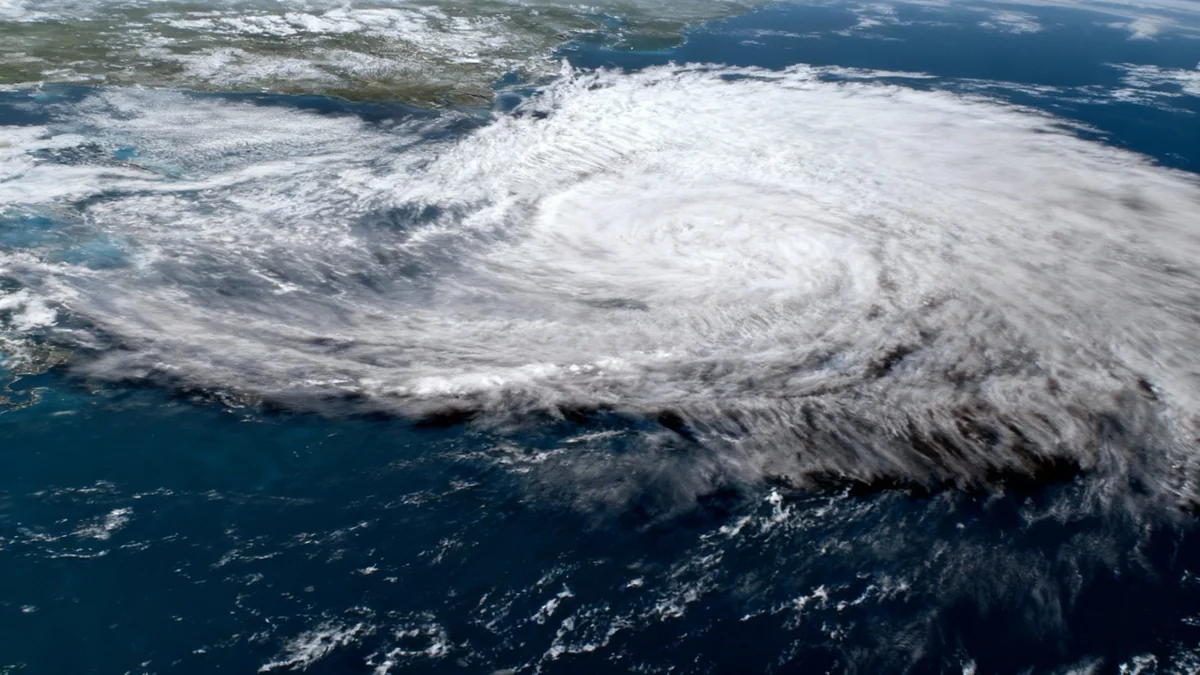





A new artificial intelligence model from Google is demonstrating remarkable accuracy in predicting the path and intensity of hurricanes, outperforming traditional methods and even human experts. The technology proved its value during the recent Hurricane Melissa, where an AI-driven forecast provided critical extra time for preparations in Jamaica, potentially saving lives.
Key Takeaways
- Google's DeepMind AI model is now a primary tool for the National Hurricane Center (NHC).
- The model accurately predicted Hurricane Melissa's rapid intensification to a Category 5 storm.
- Throughout this year's 13 Atlantic storms, the AI has consistently provided more accurate track predictions than traditional models and human forecasters.
- Unlike physics-based models that require supercomputers, the AI runs quickly on a desktop computer, analyzing patterns in historical data.
- While highly accurate, experts note the AI can sometimes struggle with peak intensity forecasts and its decision-making process is not fully transparent.
A Groundbreaking Forecast
When Tropical Storm Melissa was forming south of Haiti, National Hurricane Center (NHC) meteorologist Philippe Papin made a forecast that was unprecedented. He predicted the storm would rapidly intensify into a powerful Category 4 hurricane within just 24 hours and turn towards Jamaica. No NHC forecaster had ever issued such an aggressive prediction for rapid strengthening.
Papin’s confidence came from a new tool: Google's DeepMind hurricane model. In his public discussion on October 25, he noted the model was a primary factor in his decision. He explained that a significant number of the model's simulations showed Melissa becoming a Category 5 storm.
His forecast proved correct. Hurricane Melissa intensified with astonishing speed, making landfall in Jamaica as a Category 5 storm. It became one of the strongest landfalls ever recorded in the Atlantic basin. Papin’s bold, AI-assisted prediction gave residents and authorities in Jamaica crucial extra time to prepare for the disaster.
What is Rapid Intensification?
Rapid intensification is a phenomenon where a tropical cyclone's maximum sustained winds increase significantly in a short period. It is one of the most difficult aspects of a hurricane to forecast, making the accuracy of the DeepMind model in the case of Melissa particularly noteworthy.
How the AI Model Works
Google DeepMind represents a significant shift in weather forecasting. For decades, meteorologists have relied on complex, physics-based models. These models use current atmospheric data and run it through fundamental equations of physics on massive supercomputers. This process can take hours to complete.
The DeepMind model operates differently. It is a form of machine learning, not generative AI like ChatGPT. It has been trained on vast amounts of historical weather data, learning to recognize subtle patterns that often precede specific storm behaviors. By analyzing these patterns, it can generate a forecast in just a few minutes on a standard desktop computer.
"They do it much more quickly than their physics-based cousins, and the computing power is less expensive and time consuming," said Michael Lowry, a former NHC forecaster. "What this hurricane season has proven in short order is that the newcomer AI weather models are competitive with and, in some cases, more accurate than the slower physics-based weather models we’ve traditionally leaned on."
This speed and efficiency allow forecasters to run more scenarios and gain confidence in their predictions much faster than before.
A New Standard in Accuracy
The performance of Google's model during Hurricane Melissa was not an isolated success. Throughout all 13 Atlantic storms this year, the DeepMind model has consistently been the most accurate predictor of a storm's future path, even outperforming the official forecasts from human experts at the NHC.
This level of performance from a new system has impressed veteran forecasters.
Did You Know? The parent system for Google's hurricane model also performed exceptionally well last year in diagnosing large-scale weather patterns, indicating the technology's broad applicability beyond tropical cyclones.
"I’m impressed," said James Franklin, a retired NHC forecaster. "The sample is now large enough that it’s pretty clear this is not a case of beginner’s luck."
Challenges and the 'Black Box' Problem
Despite its successes, the DeepMind model is not flawless. Franklin pointed out that while it excels at forecasting a storm's track, it can sometimes misjudge the highest-end intensity. The model struggled with Hurricane Erin earlier this year as it was also undergoing rapid intensification to Category 5. It also had difficulties with Typhoon Kalmaegi, which recently made landfall in the Philippines.
A more fundamental concern for meteorologists is the model's lack of transparency. Because it learns from patterns rather than applying physical laws, it's not always clear why the AI makes a particular prediction. This is often referred to as the "black box" problem.
"The one thing that nags at me is that while these forecasts seem to be really, really good, the output of the model is kind of a black box," Franklin explained. He plans to discuss with Google how they can provide more underlying data to help forecasters understand the model's reasoning.
This also highlights a difference in approach. Nearly all traditional weather models are developed by government agencies and their methods are provided free to the public. Google has made the top-level output of DeepMind available, but the internal workings remain proprietary.
The Growing Role of AI in Weather Prediction
Google is not the only entity exploring AI for weather forecasting. The U.S. and European governments are also developing their own AI models, which have shown improved skill over older, non-AI versions. The success of these systems signals a major technological shift in meteorology.
The next wave of innovation appears to be coming from startup companies, which are using AI to tackle other difficult forecasting challenges. These include:
- Better sub-seasonal outlooks (forecasts for several weeks ahead).
- More advanced warnings for tornado outbreaks.
- Improved predictions for flash flooding events.
Some of these companies are receiving U.S. government funding to advance their work. One company, WindBorne Systems, is even launching its own weather balloons to gather more data, filling gaps in the national observation network. The era of AI-driven weather forecasting has arrived, promising faster, more accurate predictions that can better protect communities from extreme weather events.