


Even as artificial intelligence models demonstrate remarkable capabilities, they continue to fall short in one of humanity's most abstract domains: advanced mathematics. According to leading experts in the field, the creative, intuitive leap required for groundbreaking mathematical research remains a distinctly human trait, allaying fears that AI will soon render mathematicians obsolete.
Concerns about AI's potential to surpass human intellect are growing, particularly among the next generation of scientists and thinkers. However, a closer look at the performance of large language models on research-level problems reveals significant limitations, highlighting the irreplaceable role of human insight in pushing the boundaries of knowledge.
Key Takeaways
- Leading mathematicians observe that current AI models struggle with solving novel, research-level math problems.
- Fields Medal winner Martin Hairer suggests that AI's current limitations stem from its inability to perform the creative leaps required for true mathematical discovery.
- While useful for computation and data analysis, AI has not demonstrated the ability to formulate new, meaningful mathematical questions.
- The dialogue addresses growing anxiety among aspiring mathematicians about being replaced by intelligent machines.
The Human Element in an Automated World
The rapid advancement of artificial intelligence has sparked a widespread debate across numerous professions, from artists to software engineers. The field of mathematics, often seen as the purest form of logic, is no exception. A recent exchange involving a high school student and a world-renowned mathematician brought this anxiety into sharp focus.
The student, an aspiring mathematician, expressed a common fear: that AI models are improving so quickly they might soon make human problem-solvers useless. He questioned whether mathematics would lose its "magic" if a machine could outperform humans.
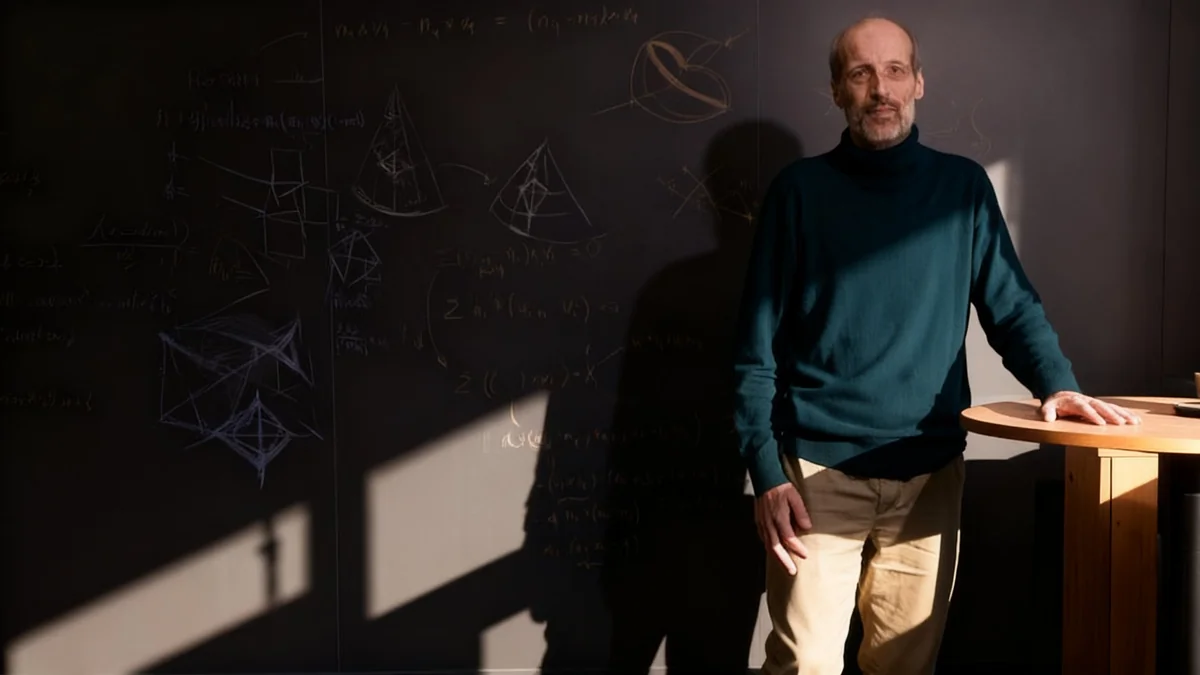
This concern reached Martin Hairer, a celebrated mathematician at the Swiss Federal Technology Institute of Lausanne and Imperial College London. His work, which earned him a Fields Medal in 2014 and a Breakthrough Prize in 2021, is known for its profound creativity.
In a response to the student, Dr. Hairer acknowledged that many fields are grappling with the prospect of AI-induced obsolescence. He noted, however, that the current state of AI in mathematics is far from achieving the level of insight required for true innovation.
This perspective from one of the world's leading mathematical minds provides a crucial counterpoint to the hype surrounding AI's capabilities. It suggests that the core of mathematical progress is not just about computation, but about a deeper, more intuitive understanding that machines have yet to replicate.
Where AI Succeeds and Fails in Mathematics
To understand the current landscape, it is important to distinguish between what AI can and cannot do in mathematics. Large language models (LLMs) are incredibly effective at processing vast amounts of existing information, recognizing patterns, and performing complex calculations based on established rules.
What is a Fields Medal?
The Fields Medal is often described as the "Nobel Prize of Mathematics." Awarded every four years to mathematicians under the age of 40, it recognizes outstanding mathematical achievement for existing work and for the promise of future accomplishment. Winning a Fields Medal, as Dr. Hairer did, places a mathematician at the very top of their field.
However, groundbreaking mathematics is not about repeating what is already known. It involves formulating new questions, developing entirely new frameworks, and connecting seemingly unrelated concepts. This is where current AI systems falter.
Experts in the field note that while an AI can solve complex equations or verify proofs within an existing system, it struggles to:
- Ask meaningful questions: Identifying a problem worth solving is a creative act that requires deep domain knowledge and intuition.
- Invent new concepts: Much of mathematical history involves the invention of new ideas, like calculus or non-Euclidean geometry. AI has not shown this capability.
- Judge the importance of a result: A human mathematician can recognize if a solution is elegant, significant, or opens up new avenues of research. An AI, by contrast, simply arrives at a correct or incorrect answer.
Dr. Hairer's work itself is an example of this. His contributions to the field of stochastic partial differential equations involved creating new mathematical structures to make sense of randomness in complex systems—a task that required a creative leap far beyond pattern recognition.
The Future of Mathematical Collaboration
Rather than viewing AI as a replacement, many in the scientific community see it as a powerful new tool. Just as calculators and computers revolutionized mathematical work in the 20th century without replacing mathematicians, AI is poised to become an indispensable assistant.
AI as a Research Assistant
Mathematicians are already exploring ways to use AI to check tedious parts of proofs, search for counterexamples, and analyze large datasets for patterns that might suggest new theorems. This allows human researchers to focus on the more creative aspects of their work.
The fear expressed by the high school student is rooted in the perception of AI as a competitor. Dr. Hairer's response reframes the relationship as one of potential collaboration. The role of the mathematician may evolve, but the need for human creativity, intuition, and critical judgment will likely become even more valuable.
The process of mathematical discovery is often messy and non-linear. It involves trial and error, moments of sudden insight, and an aesthetic appreciation for the elegance of a solution. These are qualities that are deeply human and, for now, remain beyond the grasp of algorithms.
A Lesson for Other Fields
The conversation in the mathematical community offers broader insights for any profession facing the rise of AI. The key to remaining relevant is not to compete with machines on their terms—computation and data processing—but to cultivate the skills that are uniquely human.
These skills include:
- Critical Thinking: Questioning assumptions and evaluating information from multiple perspectives.
- Creativity: Generating novel ideas and making connections between disparate fields of knowledge.
- Strategic Insight: Understanding the bigger picture and determining which problems are most important to solve.
As Dr. Hairer's exchange with the student illustrates, the rise of AI does not necessarily diminish the magic of human intellect. Instead, it challenges us to better understand and value the creative spark that drives discovery and innovation. For the foreseeable future, the most profound questions in mathematics and beyond will still require a human mind to ask them.