




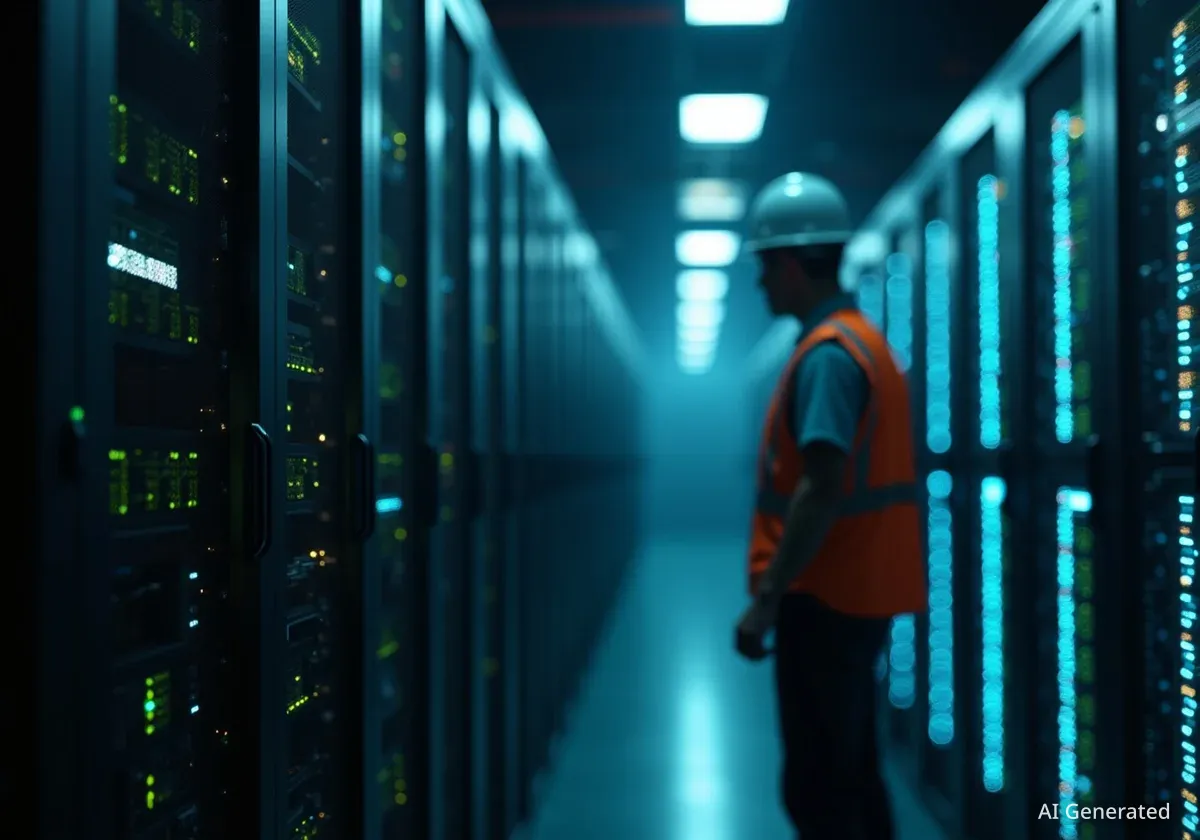
In response to the escalating energy demands of artificial intelligence and data processing, a Chinese company is developing underwater data centers off the coast of Shanghai. This initiative aims to use natural ocean currents for cooling, a method that could drastically reduce electricity consumption compared to traditional land-based facilities. While the project promises significant energy savings and reliance on renewable power, scientists are raising concerns about the potential ecological impact on marine environments.
Key Takeaways
- China is establishing one of the world's first commercial underwater data centers near Shanghai to meet growing data demands.
- The project uses ocean currents for cooling, which could cut energy use for this purpose by up to 90%.
- Over 95% of the facility's power is planned to come from nearby offshore wind farms, promoting green energy usage.
- Scientists warn of potential ecological risks, including thermal pollution from heat emitted by the servers, which could disrupt local marine life.
- Technical and economic challenges remain, including structural maintenance, underwater connectivity, and long-term commercial viability.
A New Frontier for Data Infrastructure
The global demand for data storage is increasing rapidly, driven by advancements in artificial intelligence and cloud computing. Traditional data centers are major consumers of electricity, with a significant portion used for cooling systems to prevent servers from overheating. To address this, companies are exploring innovative solutions, including placing data infrastructure beneath the ocean's surface.
A project led by the maritime equipment firm Highlander is pioneering this concept in China. According to company representative Yang Ye, leveraging the consistent, low temperatures of deep ocean water provides a natural and efficient cooling mechanism. This method of passive cooling is expected to be far more energy-efficient than the air-conditioning systems used in conventional data centers.
Learning from Past Experiments
The idea of submerging data centers is not entirely new. In 2018, Microsoft conducted a notable experiment called Project Natick, where a data center was submerged off the coast of Scotland. The project was considered a technical success, demonstrating the feasibility of the concept. However, Microsoft did not proceed with commercial-scale implementation, leaving the door open for other companies to lead the way in this emerging field.
The new facility near Shanghai is positioned to be one of the world's first commercially operational underwater data centers. It has already secured major clients, including China Telecom, one of the country's largest telecommunications providers. This project aligns with the Chinese government's broader strategic goals to reduce the carbon footprint of its rapidly expanding digital infrastructure.
Technical Hurdles of Subsea Operations
Placing high-tech electronics in a saltwater environment presents a unique set of engineering challenges. The servers for the Shanghai project are housed within a large, sealed steel capsule designed to withstand immense underwater pressure and prevent leaks.
Zhou Jun, an engineer with Highlander, noted that protecting the structure from corrosion is a primary concern. The capsule is coated with a specialized layer containing glass flakes to create a durable barrier against the corrosive effects of seawater. Maintaining a completely dry and stable internal environment is critical for the longevity and reliability of the servers.
Powering the Deep Web
Another significant challenge is providing a reliable power source and internet connection to the submerged facility. The Shanghai data center is designed to be a model of sustainable operation, drawing its electricity from renewable sources.
According to the project's design, over 95% of the energy consumed by the underwater data center will be supplied by nearby offshore wind farms. This integration of renewable energy is a key component of its green credentials.
Connecting the facility to the internet is also more complex than for land-based centers. It requires laying specialized submarine fiber-optic cables, a process that is both costly and technically demanding, requiring careful planning to avoid disrupting marine ecosystems and shipping lanes.
Ecological and Environmental Questions
While underwater data centers offer a promising way to reduce energy consumption, their potential impact on marine ecosystems is a growing area of scientific concern. The primary issue is thermal pollution. Even with efficient water cooling, the servers still generate a substantial amount of heat, which is then dissipated into the surrounding ocean.
"The heat emitted by these facilities could alter marine ecosystems. Some species might be attracted to the warmth, while others could be driven away, potentially disrupting local biodiversity," stated Andrew Want, a marine ecologist at the University of Hull.
This localized increase in water temperature could affect the behavior, metabolism, and reproductive cycles of marine organisms. A 2020 assessment of a smaller test project by Highlander in Zhuhai found that the temperature change in the immediate vicinity remained within acceptable limits. However, experts caution that these findings may not apply to larger, commercial-scale operations.
Shaolei Ren, an expert on data center sustainability, warned that as these facilities grow in size and number, their cumulative thermal output will also increase. He stressed the need for comprehensive and long-term studies to fully understand the potential for widespread thermal pollution and its effects on marine life before large-scale deployment proceeds.
The Economic Outlook for Underwater Data
Beyond the technical and environmental considerations, the long-term economic viability of underwater data centers remains an open question. The initial construction and deployment costs are substantial, involving specialized materials, marine engineering, and complex installation procedures.
To encourage innovation in this sector, the Chinese government has provided financial support. For instance, Highlander received a government grant of $5.62 million for a previous project in Hainan province. Such subsidies are crucial for offsetting the high initial investment and encouraging further research and development.
A Niche or Mainstream Solution?
Experts like Shaolei Ren suggest that underwater data centers may not be a universal replacement for their land-based counterparts. Instead, they could fill specific niches in the market, such as serving coastal cities where land is scarce or providing low-latency processing for offshore industries like energy exploration or scientific research.
The future of this technology will depend on balancing its significant energy-saving benefits against the high costs and potential environmental risks. As the world's data needs continue to grow, the development of these underwater facilities will be closely watched by the technology industry and environmental scientists alike. Continued innovation in materials science, renewable energy integration, and ecological monitoring will be essential for determining whether the internet's future hums beneath the waves.