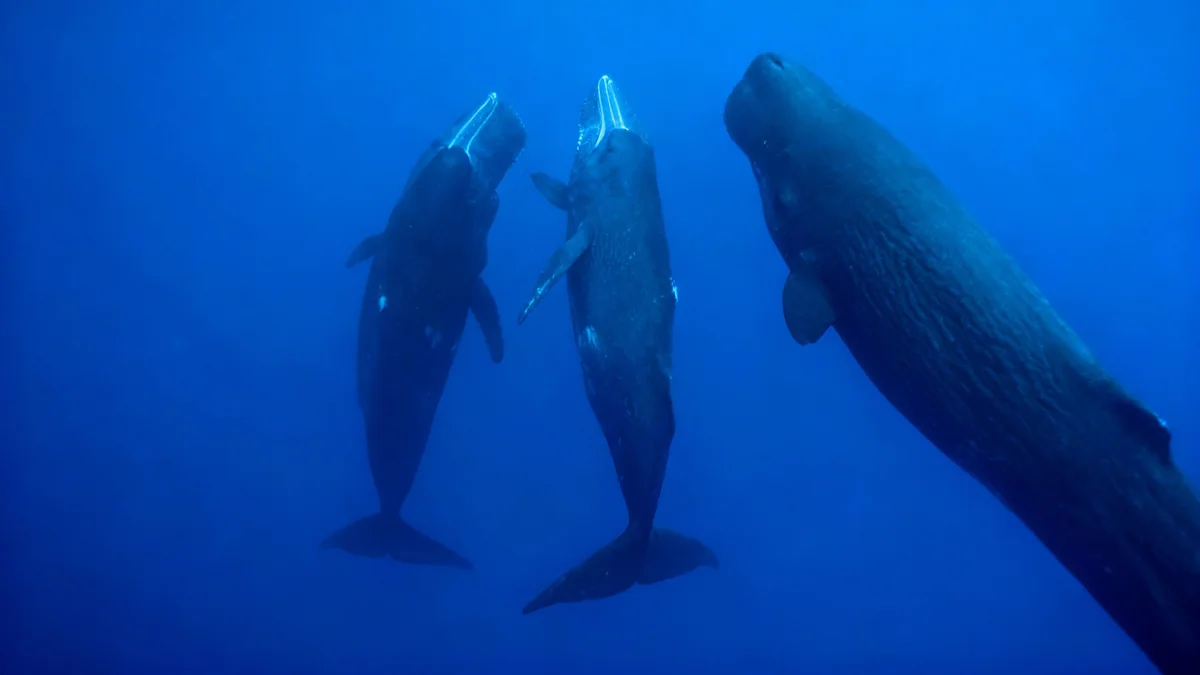





In the deep waters of the Caribbean, an ambitious project is using artificial intelligence to listen to and understand the complex clicks of sperm whales. Researchers believe they are on the verge of a breakthrough that could fundamentally change our understanding of animal communication and intelligence.
A multi-disciplinary team has discovered that sperm whale vocalizations contain a sophisticated structure, similar to human language. This finding suggests we may not be the only species on Earth with a complex form of communication, potentially opening the door to interspecies dialogue for the first time in history.
Key Takeaways
- Project CETI is using advanced AI to analyze the clicks, or "codas," of sperm whales.
- Initial AI models can identify individual whales and their family groups with over 90% accuracy from their vocalizations.
- New research indicates sperm whale communication has an alphabet-like structure, including components that function like vowels.
- The ultimate goal is to translate whale communication, potentially allowing for two-way interaction.
Listening to the Deep
For years, scientists have known that sperm whales communicate using series of clicks called codas. These sounds, among the loudest in the animal kingdom, are used during social interactions deep beneath the ocean's surface. However, the complexity and meaning behind these codas have remained a mystery.
Project CETI (Cetacean Translation Initiative) was founded to crack this code. The team, comprised of over 50 experts including marine biologists, AI specialists, linguists, and roboticists, is conducting its primary research off the coast of Dominica. This region is home to a well-studied population of sperm whales, providing a rich dataset for analysis.
Dr. David Gruber, a marine biologist and the founder of Project CETI, described a recent encounter with a 40-foot sperm whale named Pinchy. He noted the profound difference in their worlds, one living a mile underwater and the other in a modern metropolis, fueling his desire to bridge that communication gap.
The Power of Artificial Intelligence
The key to unlocking these aquatic conversations is artificial intelligence. Researchers are applying the same kind of large language models that power tools like ChatGPT to the vast library of whale sounds collected over two decades.
In a pilot study, an AI model was fed thousands of annotated codas. The results were remarkable. The system learned to accurately predict the type of coda being used, identify the specific whale making the sound, and even determine its vocal clan with more than 90 percent accuracy.
"We realized it might be possible to use A.I. to study even larger swaths of whale codas, find patterns within the vocal data, and eventually translate what whales were saying to each other," the research team noted in a recent publication.
An Alphabet Beneath the Waves
Recent findings from the project have revealed an extraordinary level of structure within whale communication. A study published by the team shows that sperm whales possess what appears to be a phonetic alphabet.
This system includes elements that function similarly to vowels and diphthongs in human language. These components are combined in complex ways, suggesting a communication system far more intricate than previously imagined. It is possible this system predates human language by tens of millions of years.
A Language More Complex Than Our Own?
The project's findings are leading to an extraordinary conclusion: whales may possess a communication system more intricate and ancient than our own. This challenges the long-held belief that complex language is a uniquely human trait.
The team is now developing a novel AI system called the Whale Acoustics Model. This tool is designed to translate any audio into sperm whale vocalizations. This could allow humans, for the first time, to generate whale-like sounds and potentially engage in a basic form of interaction with these marine mammals in their own language.
Bridging Worlds with Technology
While the prospect of talking to whales is compelling, the project's leaders emphasize a deeper purpose. They believe that technology, particularly AI, can serve as a bridge to reconnect humanity with the natural world, rather than being a force of destruction or extraction.
From Copernicus to CETI
Project leaders compare the potential impact of their work to the Copernican revolution. Just as Copernicus revealed Earth was not the center of the cosmos, CETI's research could show that humans are not the sole proprietors of complex thought and communication on our own planet.
There are valid concerns about the misuse of AI, from reinforcing biases to accelerating ecological harm. However, Project CETI aims to use it with care and humility. The goal is not just to collect data, but to foster a deeper sense of wisdom and connection.
If successful, the initiative could have profound implications. Proving that whales possess a true language would not only rewrite biology textbooks but also redefine what it means to be human. Furthermore, it could pave the way for instituting new, stronger legal protections for whales, their habitats, and the ocean as a whole.
As Dr. Gruber states, the real promise of this technology is not to make humans faster or more efficient, but to make us wiser and more connected to the other intelligent life that shares our world.