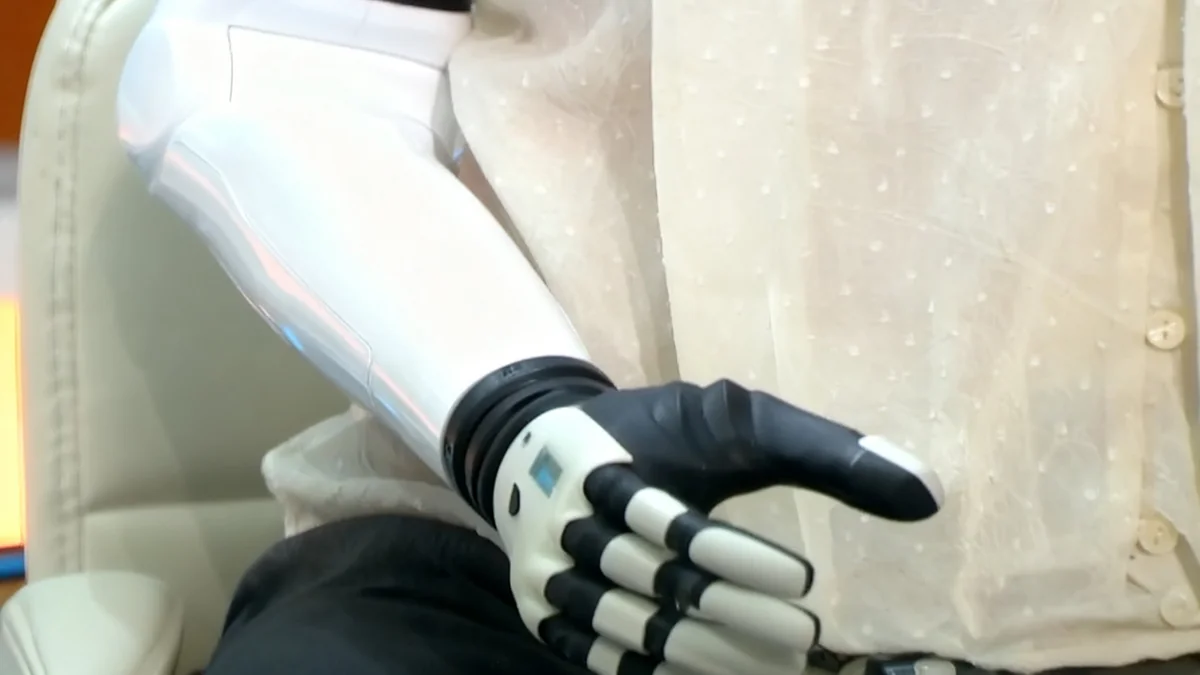

A British woman who lost two limbs in a severe accident now describes herself as "80 percent human and 20 percent bionic" after being fitted with an advanced, mind-reading prosthetic arm. The device uses artificial intelligence to interpret her muscle signals, allowing her to perform daily tasks with remarkable dexterity.
Sarah De Lagarde, who survived being struck by two trains in 2022, says the technology has fundamentally changed her life, enabling her to hug her children and even climb mountains. The bionic arm learns her most frequent movements, becoming more intuitive and responsive over time.
Key Takeaways
- Sarah De Lagarde lost her right arm and leg in a 2022 train accident.
- She now uses a bionic arm powered by artificial intelligence that reads muscle signals.
- The AI software learns and adapts to her movements, making them more natural.
- De Lagarde says the technology has given her a new lease on life, allowing her to regain independence.
- The arm can be detached and charged overnight, a feature her children find fascinating.
A Life Transformed by Technology
In 2022, Sarah De Lagarde’s life was irrevocably altered following a traumatic accident on the London transport network that resulted in the loss of her right arm and leg. In the face of such a challenge, she has since become a pioneer in the use of next-generation prosthetic technology.
Fitted with a state-of-the-art bionic arm, De Lagarde is navigating a new reality where human biology and artificial intelligence merge. The experience has been so profound that she has adopted a new identity.
"I am 80 percent human and 20 percent bionic," she explained in a recent interview, highlighting the deep integration of the technology into her daily existence.
This sentiment captures a growing trend where advanced prosthetics are no longer just passive tools but active, learning extensions of the user's own body. For De Lagarde, the arm is not just a replacement; it is an enhancement that has restored her ability to connect with the world and her family.
How the Mind-Reading Arm Works
The functionality of De Lagarde's bionic arm sounds like something from science fiction, but it is grounded in real, cutting-edge technology. The device operates using a system of myoelectric sensors that rest against the skin of her residual limb.
These sensors are designed to detect the faint electrical signals generated when she tenses her muscles. These are the same signals that would have once controlled her hand and arm. Instead of being lost, they are now captured and interpreted.
The Science of Myoelectric Control
Myoelectric prosthetics have been in development for decades, but the integration of artificial intelligence is a recent game-changer. Early models required users to learn complex muscle flex patterns to trigger pre-set movements. Modern AI-driven systems, like the one De Lagarde uses, reverse this process: the software learns the user's unique muscle signals, making control far more intuitive and natural.
An artificial intelligence software inside the arm processes these signals in real-time. The AI has been trained to recognize the patterns associated with specific intended movements, such as opening her hand, gripping an object, or pointing. Over time, the software learns De Lagarde’s unique patterns, becoming more accurate and responsive.
This learning capability means the arm becomes more efficient at executing the movements she makes most often, effectively streamlining her daily interactions and reducing the cognitive effort required to control it.
Restoring Independence and Family Life
The practical impact of the bionic arm on De Lagarde's life has been immense. She reports that the technology has given her a "whole new lease on life," allowing her to reclaim activities she thought were lost forever.
Among the most meaningful of these is the ability to hug her children again. The arm's sensitive and responsive grip allows for a level of physical interaction that is crucial for family connection. Beyond the home, she has also taken on significant physical challenges, including climbing mountains, demonstrating the durability and capability of the technology.
A New Daily Routine
One of the most novel aspects of the technology is its power source. De Lagarde explained that the arm is detachable and can be plugged in to charge overnight, much like a smartphone. "I think the part that they enjoyed the most is the realization that I can take it off at night and plug it in to charge, just like an iPhone; they find that very funny," she said of her children's reaction.
This simple, almost mundane aspect of the technology underscores how seamlessly it has been integrated into her life. It is not just a medical device but a part of her daily routine, normalizing an extraordinary piece of engineering.
The Future of Human-Machine Integration
Sarah De Lagarde's experience offers a powerful glimpse into the future of medical technology and human augmentation. As artificial intelligence becomes more sophisticated, the line between human and machine is becoming increasingly blurred, particularly in the field of prosthetics.
These advancements are part of a long history of AI development, which has seen rapid acceleration in recent years.
Here are some key moments in the history of artificial intelligence:
- 1950: Alan Turing proposes the "Turing Test" to assess a machine's ability to exhibit intelligent behavior equivalent to, or indistinguishable from, that of a human.
- 1956: The term "Artificial Intelligence" is officially coined at a research workshop at Dartmouth College.
- 1997: IBM's Deep Blue supercomputer defeats world chess champion Garry Kasparov, a landmark moment for AI.
- 2011: Apple integrates Siri, the first widely available AI-powered virtual assistant, into its smartphones.
- 2022: OpenAI releases ChatGPT, making advanced conversational AI accessible to the general public and sparking a global technology race.
The use of AI in devices like bionic limbs represents one of its most compelling and beneficial applications. For individuals like Sarah De Lagarde, it is not just a technological breakthrough; it is a life-restoring innovation that redefines what is possible after catastrophic injury.