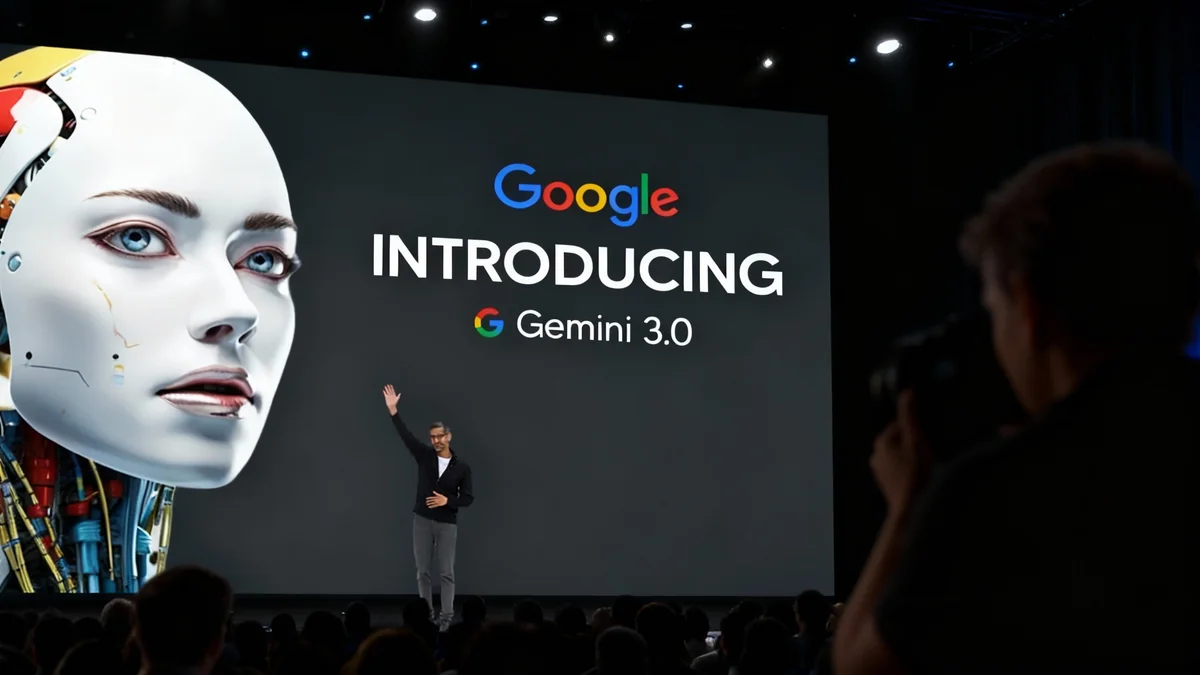





Google is preparing to release a preview of its next-generation artificial intelligence model, Gemini 3.0, this month. The new system is designed to compete directly with leading models from companies like OpenAI and Anthropic, featuring significant upgrades in reasoning, coding, and visual data interpretation.
Early performance data indicates that Gemini 3.0 surpasses current industry standards in several key areas, signaling a potential shift in the competitive landscape of AI development. The model's capabilities are expected to have a broad impact, from streamlining software development to enabling new applications in scientific research and design.
Key Takeaways
- Google plans to launch a preview of Gemini 3.0 Pro in November 2025, positioning it as a major competitor to existing AI models.
- The model demonstrates superior performance in benchmarks measuring creative reasoning, real-world adaptability, and visual understanding.
- Key features include advanced problem-solving, highly efficient code generation, and the ability to interpret complex visual information.
- The release is part of Google's long-term strategy to advance its AI capabilities, with further goals set for 2026.
A New Contender in the AI Arena
Google is positioning Gemini 3.0 as a foundational technology for its future AI ambitions. The model builds on the architecture of its predecessors but introduces core improvements aimed at addressing the limitations of current systems. The company intends for this technology to be more than just an incremental update; it represents a strategic effort to reclaim a leadership position in the rapidly evolving AI sector.
The upcoming release is the Gemini 3.0 Pro Preview, scheduled for November 2025. This version will give developers and researchers an early look at the model's enhanced functions. It is designed to handle a wider range of complex tasks with greater accuracy and efficiency than previous iterations.
Core Capabilities of Gemini 3.0
The new model is distinguished by four primary areas of advancement. These enhancements are designed to work together, allowing the AI to process and synthesize information from multiple sources seamlessly.
The core features include:
- Advanced Reasoning: The system exhibits strong capabilities in lateral and abstract thinking, allowing it to generate creative solutions to complex problems that require non-linear thought processes.
- Enhanced Visual Understanding: Gemini 3.0 can analyze intricate visual data, such as medical scans, engineering diagrams, and design mockups, with a high degree of accuracy.
- Improved Coding Efficiency: For developers, the model is built to generate complex and optimized code, which could significantly reduce development time and improve software performance.
- Seamless Multimodal Integration: The AI combines its language and vision capabilities to understand and operate in diverse scenarios, bridging gaps that existed in earlier models that often handled different data types separately.
Setting New Performance Benchmarks
To validate its capabilities, Google has tested Gemini 3.0 against several industry-standard benchmarks. Preliminary results show the model outperforming established competitors, including OpenAI's GPT series and Anthropic's Claude models, in specific areas of reasoning and analysis.
In tests focused on real-world adaptability and coding, a variant named Gemini 3.0 Pro claimed the top position on the Kingbench Leaderboard, surpassing models like Sonet 4.5.
One of the key evaluations was the Hieroglyph Benchmark, which measures an AI's capacity for creative problem-solving. In this test, Gemini 3.0 Pro showed a substantial improvement over its predecessor, Gemini 2.5, demonstrating its enhanced ability for innovative thinking.
In another set of tests, the SVG Benchmarks, which assess visual reasoning, Gemini 3.0 displayed clear superiority over existing models. This highlights its advanced capacity to process and understand complex graphical information, a critical skill for applications in design, manufacturing, and autonomous systems.
Implications for the Broader AI Industry
The introduction of Gemini 3.0 is expected to intensify competition within the AI industry. Google's vast infrastructure and resources give it a significant advantage in deploying large-scale AI models efficiently. This scale could allow the company to offer high-performance AI solutions at a potentially lower cost, making the technology more accessible to smaller businesses, startups, and individual developers.
The Race for AI Dominance
The AI sector is currently led by a few key players, including OpenAI, backed by Microsoft, and Anthropic. Google's renewed push with the Gemini series is a direct challenge to their market position. The competition is driving rapid innovation, with each company striving to develop models that are more powerful, efficient, and versatile.
The advancements in coding efficiency and multimodal integration are particularly significant. These features address practical challenges faced by developers and researchers, potentially accelerating innovation across many fields. As businesses and developers gain access to these new tools, competitors will likely be compelled to fast-track their own research and development to keep pace.
Google's Long-Term Vision for AI
While the immediate focus is on the November 2025 preview, Gemini 3.0 is a key part of Google's larger strategic plan. The company has indicated that this model will serve as the foundation for even more sophisticated systems in the coming years.
According to public statements from Google CEO Sundar Pichai, the company has set ambitious goals for its AI initiatives, aiming to achieve new breakthroughs in artificial intelligence and its applications by 2026.
This long-term vision suggests that Google sees Gemini 3.0 not as an endpoint, but as a critical stepping stone. The focus will likely remain on improving practical applications like coding and multimodal understanding, which are seen as key differentiators in the market. As the release approaches, the technology community is watching closely to see if Gemini 3.0 will deliver on its promise to reshape the AI landscape.