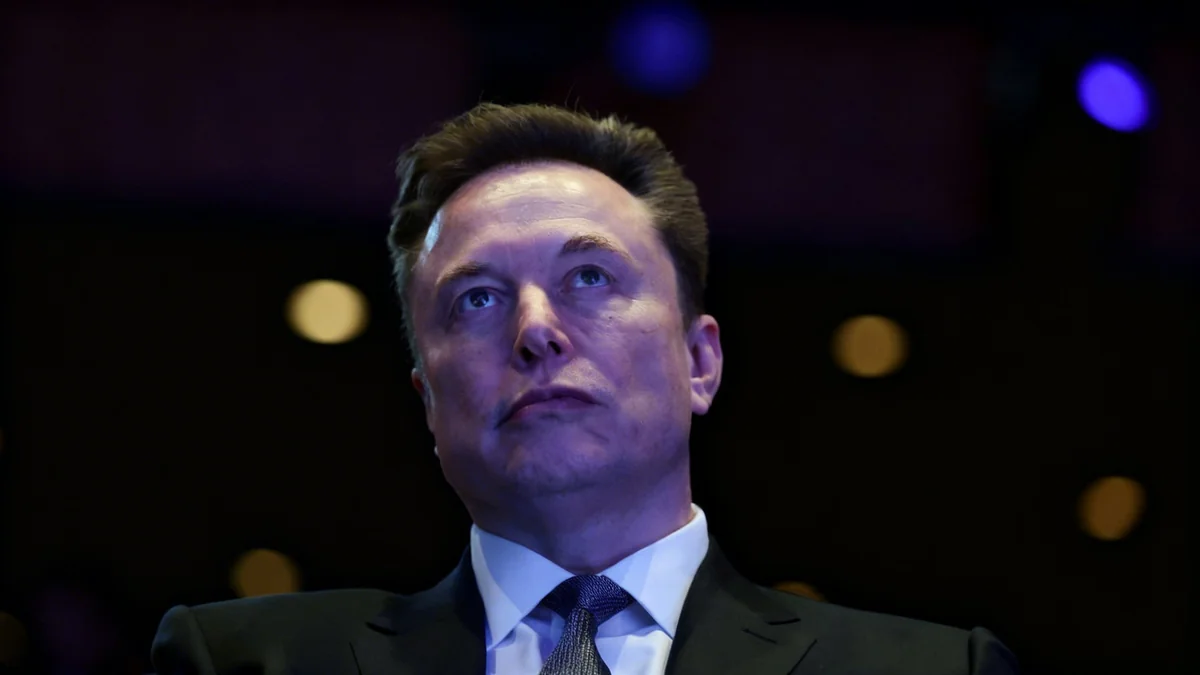


Tesla is set to launch a major new project to manufacture its own artificial intelligence chips in seven days, according to CEO Elon Musk. The initiative, dubbed the "Terafab," aims to address the growing demand for specialized processors required for the company's autonomous driving technology.
The move signals a significant step towards vertical integration for the electric vehicle manufacturer, as it seeks to control the supply of critical components for its Full Self-Driving (FSD) systems.
Key Takeaways
- Tesla CEO Elon Musk announced the company's "Terafab" project for AI chip manufacturing will launch in one week.
- The facility is intended to produce Tesla's fifth-generation AI chip, known as AI5, to power its autonomous vehicle systems.
- This decision comes after Musk previously stated that production from existing suppliers like TSMC and Samsung is insufficient to meet Tesla's long-term volume needs.
- The project highlights Tesla's strategy to secure its supply chain and accelerate its ambitions in artificial intelligence and robotics.
Musk Announces Imminent Launch
In a statement on Saturday, Elon Musk confirmed the timeline for the company's ambitious new manufacturing endeavor. The project, named "Terafab," is designed to produce AI chips on a massive scale, reflecting a strategic pivot to in-house production for one of its most critical technologies.
Tesla has not yet disclosed the location of the new facility or the total investment required for its construction. The name itself, combining "tera" (a prefix denoting a trillion) with "fab" (short for fabrication plant), suggests a facility with a production capacity far exceeding current industry standards.
This initiative is the culmination of plans Musk has discussed publicly for over a year. At the company's previous annual meeting, he first raised the possibility of building what he described as a "gigantic chip fab" to overcome supply chain bottlenecks.
Addressing the AI Chip Bottleneck
The primary driver behind the Terafab is the immense computational power required for Tesla's autonomous driving software. The company's FSD system relies on sophisticated AI models that process vast amounts of data from vehicle sensors in real-time.
Currently, Tesla partners with established semiconductor giants, including Taiwan's TSMC and South Korea's Samsung, for its chip needs. However, Musk has repeatedly expressed concerns that these partnerships cannot scale quickly enough to match Tesla's production and development goals.
"Even when we extrapolate the best-case scenario for chip production from our suppliers, it's still not enough," Musk stated at a previous company event. "I can't see any other way to get to the volume of chips that we're looking for."
By bringing chip manufacturing in-house, Tesla aims to gain direct control over the design, production, and supply of its processors, reducing its dependence on third-party foundries and insulating itself from global semiconductor shortages.
From Giga to Tera
Elon Musk has described the scale of the new project as a significant leap beyond its current "Gigafactories." He explained, "It's like giga but way bigger." This implies a manufacturing capability designed to support millions of autonomous vehicles and future robotics projects.
The AI5 Chip: Powering Full Self-Driving
At the heart of the Terafab project is Tesla's fifth-generation AI chip, reportedly named AI5. This custom-designed processor is engineered specifically to run the neural networks that underpin Tesla's Autopilot and FSD features.
Each new generation of Tesla's AI hardware has delivered substantial performance increases, enabling more complex and reliable autonomous capabilities. The development of the AI5 chip is a critical step in the company's roadmap toward achieving Level 4 or Level 5 autonomy, where a vehicle can operate without human intervention under most or all conditions.
Controlling the manufacturing process will allow Tesla's engineers to tightly integrate hardware and software development, potentially accelerating innovation and optimizing performance in ways that are not possible when relying on external suppliers.
A History of In-House Hardware
Tesla is no stranger to designing its own hardware. The company has been developing custom AI chips since it moved away from using Nvidia processors in 2019. The introduction of its first Full Self-Driving (FSD) computer marked a key moment in its strategy to build a vertically integrated technology stack for its vehicles.
Strategic Implications for the Industry
Tesla's decision to build its own chip fabrication plant places it in a small and exclusive group of companies with end-to-end control over semiconductor production. This move follows a broader industry trend of tech giants like Apple, Google, and Amazon designing their own custom silicon to optimize performance for their specific products and services.
However, building and operating a state-of-the-art chip fab is an incredibly complex and capital-intensive undertaking. It requires billions of dollars in investment and highly specialized expertise.
Last year, Musk mentioned that Tesla had considered potential collaborations with other major chip manufacturers, including Intel. He noted that while no deal had been signed, it was "probably worth having discussions with Intel." The announcement of the Terafab suggests Tesla has ultimately chosen to pursue its own independent path, a decision that underscores the strategic importance of AI hardware to its future.
As the project launches, the technology and automotive industries will be watching closely to see how Tesla navigates the challenges of high-volume semiconductor manufacturing and whether this bold move will give it a decisive edge in the race to develop fully autonomous vehicles.