

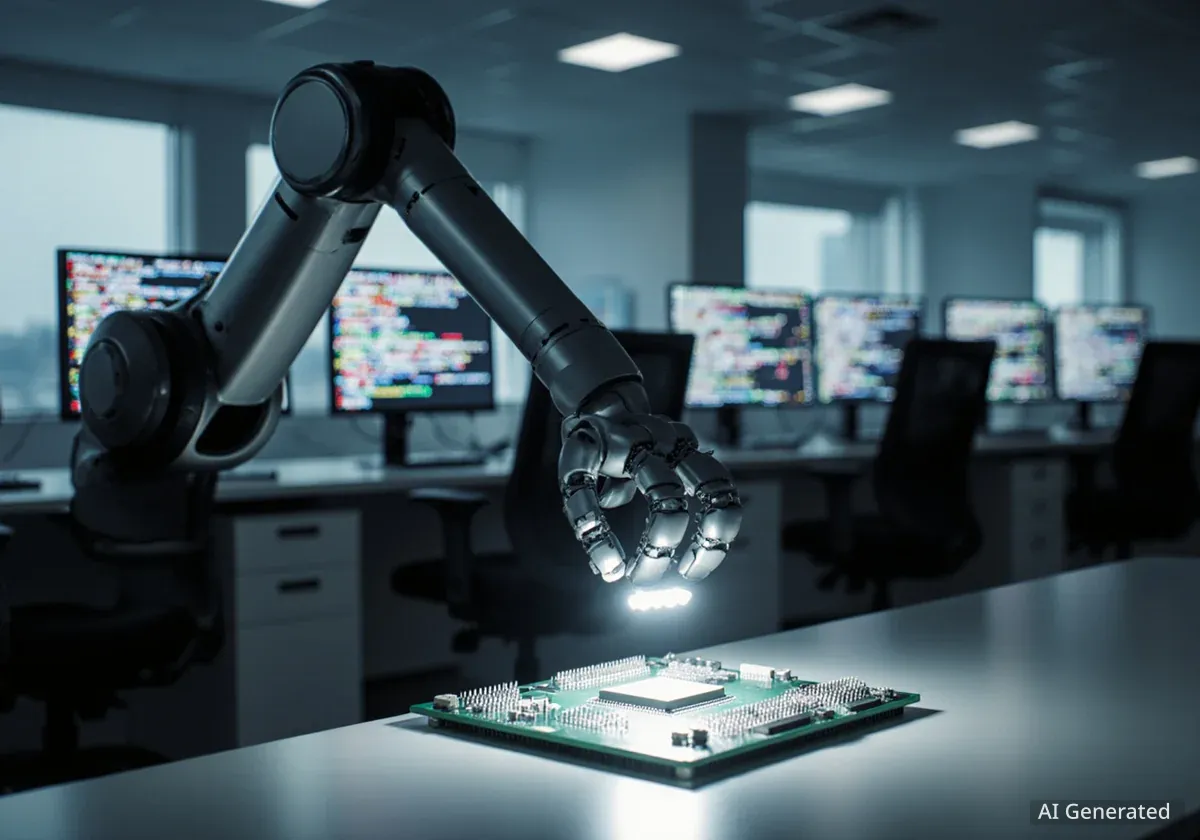



The deployment of autonomous AI agents capable of handling legal, marketing, and sales tasks has ignited fresh debate over the future of white-collar work. A recent announcement from artificial intelligence firm Anthropic confirmed its systems are now actively performing these functions, a development that is accelerating conversations about workforce displacement and economic restructuring.
While some experts highlight the potential for increased efficiency and the creation of new roles, many professionals are expressing concern about the speed of this transition. The development moves AI from a tool that assists workers to an autonomous agent that replaces specific job functions, raising fundamental questions for multiple industries.
Key Takeaways
- AI company Anthropic has deployed autonomous AI agents to perform tasks in legal, marketing, and sales.
- This shift from AI as a supportive tool to an autonomous worker is causing significant discussion about job security.
- Public sentiment reveals widespread skepticism that new job creation will offset the roles eliminated by AI.
- The legal profession is one of the primary white-collar sectors facing immediate disruption from these new capabilities.
The New Generation of AI Workers
Artificial intelligence is no longer just a background process for analyzing data or generating text. The latest advancement involves what are known as AI "agents"—systems designed to autonomously execute multi-step tasks that traditionally required human oversight. Anthropic's recent deployment is a significant milestone in this evolution.
These agents can manage complex workflows from start to finish. For example, in a sales department, an AI agent might identify potential leads, draft and send outreach emails, schedule meetings, and update customer relationship management (CRM) software without human intervention. This level of autonomy represents a major leap from previous AI models.
The core difference is the ability to plan, execute, and adapt. Unlike a simple chatbot, these agents can reason through a problem, use various software tools, and complete a sequence of actions to achieve a specific business goal. This capability is what allows them to take on entire job functions, not just isolated tasks.
Immediate Impact on Professional Services
The legal and marketing fields are among the first to feel the impact of this technological shift. In law, AI agents can now conduct legal research, draft standard contracts, and manage case files—tasks that are foundational for paralegals and junior associates. This automation promises to reduce costs and speed up legal processes.
However, it also raises concerns within the legal community about the future of entry-level positions that have long served as a training ground for new lawyers. The discussion is no longer theoretical; it is a practical reality that law firms must now address.
What Are AI Agents?
An AI agent is a software program that can perceive its environment, make decisions, and take autonomous actions to achieve specific goals. Unlike earlier AI, which required direct commands for each step, an agent can operate independently to complete a complex objective, such as running a full marketing campaign or managing a sales pipeline.
In marketing, the story is similar. AI agents are capable of analyzing market data, creating advertising campaigns, managing social media accounts, and reporting on performance metrics. While creative direction may still require a human touch, the day-to-day execution of marketing strategies is becoming increasingly automated.
Widespread Skepticism and Economic Anxiety
Despite optimistic projections that AI will handle tedious work and free up humans for more creative endeavors, a significant portion of the public remains unconvinced. The prevailing sentiment is one of anxiety over job displacement, particularly in white-collar professions once considered safe from automation.
The argument that technology has always created more jobs than it has destroyed is being met with skepticism. Many believe the pace and scale of the AI revolution are fundamentally different from previous industrial shifts. The concern is that AI is not just automating physical labor but is now capable of performing cognitive tasks that form the bedrock of the knowledge economy.
"The idea that AI will only eliminate drudgery is a comforting narrative, but it overlooks the reality that one person's drudgery is another person's stable career. We need a more honest conversation about the transition."
This apprehension is reflected in online forums and professional networks, where discussions about reskilling and career pivots have become commonplace. Professionals in fields like accounting, customer service, and even software development are questioning the long-term viability of their roles.
Navigating an Uncertain Future
The deployment of autonomous AI agents marks a clear inflection point. For businesses, the economic potential is undeniable. The ability to automate complex workflows promises massive gains in productivity and efficiency, potentially reshaping entire industries and creating new market leaders.
For the workforce, the path forward is less clear. The transition will likely require a fundamental rethinking of education, career development, and the social safety net. Several key areas are emerging as critical for adaptation:
- Continuous Learning: Professionals will need to constantly update their skills to work alongside advanced AI systems, focusing on areas that require critical thinking, emotional intelligence, and complex problem-solving.
- Focus on Human-Centric Roles: Jobs that rely heavily on interpersonal relationships, empathy, and nuanced human judgment may prove more resilient to automation.
- Policy and Regulation: Governments and industry bodies face the challenge of creating frameworks that manage the societal impact of AI, from supporting displaced workers to ensuring ethical deployment of the technology.
As AI agents become more integrated into the economy, the debate over their role will only intensify. The current developments are not an endpoint but the beginning of a profound transformation in how work is organized and valued in the 21st century.