


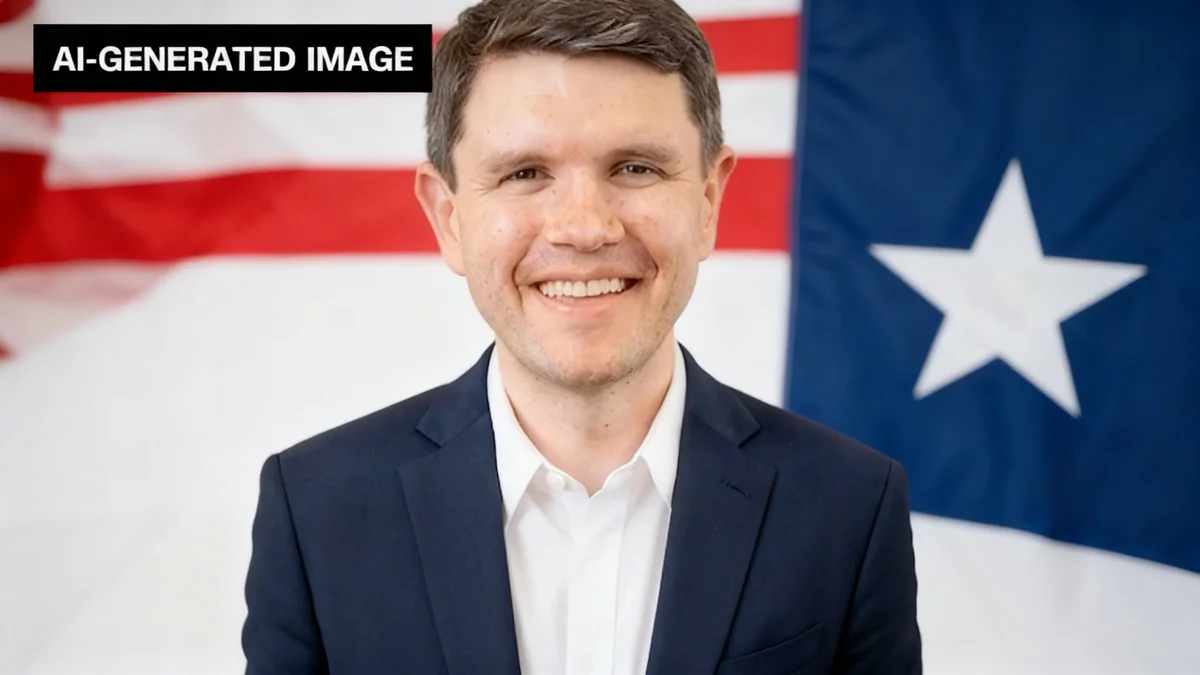

A high-stakes political battle is unfolding in New York City, where a Super PAC backed by some of the biggest names in artificial intelligence is spending millions of dollars in a congressional primary. The group, called Leading the Future, has targeted New York Assemblymember Alex Bores, a candidate who championed the nation's most comprehensive AI safety law.
The campaign against Bores is seen by many as a test case for how the powerful AI industry will exert its influence on lawmakers across the country, sending a clear message to anyone considering regulation: step out of line, and we will come for you.
Key Takeaways
- An AI industry-funded Super PAC, Leading the Future, has committed over $100 million to influence politics.
- Its first major target is Alex Bores, a Democratic congressional candidate in New York's 12th district.
- Bores authored the RAISE Act, a New York state law requiring safety checks on advanced AI models.
- The PAC is running ads attacking Bores not just on AI, but on his past employment at data analytics firm Palantir.
- A rival PAC, Public First, has formed to counter the industry's influence, backed by a $20 million donation from AI company Anthropic.
The Candidate and The Law
Alex Bores, a 35-year-old Democratic state assemblymember, is at the center of this political storm. After being elected in 2022 on a platform that included bringing tech expertise to Albany, the former tech worker quickly turned his attention to artificial intelligence.
Concerned by a lack of federal action, Bores drafted the Responsible Artificial Intelligence Safety and Education (RAISE) Act. The bill requires companies developing powerful AI models to conduct safety tests and disclose the results, aiming to prevent catastrophic outcomes defined as causing over a hundred deaths or a billion dollars in damages.
"The goal was to avoid a dynamic like the one involving U.S. tobacco companies through the 1990s, where they knew that their products caused cancer but continued to deny it publicly," Bores explained.
Despite dropping some provisions opposed by the industry, the bill passed the New York legislature with large margins in June 2025. While Bores viewed it as a reasonable safeguard, some in the AI industry saw it as a declaration of war.
Enter the 'Death Star'
In August 2025, Leading the Future announced its formation with a staggering $100 million war chest. The Super PAC is backed by a who's who of Silicon Valley, including OpenAI co-founder Greg Brockman, venture capital firm Andreessen Horowitz, and Palantir co-founder Joe Lonsdale.
A Playbook from Crypto
The group's strategy is managed by seasoned political operatives, including Zac Moffatt, a Republican consultant, and Josh Vlasto, a former aide to New York Governor Andrew Cuomo. Vlasto also serves as spokesperson for Fairshake, a crypto-focused Super PAC that successfully targeted crypto skeptics in the 2024 elections, instilling fear in many politicians.
When long-time Congressman Jerry Nadler announced his retirement, Bores jumped into the race for New York's 12th district. This provided Leading the Future with a perfect opportunity: a high-profile race featuring a vocal proponent of AI regulation.
In November 2025, the group officially named Bores its first target. Their statement claimed his RAISE Act represented a "patchwork, uninformed, and bureaucratic" approach that would stifle American innovation and help China win the global AI race.
A Two-Pronged Attack
Leading the Future's campaign against Bores has been aggressive and multifaceted. The first ad, released in December, used ominous music to portray the RAISE Act as a job-killing measure that would "CRUSH innovation."
However, a second ad significantly escalated the conflict. Instead of focusing on AI policy, it attacked Bores over his previous employment at Palantir, a controversial data analytics company. The ad claimed he "made hundreds of thousands of dollars building and selling the tech for ICE," referring to U.S. Immigration and Customs Enforcement.
A Calculated Move
By mid-February 2025, Leading the Future had already spent approximately $1.3 million on its campaign to defeat Bores in the primary, according to FEC filings. The group currently reports having $70 million cash on hand.
Bores has stated he never worked on the company's ICE contract and quit over his objections to it. He sent a cease-and-desist letter to the PAC. Ironically, one of Leading the Future's main backers is Joe Lonsdale, a co-founder of Palantir.
"In a Democratic primary, that’s going to be a potent issue," said Josh Vlasto of Leading the Future. "When we decide to engage in a race, we’re going to run the campaign that’s most effective."
Critics argue this strategy is designed to intimidate other politicians. Adam Billen, vice president of public policy at Encode AI, a group funded by AI skeptics, believes the goal is to send a warning. "Their goal... is to scare other legislators into submission," Billen said. "[And] to signal to legislators in other races, in other states, that if you step out of line in this way, this is what we’re going to do to you."
The Battle Lines Are Drawn
The aggressive tactics have not gone unanswered. A counter-movement is organizing to fight back against the industry's influence. In November, former congressmen Brad Carson (D-OK) and Chris Stewart (R-UT) launched Public First, a non-profit and affiliated Super PAC to provide a "countervailing voice."
"We understand that people will be scared of a Death Star of $100 million," Carson stated, acknowledging the financial power of Leading the Future.
In a significant development, the AI company Anthropic, which markets itself as a more safety-conscious firm, announced a $20 million donation to Public First in February. This move solidifies the midterm election as a battleground between competing factions within the AI industry itself.
Shortly after the donation, Public First released its own ad defending Bores. "Right-wing billionaires think they can buy this congressional seat," the ad states, positioning Bores as the only candidate who has stood up to them.
A National Chilling Effect
While the fight is centered in Manhattan, its implications are being felt by lawmakers across the country. A small, informal group of around 20 tech-focused state legislators are watching the race closely.
"A bunch of us are watching Alex’s race for sure," said Monique Priestley, a Democratic state representative in Vermont. She described the pressure from the industry as both terrifying and galvanizing for lawmakers who believe in regulation.
Bores, for his part, has embraced the fight, using the PAC's attention to elevate his profile in a crowded primary field. He argues that voters are on his side, citing polls showing broad public support for government regulation of AI.
"I frankly appreciate their transparency, that they’re saying, ‘Hey, Alex is the biggest obstacle to our quest for unbridled power,’" Bores remarked.
As millions of dollars pour into this single congressional district, the outcome will likely resonate far beyond New York. It may determine whether the future of artificial intelligence is shaped by public policy or by the immense financial power of the companies building it.