


The Chinese Embassy in the United States has released an AI-generated video mocking a recent summit hosted by President Donald Trump. The event, called the "Shield of the Americas Summit," was intended to counter foreign influence in Latin America, but the satirical animation from Beijing portrays the U.S. initiative as a trap rather than a protective measure.
The video, produced by the state-run Xinhua News Agency, was shared on the embassy's social media accounts just days after the summit concluded in Florida. This move escalates the public rivalry between Washington and Beijing as both nations compete for economic and political influence throughout the Western Hemisphere.
Key Takeaways
- China's U.S. embassy shared a satirical AI-generated video targeting President Trump's "Shield of the Americas Summit."
- The video depicts a U.S. eagle trapping Latin American doves in a cage disguised as a shield, questioning American motives.
- The summit was part of a broader U.S. strategy to limit Chinese influence, which Trump has called a threat to the region.
- Despite U.S. warnings, China's economic ties with Latin America continue to grow, with trade increasing significantly in recent years.
A Diplomatic Jab Through Animation
The animated video, titled "Shield of the Americas, or shackles of the Americas?", uses simple allegories to convey its message. In the 18-second clip, a bald eagle wearing a suit addresses a group of white doves, which appear to represent the nations of Latin America. The eagle promises to "keep everyone safe" by deploying a large red, white, and blue shield.
However, the shield quickly transforms into a cage, trapping the doves inside. As the doves appear frightened, the eagle offers a chilling reassurance: "Relax, sometimes security comes with a little control."
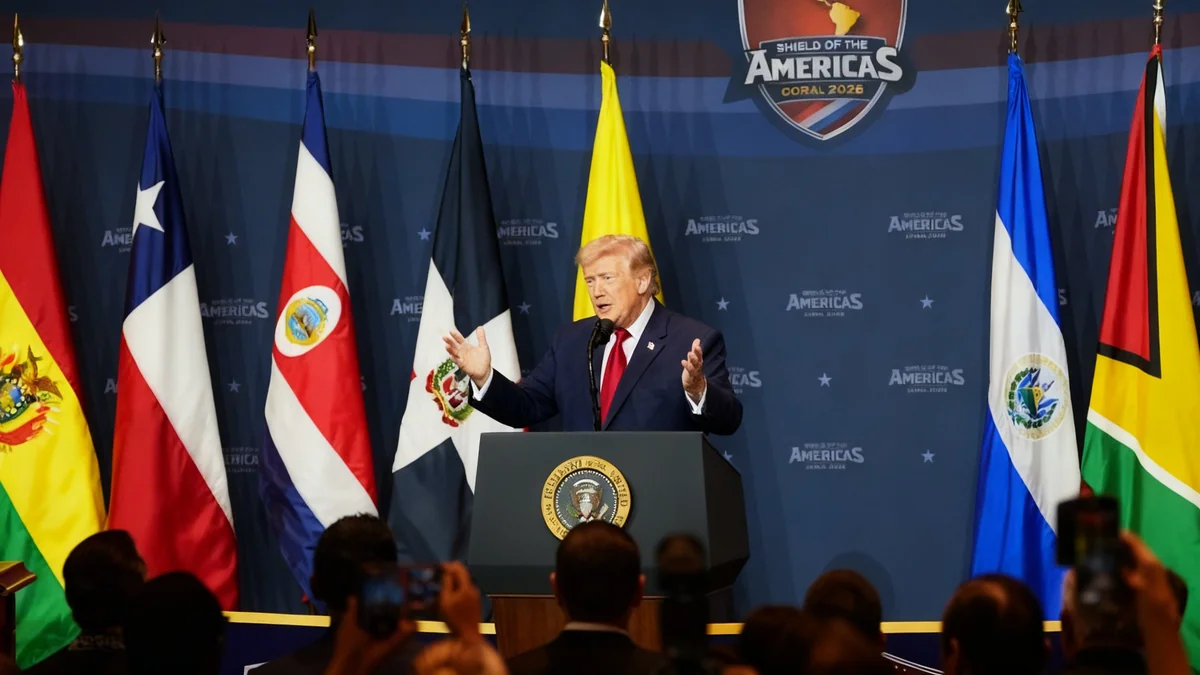
The video directly targets the central theme of the summit held on March 7, 2026, in Doral, Florida. During the event, which gathered right-wing and center-right leaders from 12 Latin American countries, President Trump proposed the creation of a "regional military coalition" to combat what he described as "hostile foreign influence."
The 'Trump Corollary' and U.S. Strategy
The summit is the latest step in the Trump administration's plan to reassert U.S. dominance in the Western Hemisphere. This policy was formalized in November 2025 with the unveiling of the "Trump Corollary" to the Monroe Doctrine, a historical policy that warned European powers against intervention in the Americas.
While the original doctrine focused on Europe, the modern interpretation is squarely aimed at China. The administration's official declaration stated its intent to "deny non-Hemispheric competitors the ability to position forces or other threatening capabilities, or to own or control strategically vital assets, in our Hemisphere."
"We will not allow hostile foreign influence to gain a foothold in this hemisphere – that includes the Panama canal," President Trump stated at the summit.
The President has repeatedly raised concerns over the Panama Canal. He has claimed that China is "operating" the canal, a statement that is factually incorrect. A Hong Kong-based company did operate two terminals at either end of the waterway, but Panama's high court ruled the arrangement illegal in early 2026. Beijing described that court decision as "truly shameful and pathetic."
Background: The Monroe Doctrine
Originally established in 1823, the Monroe Doctrine was a U.S. foreign policy that opposed European colonialism in the Americas. It stated that any intervention in the political affairs of the Americas by foreign powers was a potentially hostile act against the U.S. The Trump administration's recent policy updates specifically adapt this historical stance to counter China's modern economic and strategic expansion.
China's Deepening Economic Roots
Despite Washington's warnings, Beijing's economic presence in Latin America has grown substantially over the past decade. China has become a primary trading partner for numerous countries in the region, financing major infrastructure projects that strengthen its logistical and commercial ties.
A prominent example is the Chancay mega-port in Peru, which was inaugurated in 2024. Developed with significant investment from the Chinese shipping giant COSCO Shipping, the port drastically reduces maritime transport times between South America and Asia, making trade with China more efficient and appealing for regional exporters.
Trade by the Numbers
According to China’s General Administration of Customs, Chinese exports to Latin America saw a 9.3% increase between January and November 2025 compared to the same period in the previous year. This demonstrates a continued upward trend in economic engagement, irrespective of U.S. political pressure.
Even U.S. Allies Strengthen China Ties
The economic pull from China is so strong that even countries with close political ties to the United States continue to expand their trade with Beijing. Argentina, led by President Javier Milei, who is considered one of President Trump's strongest regional allies, provides a clear example.
In 2025, Argentine imports from China surpassed $16 billion. This figure represents a staggering 57.1% year-on-year increase, highlighting the practical economic realities that often override political alignments. For many Latin American nations, China offers investment and trade opportunities that are difficult to ignore, creating a complex diplomatic landscape for the United States.
A New Front in a Global Rivalry
The use of an AI-generated video marks a new and modern approach in the diplomatic messaging war between the two global powers. By employing shareable, social-media-friendly content, Beijing is attempting to shape public opinion in Latin America and portray U.S. intentions as self-serving and controlling.
As the U.S. pushes for security alliances and warns of external threats, China continues to build influence through economic partnerships and infrastructure investment. The satirical video serves as a pointed reminder that the competition for influence in Latin America is not just about military power or political declarations, but also about winning the narrative in the eyes of the region's people and leaders.