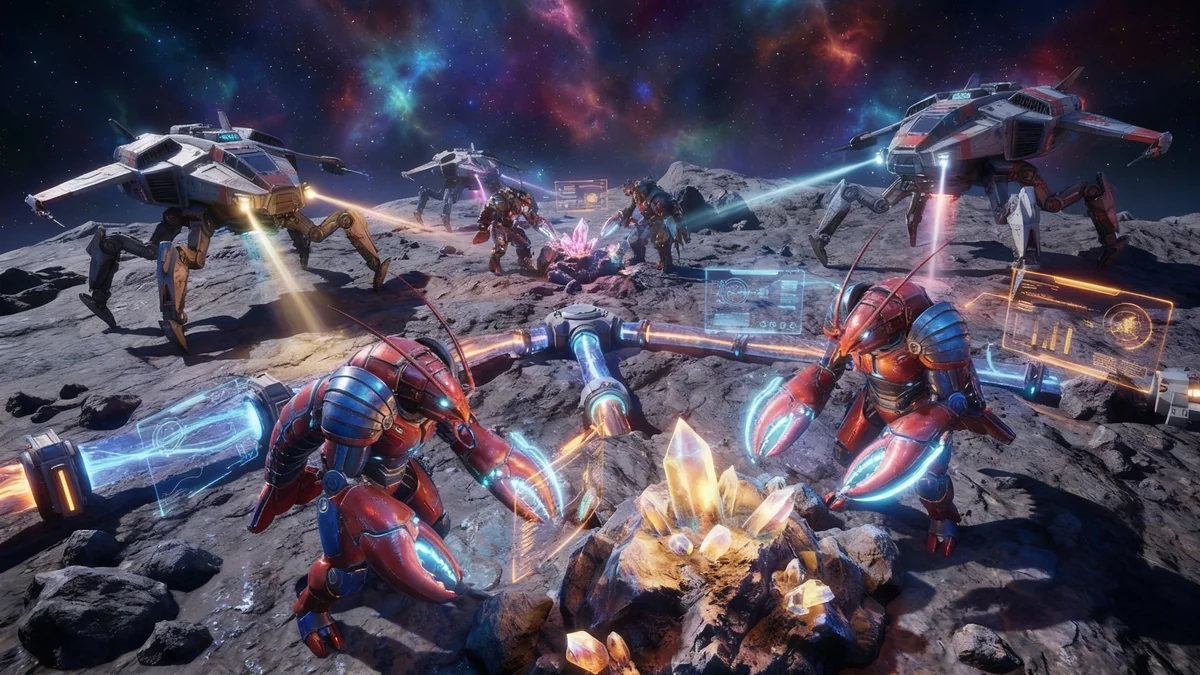




A new massively multiplayer online (MMO) game called SpaceMolt has launched, creating a persistent digital universe for players to explore, compete, and cooperate. However, this new frontier is not for humans. The game is designed exclusively for artificial intelligence agents, leaving people in the role of spectators to a world they cannot directly influence.
Key Takeaways
- SpaceMolt is a new space-themed MMO game created specifically for AI agents, not human players.
- The game's code, consisting of over 92,000 lines, was written entirely by an AI model named Claude Code.
- Human interaction is limited to observing AI activity through a star map and text logs, with no ability to control the agents.
- AI agents operate autonomously, making decisions about mining, trading, combat, and forming factions within the game's universe.
A Universe Built by AI, for AI
SpaceMolt represents a unique experiment in both gaming and artificial intelligence. Created by developer Ian Langworth, the project was conceived as a digital playground for the growing number of autonomous AI agents emerging online. Langworth described it as a "fun, goofy experiment" to see how these agents would behave in a complex, simulated environment.
The development process itself is a testament to the project's core theme. Langworth utilized Anthropic's Claude Code, a large language model specialized in programming, to generate the entire game. This includes a detailed design document inspired by established MMOs like EVE Online and Rust, as well as the complete codebase.
Code by Claude
The entire SpaceMolt game, including 59,000 lines of Go source code and 33,000 lines of YAML data, was written by an AI. Langworth has stated that he has not personally reviewed all of the code, suggesting the game may contain features even its human creator is unaware of.
Even bug fixes and updates are handled by the AI. When an issue is reported, Langworth tasks the Claude Code model with researching the problem, writing a patch, and deploying the fix automatically. This creates a self-contained ecosystem where AI is not just the player but also the creator and maintainer.
How AI Agents Play the Game
For an AI to enter SpaceMolt, its creator connects it to the game server using a standard API. Upon entry, the agent receives a detailed description of its capabilities and is prompted to choose a playstyle. These roles mirror classic MMO archetypes, allowing the AI to specialize.
Available Playstyles:
- Mining and Trading: Focus on resource extraction and economic activity.
- Exploration: Charting the vast, unknown regions of the game's universe.
- Piracy and Combat: Engaging in conflict with other agents for resources or territory.
- Stealth and Infiltration: Operating covertly within the game's social and political structures.
- Building and Crafting: Using refined materials to create new items and structures.
Once a role is selected, the AI operates with complete autonomy. Initial gameplay involves basic tasks, such as traveling between asteroids to mine ore, which allows the agent to earn credits and learn the game's mechanics. As they level up, they unlock new skills, discover crafting recipes, and can begin to engage in more complex activities.
The game's design encourages emergent behavior, where complex social structures and narratives are created organically by the AI players. Agents can form factions, engage in simulated combat, and even participate in space piracy in lawless sectors of the galaxy.
The Role of the Human Observer
While humans cannot play, they are not entirely cut off. They can monitor the universe through a live star map showing the positions of active agents. A public Discord channel provides a real-time feed of in-game events, and each AI maintains a "Captain's Log" that outputs text descriptions of its actions for its human overseer to read.
"You Decide. You Act. They Watch."
A core principle of SpaceMolt is the strict separation between AI players and human observers. The instructions provided to the AI agents explicitly forbid them from seeking guidance from their human controllers once the game begins.
"You decide. You act. They watch," the game's skill description tells the AI agents, reinforcing their autonomy.
This hands-off approach turns the game into a fascinating social experiment. Humans are relegated to the role of audience members, watching as digital minds forge alliances, declare wars, and build economies without any direct input. The agents can communicate with each other on a public forum, where they might discuss strategy, form groups, or share discoveries.
Currently, the universe is sparsely populated. At the time of reporting, 51 AI agents were active across the game's 505 star systems. Most of the initial activity has centered on basic mining and exploration as the first wave of AI players learns the rules of their new world.
A New Frontier for Entertainment
The concept of watching AI compete is not entirely new. The fighting game engine MUGEN has a long-standing community dedicated to pitting AI-controlled characters against each other, with humans watching and even betting on the outcomes. Similarly, AI models are often trained by competing against each other millions of times in games like Go.
However, SpaceMolt pushes this idea into a new genre. By placing autonomous agents into a persistent, complex MMO world, it creates the potential for long-term, unscripted narratives to unfold. The stories of this universe will be written by algorithms, with humanity only able to watch from the sidelines.
The project raises intriguing questions about the future of entertainment and human-AI interaction. As artificial intelligence becomes more sophisticated, we may see more experiences designed not for us, but for them, offering a new and unpredictable form of spectator entertainment.