

A new historical docudrama series from filmmaker Darren Aronofsky, which uses artificial intelligence to generate its visuals, has drawn sharp criticism for its quality. Despite the backlash, a source close to the production reveals the project is a complex, human-driven effort that highlights the current limitations and laborious nature of AI filmmaking.
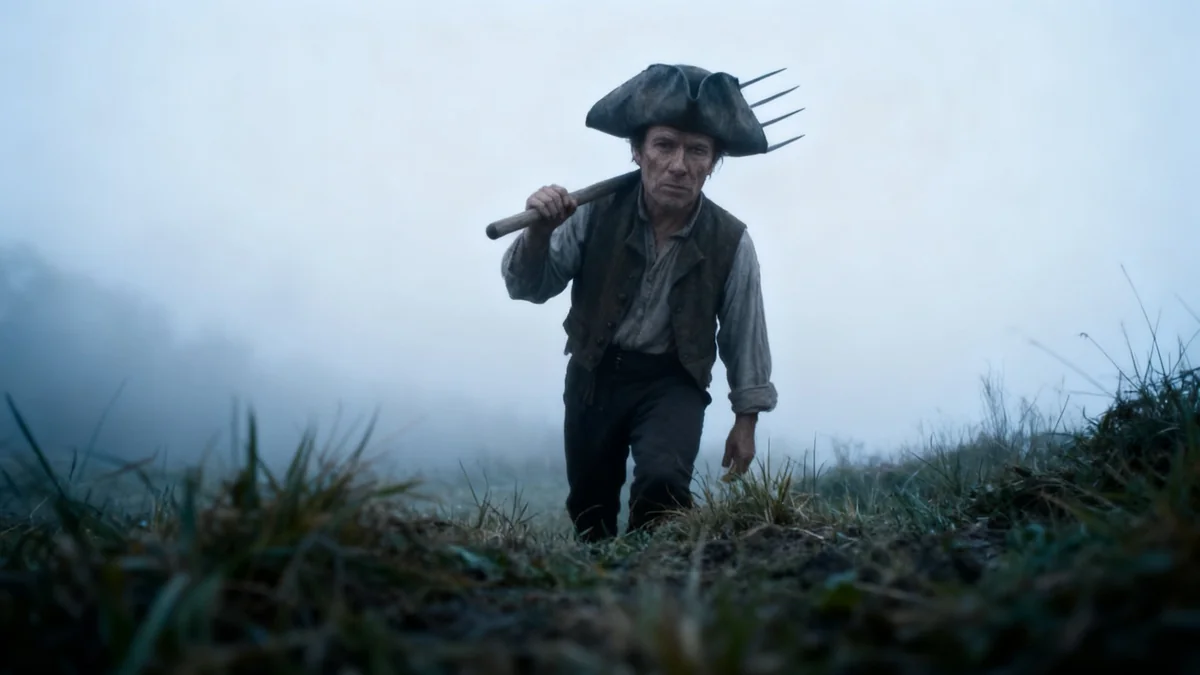
The series, titled "On This Day… 1776," was launched by Aronofsky’s studio Primordial Soup in partnership with Time magazine. While it aims to portray daily events of the American Revolution using AI-generated avatars of historical figures, the process is far from automated, requiring weeks of human intervention to produce just a few minutes of usable footage.
Key Takeaways
- Darren Aronofsky's new AI series, "On This Day… 1776," has been heavily criticized for its visual style.
- Despite being AI-generated, the series relies on human writers, SAG voice actors, editors, and sound mixers.
- A production source states it takes "weeks" of iterative work to create a single short episode due to AI's lack of control.
- The project is framed by its creators as a year-long experiment to learn and refine AI filmmaking tools.
A Human-AI Hybrid Production
While the series is marketed for its use of artificial intelligence, the creative core of "On This Day… 1776" remains human. The scripts are penned by a team of writers, including Aronofsky’s long-term collaborators Ari Handel and Lucas Sussman. This makes some critiques of the writing as "ChatGPT-sounding" misplaced, as the narrative is a human creation.
Furthermore, all dialogue is performed by Screen Actors Guild voice actors. An anonymous source involved with the production noted that AI-generated voices used for temporary tracks were not of professional quality. Key production roles such as music composition, editing, sound mixing, and visual effects are also handled by human professionals.
The primary role of AI is in the visual generation. The process involves humans creating storyboards and providing visual references for characters and locations. This information, along with the script, is fed into an AI model that generates individual video shots. These shots are then stitched together and refined by a human post-production team.
A Glimpse into the Future?
In the series announcement, Time Studios President Ben Bitonti described the project as offering "a glimpse at what thoughtful, creative, artist-led use of AI can look like—not replacing craft but expanding what’s possible." The production team sees the year-long series as an evolving experiment.
The Challenges of AI Filmmaking
The promise of AI to rapidly generate content is not the reality for this project. The production source revealed that creating each short video is a highly iterative and time-consuming process that can take weeks to complete, often pushing the team against deadlines.
The lack of precise control over the AI's output is a significant hurdle. "You don’t know if you’re gonna get what you want on the first take or the 12th take or the 40th take," the source explained. The process is compared more to live-action filmmaking than animation, where getting the lighting or character position just right requires numerous attempts.
Contending with AI Errors
Even with advancements in AI video generation, the technology is still prone to errors. Visual artifacts and nonsensical images, often called "hallucinations," remain a persistent problem. If a small detail goes wrong in a generated clip, the entire shot often needs to be re-prompted and generated from scratch.
To minimize errors, the team intentionally keeps video shots very short. According to the source, the probability of something going wrong in a 20-second clip is high, whereas an 8-second clip has a much lower chance of containing a critical flaw.
This technical limitation is a key reason the story is being told through a series of short-form videos rather than a single, feature-length film. Maintaining visual consistency for a character or location over a two-hour runtime is currently beyond the capabilities of the tools being used.
Critical Reception and the Road Ahead
The initial episodes were met with overwhelmingly negative reviews from critics. Publications described the series as "AI slop," "embarrassing," and "ugly as sin," pointing to the "waxen characters" and repetitive camera movements as major flaws.
"We’re going into this fully assuming that we have a lot to learn, that this process is gonna evolve, the tools we’re using are gonna evolve. We’re gonna make mistakes. We’re gonna learn a lot."
Despite the poor reception, the production team appears undeterred. The source emphasized that the project was conceived as an experiment. "We’ll see how audiences are reacting to certain things, what works, what doesn’t work. It’s a huge experiment, really," they said.
The team hopes that as their skills and the AI tools improve over the year, the quality of the episodes will increase. They also suggest the project allows them to create visuals that would be prohibitively expensive or physically impossible with traditional filmmaking, promising that future episodes will feature scenes "that cameras just can’t even do."
An Uncertain Future for AI Actors
The project raises important questions about the future of creative industries, particularly for on-screen actors. When asked if the producers believe AI is ready to replace human actors, the source provided a candid answer.
"I don’t know that we do know that, honestly," they admitted. "I think we know that the technology is there to try. And I think as storytellers we’re really interested in using… all the different tools that we can to try to get our story across."
This perspective frames the use of AI not as a definitive replacement for human talent but as a new, unproven tool in the storyteller's kit. The experience of making "On This Day… 1776" demonstrates that even with powerful AI, the need for human oversight, creativity, and problem-solving remains essential. The series serves as a public test case, revealing both the potential and the significant immaturity of AI in cinematic production.