




Despite a fierce technological rivalry between Washington and Beijing, a growing number of American companies and developers are turning to Chinese open-source artificial intelligence models. This unexpected trend is driven by their high performance and significantly lower costs, creating a complex dynamic in the global AI race.
While the U.S. government works to limit China's access to advanced semiconductor technology, powerful and freely available AI software from Chinese firms like Alibaba and DeepSeek is gaining a substantial foothold in American research labs and businesses, challenging the dominance of domestic giants like OpenAI and Google.
Key Takeaways
- American usage of Chinese open-source AI models surged from 1.2% at the end of 2024 to nearly 30% by late 2025.
- Cost is a major factor, with some U.S. companies reporting savings of hundreds of thousands of dollars annually by switching to Chinese alternatives.
- Models from Chinese companies like Alibaba (Qwen) and DeepSeek are praised for their performance and accessibility, competing directly with Western counterparts.
- The U.S. government is responding with new policies, including a recent deal allowing Nvidia to sell advanced H200 chips to approved Chinese customers under strict conditions.
A Surprising Surge in Adoption
The artificial intelligence landscape is witnessing a quiet but significant shift. Data from AI development platform OpenRouter, analyzed by venture capital firm Andreessen Horowitz, reveals a dramatic increase in the use of Chinese open-source AI models by American developers.
Usage skyrocketed from a marginal 1.2 percent at the close of 2024 to nearly 30 percent by the end of 2025. This rapid adoption highlights a practical reality that often exists separately from geopolitical tensions: developers seek the best tools for the job, regardless of origin.
Unlike the closed, proprietary systems of OpenAI's ChatGPT or Google's Gemini, open-source models allow users to view, modify, and build upon the source code. This flexibility is crucial for businesses that need to tailor AI solutions for specific tasks without being locked into a single provider's ecosystem.
Why American Companies Are Making the Switch
The primary driver behind this trend is a compelling combination of cost and performance. Chinese models are often much cheaper, and in some cases free, to use compared to their American counterparts.
"These models are inexpensive—sometimes free—and they perform well," explained Wang Wen, dean of the Chongyang Institute for Financial Studies at Renmin University of China.
One U.S. business owner, who requested anonymity to speak freely, confirmed the financial benefits. He stated that his company saves approximately $400,000 per year after switching to Alibaba's Qwen models from more expensive American closed-source options.
"For top-tier performance, you might still turn to OpenAI, Anthropic, or Google," he noted. "But for most everyday uses, that’s overkill." This sentiment is echoed across the industry, where cost-efficiency is paramount for routine tasks.
The Rise of High-Performance Chinese Models
The notion that Chinese AI lags behind American innovation was directly challenged in January 2025 with the release of DeepSeek's R1 model. This high-performing, low-cost, and open-source system demonstrated that Chinese firms could compete at the highest levels.
It was a clear signal of China's rapid advancement in the field. Other models from companies like MiniMax and Z.ai have also found an international user base. Even major American tech players have taken notice. Companies like Nvidia and Perplexity, along with researchers at Stanford University, have reportedly integrated Alibaba's Qwen model into some of their projects.
From Models to Agents
China is now aggressively pushing into the next frontier of AI: "AI agents." These are sophisticated software programs capable of autonomously handling complex tasks, such as booking travel or managing schedules. Moonshot AI's Kimi K2 model, launched in November 2025, is seen as a significant step forward in this domain, with powerful open-source features.
This progress comes as some American firms pull back from open-source development. Meta, once a leader with its Llama series, has shifted its focus toward closed systems. While OpenAI recently released some "open-weight" models, they offer less flexibility than true open-source alternatives. In the West, France's Mistral remains a key player in the open-source space but has not seen the same level of adoption as its top Chinese competitors.
Navigating the Political Landscape
The growing reliance on Chinese AI tools occurs against a backdrop of intense geopolitical maneuvering, particularly in the semiconductor industry. The so-called "chip war" has seen successive U.S. administrations impose strict export controls to slow China's technological progress.
These controls, initiated in 2022, have targeted advanced chips and manufacturing equipment, leading to a complex series of policy adjustments. Nvidia, a key player, developed less powerful H20 chips specifically for the Chinese market, but even these faced regulatory hurdles.
A New Deal on Chips
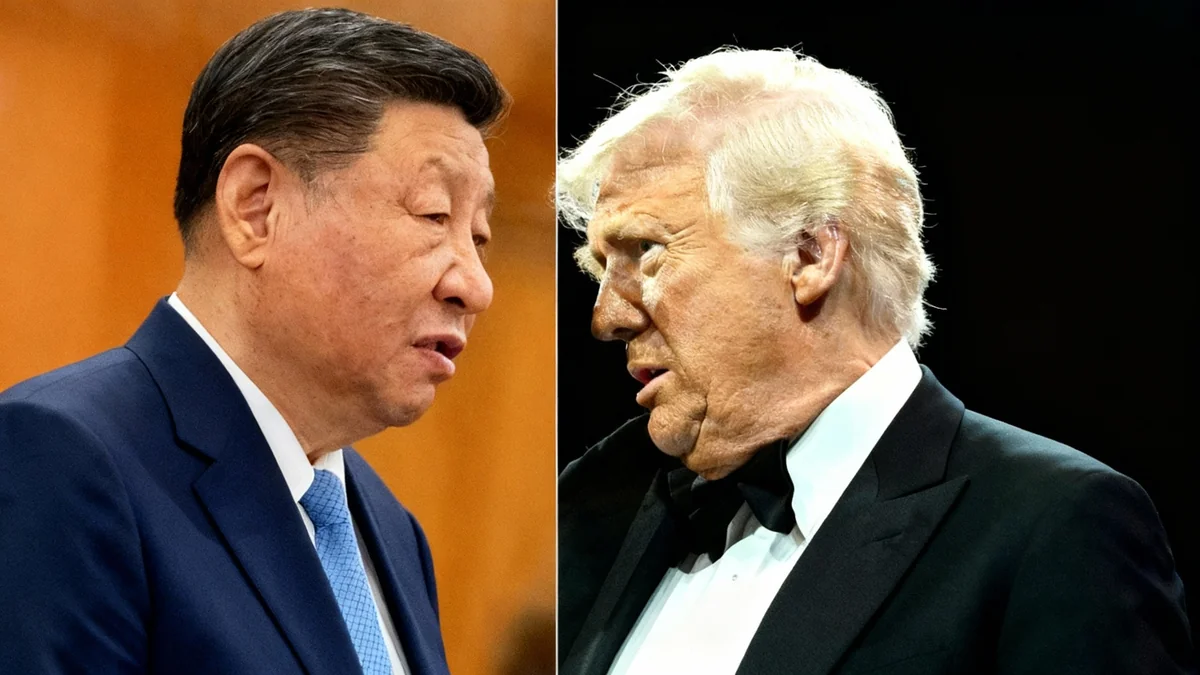
In a significant policy shift in December 2025, the Trump administration reached an agreement with Chinese President Xi Jinping. The deal permits Nvidia to sell its more powerful H200 chips to "approved customers in China."
The agreement includes a provision where 25% of the sales revenue goes to the U.S. government. In a social media post, President Trump stated the deal included "conditions that allow for continued strong National Security."
This move reversed some earlier restrictions, with the administration arguing that the previous approach stifled American innovation by forcing companies to create less competitive products. Nvidia's most advanced chips, however, remain restricted to U.S. customers.
Concerns and Reassurances
Some American businesses remain cautious. Mark Barton, chief technology officer at OMNIUX, expressed concern about relying on a provider that could be targeted by future sanctions, even while considering the use of Qwen models.
However, many experts believe the risks associated with open-source models are manageable. Paul Triolo, a partner at DGA-Albright Stonebridge Group, noted that there were no "salient issues" with data security.
"Companies can choose to use the models and build on them…without any connection to China," he explained. Because the code is open, it can be run on local servers, preventing data from being sent back to the original developers.
A recent Stanford study supported this view, suggesting that "the very nature of open-model releases enables better scrutiny" of the technology. Gao Fei, chief technology officer at the Chinese AI wellness platform BOK Health, added, "The transparency and sharing nature of open source are themselves the best ways to build trust."