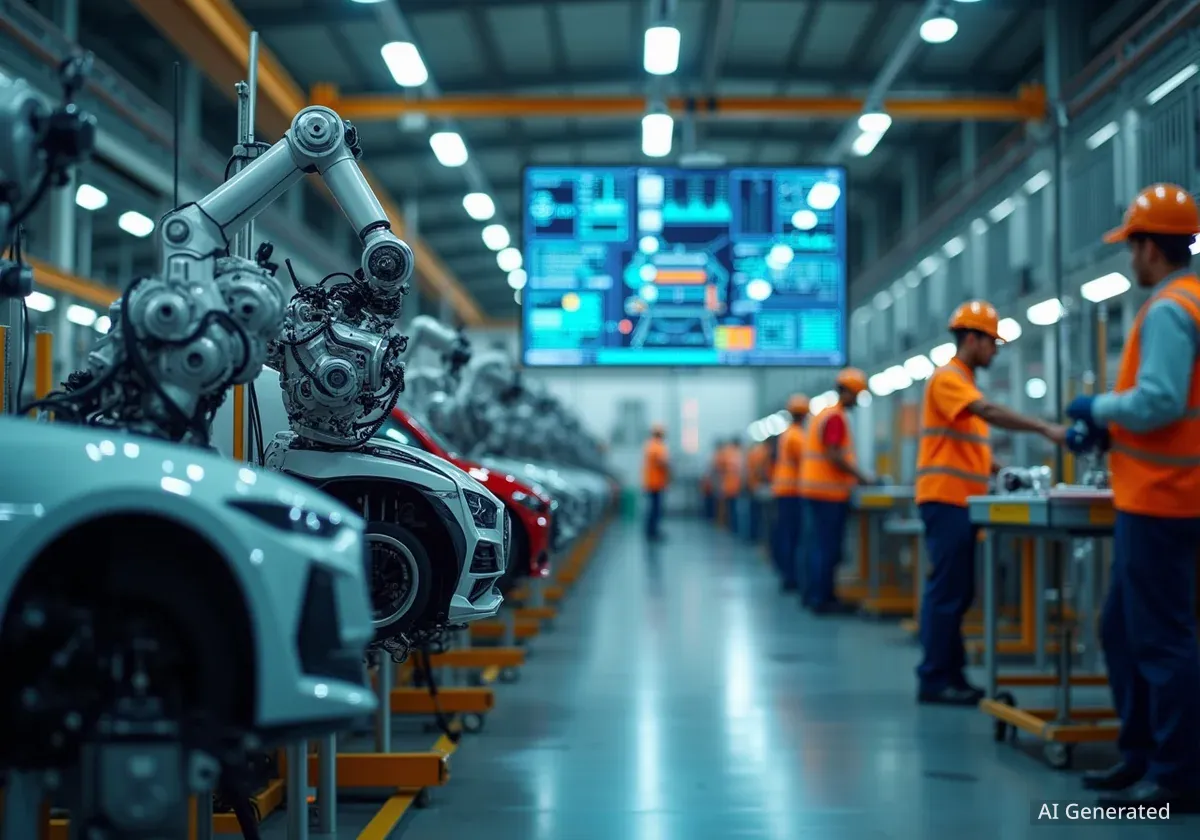





Global automotive supplier Magna International is implementing artificial intelligence to enhance its manufacturing processes and gain deeper insights into its supply chain. This strategic technology adoption comes as the wider automotive industry confronts significant market changes, including the conclusion of the federal electric vehicle tax credit, which experts predict will impact consumer adoption rates.
Key Takeaways
- Magna International is leveraging artificial intelligence to improve production efficiency and manage supply chain complexities.
- The move is partly a response to challenges posed by shifting global trade policies.
- Todd Deaville, a Magna executive, highlighted the company's focus on advanced manufacturing innovation.
- The auto industry is simultaneously adapting to the end of the $7,500 federal EV tax credit, raising concerns about future sales.
Magna Adopts AI to Optimize Production
Magna International is turning to artificial intelligence to refine its manufacturing operations. The company aims to increase efficiency, improve quality control, and predict maintenance needs before they lead to downtime. This integration of AI is a key part of the company's advanced manufacturing strategy.
According to Todd Deaville, Magna's vice president of advanced manufacturing innovation, the technology allows the company to process vast amounts of data from the factory floor. By analyzing this data, AI systems can identify patterns and anomalies that would be impossible for humans to detect in real-time.
This data-driven approach allows for proactive adjustments to machinery and production lines. The goal is to create a more resilient and efficient manufacturing environment that can adapt quickly to changing demands and potential disruptions.
What is Advanced Manufacturing?
Advanced manufacturing involves the use of innovative technologies to improve products or processes. It often includes automation, robotics, 3D printing, and, increasingly, artificial intelligence and machine learning to make production faster, more efficient, and more flexible.
AI Provides Crucial Supply Chain Insights
Beyond the factory floor, Magna is using AI to navigate an increasingly complex global supply chain. The automotive industry relies on a vast network of suppliers, and disruptions in one part of the world can have significant ripple effects.
Deaville noted that AI helps the company gain a clearer understanding of these intricate networks. The technology can analyze data related to logistics, supplier performance, and geopolitical factors to identify potential risks. This allows Magna to develop contingency plans and make more informed sourcing decisions.
"Artificial intelligence provides us with the tools to analyze complex data sets from our supply chain, helping us anticipate disruptions and react more effectively to shifting trade policies," Deaville explained in a recent discussion on the Automotive News Shift podcast.
This capability is particularly important in the current economic climate, where trade policies can change rapidly. By using AI to model different scenarios, Magna can better prepare for potential tariffs or trade restrictions, ensuring a more stable supply of necessary components for its manufacturing plants.
Automotive Sector Faces EV Tax Credit Removal
While companies like Magna focus on internal optimization, the broader automotive market is grappling with a major policy change. The long-standing $7,500 federal tax credit for electric vehicles has ended, altering the financial incentives for consumers considering a switch to EVs.
This change presents a new challenge for both automakers and dealerships. The tax credit was a significant factor in making EVs more price-competitive with traditional gasoline-powered vehicles. Its removal effectively increases the upfront cost for many potential buyers.
Automakers that have invested billions in EV development and production now face a market where the primary government incentive has disappeared. This forces them to rethink pricing strategies and marketing efforts to maintain sales momentum.
The $7,500 Incentive
The federal tax credit offered up to $7,500 to purchasers of new qualified plug-in electric vehicles. The policy was designed to encourage the adoption of cleaner transportation by reducing the initial purchase price, which is often higher for EVs compared to conventional cars.
Projected Impact on EV Sales and Adoption
Industry analysts are closely watching the market's reaction to the end of the tax credit. Many experts predict a significant slowdown in the rate of EV adoption, at least in the short term. Some forecasts suggest a potential "crash" in EV sales as consumers adjust to the new pricing reality.
Challenges for Dealers and Manufacturers
The new landscape creates several hurdles:
- Consumer Affordability: Without the credit, the price gap between EVs and internal combustion engine (ICE) vehicles widens for many models.
- Sales Projections: Automakers may need to revise their sales forecasts and production targets for their EV lineups.
- Dealer Inventories: Dealerships might face challenges moving EV inventory that consumers previously viewed through the lens of a $7,500 discount.
The question of what led to the end of the tax credits is complex, involving legislative changes and policy shifts. Regardless of the reason, the outcome is a fundamentally altered EV market. The industry's ability to sustain growth in this new environment will depend on factors like battery cost reduction, advancements in vehicle range, and the expansion of charging infrastructure.
As Magna demonstrates with its AI initiatives, technological innovation remains a critical strategy for navigating the automotive sector's many challenges. However, external economic and policy factors, such as the removal of consumer incentives, will continue to play a decisive role in shaping the industry's future.