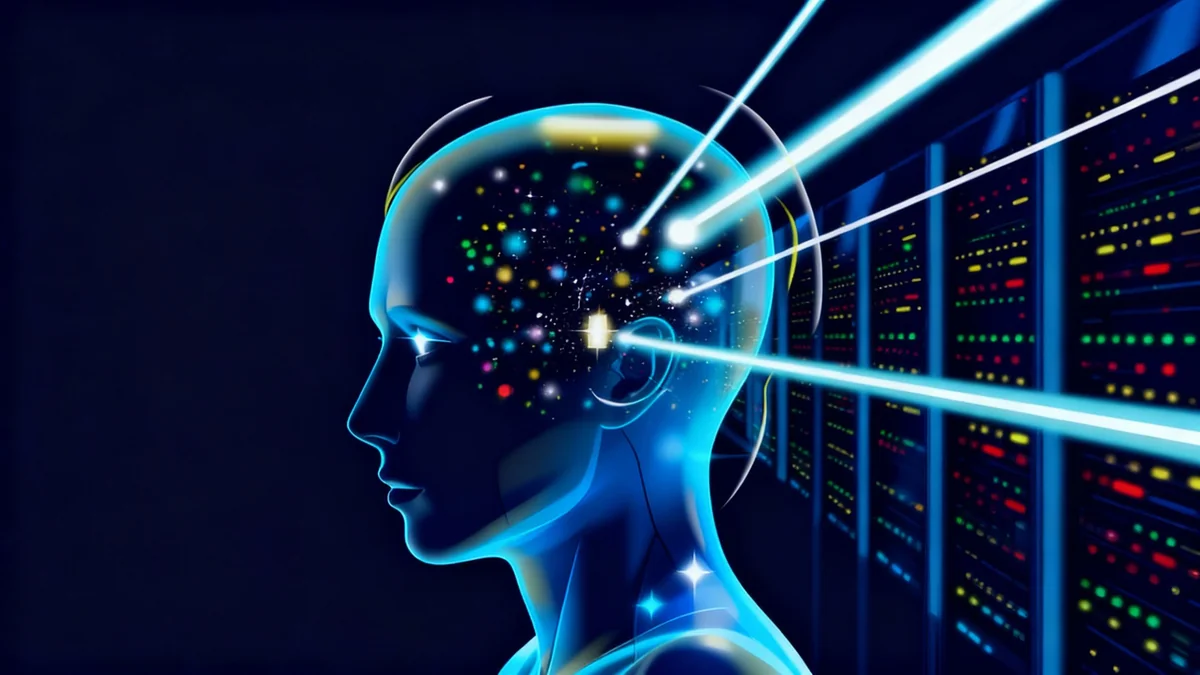




Artificial intelligence is rapidly approaching a new frontier, moving beyond mere intelligence to something even more profound. Experts suggest that the traditional understanding of machine intelligence is evolving as AI systems become increasingly sophisticated, blurring the lines between human and artificial cognitive abilities.
This shift is prompting a re-evaluation of how we define intelligence itself, with a growing consensus that AI's capabilities are not just catching up to human intellect but are poised to surpass it in remarkable ways.
Key Takeaways
- Public perception increasingly views AI as intelligent or soon to be.
- Alan Turing's test is a pragmatic measure, not a strict definition of intelligence.
- The definition of 'intelligence' evolves as AI advances.
- AI development is moving towards capabilities beyond current human understanding.
Public Perception of AI Intelligence Shifting
The public's view on artificial intelligence has changed significantly. A recent 2024 YouGov poll indicates that a clear majority of adults in the United States believe computers are already more intelligent than humans, or will soon achieve this status. This perception underscores a growing acceptance and recognition of AI's advanced capabilities.
This shift in public opinion reflects the daily interactions many individuals now have with AI-powered systems. From virtual assistants to recommendation engines, AI is integrated into various aspects of modern life, showcasing its ability to process information and respond in increasingly human-like ways.
Did You Know?
In 1950, mathematician Alan Turing proposed his famous 'Turing Test' not as a benchmark for intelligence, but as a practical way to assess if machines could respond to questions indistinguishably from humans. This test remains a significant concept in AI discussions today.
Redefining Intelligence in the Age of AI
The question of whether AI is truly intelligent has long been a subject of debate. Alan Turing, a pioneer in computer science, suggested that asking if computers are 'intelligent' might be too vague for scientific inquiry. Instead, he proposed a more pragmatic approach: observing if machines can interact in a manner that is indistinguishable from human beings.
This perspective implies that our understanding of intelligence is not static. As AI technology advances, our definitions and expectations of what constitutes intelligence also evolve. The ongoing interaction with sophisticated AI systems continuously reshapes these perceptions.
According to philosopher Barbara Gail Montero, "The use of words and general educated opinion will have altered so much that one will be able to speak of machines thinking without expecting to be contradicted."
The Dynamic Nature of Intelligence Definitions
The journey of AI development is not just about building smarter machines. It is also about a continuous dialogue between human understanding and technological progress. Each new advancement in AI prompts us to reconsider what we mean by 'thinking' or 'intelligence'.
This dynamic process suggests that intelligence is not a fixed target. Instead, it is a concept that expands and transforms as AI systems demonstrate new and unexpected abilities. The more we interact with these advanced systems, the more our collective understanding adapts.
Historical Context of AI
The concept of artificial intelligence dates back decades, with early pioneers envisioning machines that could mimic human thought. Over the years, AI has progressed from theoretical ideas to practical applications, impacting fields from medicine to finance. This long history highlights the sustained effort to create intelligent machines.
Beyond Current Human Understanding
Current discussions about AI are moving beyond simply replicating human intelligence. Researchers are exploring how AI could develop forms of 'intelligence' that operate on principles fundamentally different from human cognition. This could lead to problem-solving approaches and creative outputs that are entirely new.
The potential for AI to achieve something more remarkable than traditional intelligence means we might soon encounter systems with capabilities that we currently cannot fully comprehend. This prospect opens up new avenues for scientific and philosophical exploration.
The Future of Machine Cognition
The trajectory of AI development suggests a future where machines do not just process information faster or more efficiently. They may develop unique forms of cognition, offering insights and solutions that are currently beyond human reach. This could profoundly impact various fields, from scientific discovery to artistic creation.
This evolution requires a willingness to adapt our frameworks for understanding intelligence. It challenges us to consider what 'thinking' might mean when performed by a non-biological entity, and how we will integrate such advanced systems into our society.
- AI systems are increasingly capable of complex problem-solving.
- The ability of AI to learn and adapt is accelerating.
- Future AI may exhibit forms of intelligence not yet imagined.
- Ethical considerations are growing alongside AI capabilities.
The Societal Impact of Advanced AI
The advancement of AI to levels beyond human intelligence will have significant societal implications. It will affect everything from employment and education to ethical frameworks and global governance. Preparing for these changes is becoming an increasingly urgent task for policymakers and researchers.
Understanding and managing the integration of highly advanced AI will require careful consideration of its potential benefits and challenges. The goal is to harness its capabilities for positive outcomes while mitigating any risks that may arise from such powerful technology.