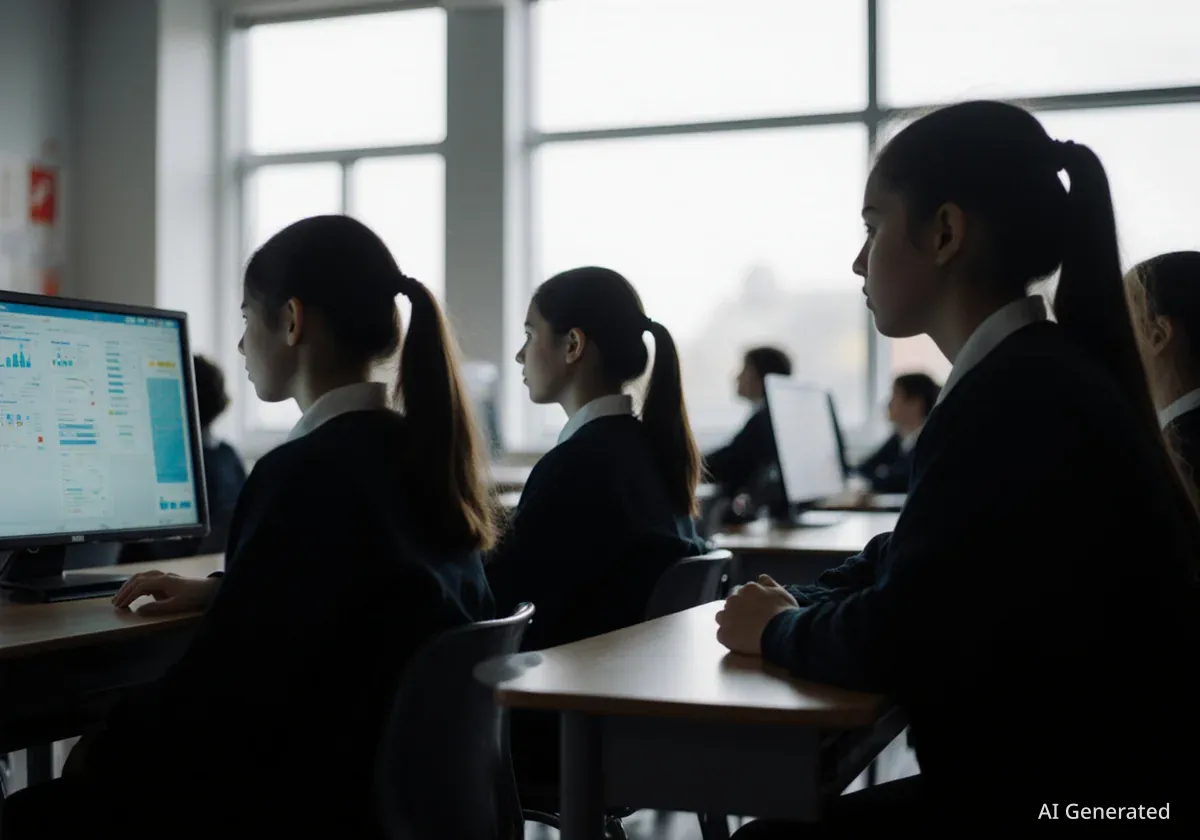




High school students across the country are facing a job market fundamentally different from any previous generation. As artificial intelligence continues to advance, its impact on entry-level positions is forcing a major reassessment of traditional career paths, pushing teenagers to adapt their educational and professional plans before they even set foot on a college campus.
The disruption is already being felt in fields once considered safe bets, like computer science, where competition is intensifying. In response, students are becoming more strategic, either by pursuing careers perceived as more resilient to automation or by actively integrating AI skills into their learning to stay ahead of the curve.
Key Takeaways
- Artificial intelligence is projected to significantly alter the entry-level job market, particularly for white-collar roles.
- Students are actively changing their career plans, with some moving toward hands-on fields like healthcare and others focusing on acquiring AI-specific skills.
- Experts advise young people to build a "portfolio of skills" rather than focusing on a single, linear career path.
- A 2024 Pew Research Center study found that half of U.S. teens have already used ChatGPT for schoolwork, indicating widespread adoption.
The Shifting Landscape of Entry-Level Work
The promise of a stable, high-paying job right after college is becoming less certain, especially in sectors vulnerable to AI automation. While overall employment remains strong, recent data shows a slight dip in employment for individuals aged 20 to 24, a potential early indicator of this shift.
Some technology leaders have offered stark predictions. Dario Amodei, CEO of the AI company Anthropic, has estimated that AI could impact as many as half of all entry-level white-collar jobs within the next few years. While others in the industry anticipate a less severe change, the consensus is that significant transformation is inevitable.
Even the once-booming field of computer science is feeling the pressure. As AI tools become capable of handling more coding and development tasks, the number of available entry-level positions has not kept pace with the number of graduates, making the field far more competitive than it was just a few years ago.
Widespread AI Use in Schools
The integration of AI into students' lives is already well underway. A 2024 study from the Pew Research Center revealed a significant statistic: 50% of American teenagers reported using ChatGPT to assist with their homework. This widespread use highlights how the next generation of workers is already familiar with AI tools, whether their schools formally incorporate them into the curriculum or not.
Students Recalibrate Their Future Plans
In response to this uncertainty, today's high school students are becoming more pragmatic and strategic in their career planning. Some are pivoting toward hands-on professions, such as healthcare, that require a level of human interaction and physical dexterity that AI cannot yet replicate. This shift reflects a search for greater job security in an unpredictable market.
Others are taking a different approach: leaning into the change by learning how to master AI tools. Colette Stallbaumer, who heads Microsoft's Future of Work team, emphasizes this proactive mindset.
"AI may not take your job, but someone who has AI skills might," Stallbaumer stated. She encourages students to experiment with AI creatively, whether for building an app or simply as a study aid, to develop a fluency that will be critical in the future workplace.
New Strategies in Higher Education
This forward-thinking approach is also changing how students approach college. Rachel Blankstein, co-founder of the advisory firm NextGen Advising, has observed a trend of students hedging their bets by double majoring in seemingly disparate fields, such as psychology and data science. This strategy provides a broader skill set, making them adaptable if one field is more heavily impacted by automation than the other.
Blankstein also notes that a college degree alone is no longer a guaranteed ticket to a job offer. "These poor kids who have worked so hard to get into college, all of a sudden, they really need to start thinking about their careers from day one," she explained. Building professional skills outside of the classroom, from the first year of college, is now essential.
A Rapidly Changing Skill Set
According to data from LinkedIn, an estimated 70% of the skills used by today's workforce will be fundamentally changed by the year 2030 due to the influence of artificial intelligence and other technological advancements.
From Job Titles to a 'Portfolio of Skills'
The emerging consensus among labor market experts is that the concept of a career is evolving. A recent study by the University of Pennsylvania’s Wharton Business School and Accenture suggests that young people should view their careers not as a linear sequence of job titles, but as a dynamic "portfolio of skills."
This report highlights a growing demand for specific, technical skills over vague, general capabilities. Employers are increasingly looking for candidates with demonstrable expertise in areas like:
- Analytical fluency
- Context-based decision-making
- Data interpretation
- Proficiency with AI tools
These concrete skills are becoming more valuable than broad terms like "communication" or "leadership" on a resume, as they signal a candidate's ability to deliver tangible results in a tech-driven environment.
Ultimately, while the exact future of the job market remains uncertain, adaptability and a commitment to lifelong learning appear to be the most crucial assets for the next generation. As one high school student, Karissa, thoughtfully questioned, "How are we building our character, tenacity, curiosity, and empathy to succeed and adapt in a world where AI is bound to rise? I think that’s the question that we should be focused on."