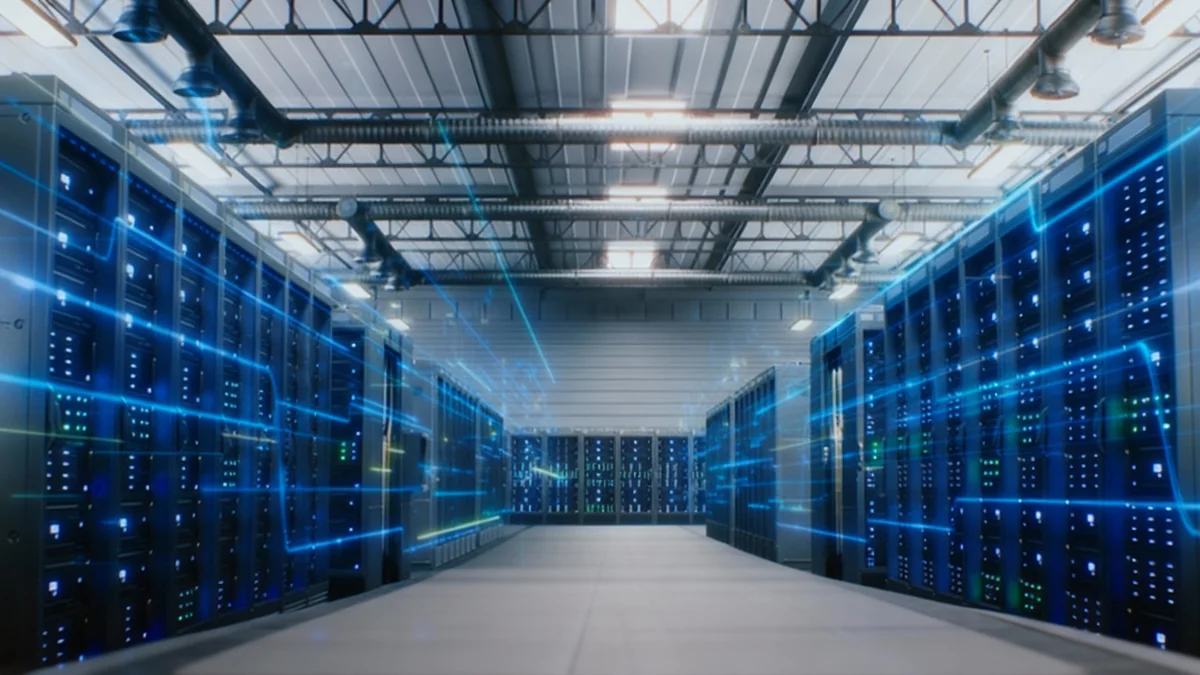




Meta Platforms has officially confirmed a massive $600 billion capital expenditure plan to build out its artificial intelligence infrastructure across the United States. The investment, which will be spread through 2028, is aimed at developing a new generation of data centers essential for powering advanced AI technologies.
This strategic move positions Meta in a high-stakes race with other tech giants, signaling a monumental financial commitment to securing a leadership position in the future of AI. The announcement follows a period of intense speculation and has significant implications for the tech industry, the U.S. economy, and the global technological landscape.
Key Takeaways
- Meta Platforms will invest $600 billion in the U.S. through 2028 to build AI infrastructure.
- The spending will focus on constructing advanced data centers and supporting workforce expansion.
- This investment places Meta among the highest spenders in the AI infrastructure race, alongside competitors like Google and Microsoft.
- The company has committed to environmental sustainability, aiming to be "water positive" by 2030 at its data center locations.
A New Era of Technological Investment
Meta's financial commitment represents one of the most substantial corporate investments in technology infrastructure in recent history. The funds are designated for the construction of industry-leading AI data centers, the acquisition of necessary resources like electricity and water, and the expansion of a skilled workforce to manage these complex operations.
"Data centers are crucial to reaching these goals and helping America maintain its technological edge," a company representative stated. The plan underscores a belief that dominance in the next technological wave will be determined by the sheer scale and sophistication of underlying infrastructure.
The company has already initiated this expansion with new or expanded data center projects announced in El Paso, Texas; Montgomery, Alabama; and Kansas City, Missouri. These locations are being developed in collaboration with local utilities to ensure the massive power and water requirements are met sustainably.
By the Numbers: The AI Spending Spree
Meta's $600 billion plan is part of a broader trend of massive capital expenditures by major tech companies. For comparison:
- Google (GOOGL): Plans to spend between $91 billion and $93 billion in 2025.
- Microsoft (MSFT): Projects spending of $88.7 billion for its 2026 fiscal year.
- Amazon (AMZN): Reportedly spending over $100 billion per year on AI efforts.
The High-Stakes Race for AI Supremacy
This investment is not happening in a vacuum. It is a direct response to the escalating competition among a handful of 'hyperscalers'—the largest cloud computing and technology companies. The ability to train and run increasingly complex AI models, particularly large language models (LLMs) and future artificial general intelligence (AGI), depends entirely on having vast computational power.
While Meta's $600 billion figure is staggering, it reflects a shared understanding in Silicon Valley that the cost of falling behind in the AI race is far greater than the cost of investment. Companies like Google, Microsoft, and Amazon are also pouring tens of billions of dollars annually into their own infrastructure to support their AI ambitions.
What is Capital Expenditure (CapEx)?
Capital expenditure, or CapEx, refers to funds used by a company to acquire, upgrade, and maintain physical assets such as property, buildings, and technology. In this case, Meta's CapEx is primarily for building and equipping massive data centers with specialized computer chips and networking hardware required for AI.
The scale of these investments raises questions about the future of the technology market. With such high barriers to entry, the development of cutting-edge AI could become concentrated in the hands of a few corporations with the capital to build the necessary infrastructure.
Sustainability and Community Impact
Operating data centers on this scale presents significant environmental challenges, particularly regarding energy and water consumption. Meta has publicly addressed these concerns, outlining a goal to become "water positive" by 2030. This means the company aims to restore more water to local watersheds than its facilities consume.
For its new El Paso data center, for example, Meta projects it will restore 200% of the water consumed by the facility. This is achieved through investments in local water restoration projects, such as improving irrigation efficiency for nearby agriculture or restoring wetlands.
"We're committing over $600 billion in the US by 2028 to support AI technology, infrastructure, and workforce expansion — and our investments are already having an impact."
The company is also working closely with local utility providers to secure the massive amounts of electricity needed to power these centers. The success of these projects will depend heavily on the capacity of local grids and the availability of renewable energy sources to minimize the carbon footprint.
Investor Reaction and Market Concerns
The announcement of the $600 billion expenditure plan was met with a mixed reaction from the market. Following the confirmation, Meta's shares saw a slight decline of 1.8%, reflecting some investor apprehension about the sheer size of the financial commitment and its potential impact on near-term profitability.
Concerns are rooted in past large-scale bets made by the company, most notably its multi-billion dollar pivot to the metaverse, which has yet to yield significant financial returns. Some analysts question whether the return on investment for this AI infrastructure will justify the enormous upfront cost, particularly as the long-term profitability of generative AI models remains uncertain.
However, others argue that this level of investment is not just strategic but necessary for survival and long-term growth. In an industry where technological advancement is exponential, failing to invest heavily in foundational infrastructure could leave a company obsolete in a matter of years. The debate continues over whether this is a visionary move to secure future dominance or a high-risk gamble fueled by industry-wide pressure.