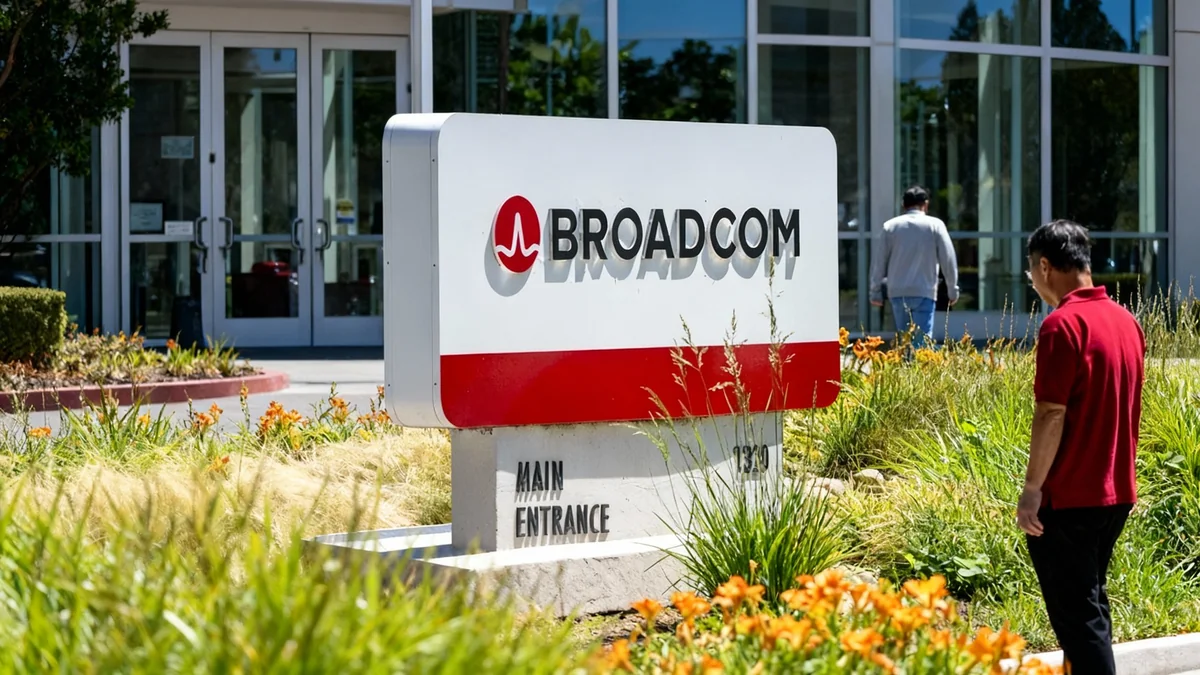





A sharp decline in Broadcom's stock on Friday sent ripples through the U.S. technology sector, erasing approximately $220 billion from its market value and triggering a broader market sell-off. The drop occurred despite the company reporting strong quarterly sales, as investors grew concerned about the future profitability of its artificial intelligence chip business.
The tech-heavy Nasdaq Composite index fell 1.7%, while the S&P 500, which had just reached a record high, dropped 1.1%. The market reaction highlights growing investor anxiety over the high valuations of companies central to the AI boom and whether massive spending in the sector will translate into sustainable profits.
Key Takeaways
- Broadcom's stock fell 11.4% after its latest earnings report, despite exceeding sales and earnings expectations.
- Investor concern centers on a forecast for lower gross margins, linked to a major $21 billion order from AI startup Anthropic.
- The sell-off spread to other major tech stocks, with the Nasdaq Composite closing down 1.7%.
- This event follows similar concerns surrounding Oracle's heavy AI spending, suggesting a pattern of investor scrutiny over AI profitability.
Broadcom's Paradoxical Performance
Chipmaker Broadcom found itself in an unusual position Friday. The company announced better-than-expected sales and earnings for the previous quarter and even raised its revenue guidance for the coming months. Ordinarily, such news would be met with investor enthusiasm.
However, the company's stock plummeted by 11.4%. The primary driver of this downturn was a warning from the company about its financial outlook. Broadcom cautioned that its gross margin for the first quarter would be lower than in previous months.
By the Numbers
- Broadcom Stock: -11.4%
- Market Value Lost: ~$220 Billion
- Nasdaq Composite: -1.7%
- S&P 500: -1.1%
This projected dip in profitability is directly linked to what should have been a major win: a significant increase in AI-related revenue. The company is fulfilling a substantial $21 billion order for AI chips from the startup Anthropic, but the costs associated with producing these advanced components are higher, squeezing profit margins.
Spreading Jitters in the AI Market
The negative reaction to Broadcom's forecast was not an isolated event. It reflects a growing unease among investors who have poured capital into companies at the forefront of the artificial intelligence revolution. For months, any association with AI has been enough to send stock prices soaring, but the focus is now shifting from potential to actual performance.
Jonathan Zauderer, head of North America specialist sales at Citi, noted the context of the market's reaction.
"Broadcom delivered strong results but has traded off due to a weaker margin outlook and commentary that non-AI [chips] would be stable in 2026 versus some investor expectations for growth."
Zauderer also pointed out that the stock's significant gains leading up to the announcement made it susceptible to a correction. "One of the issues is that the stock was up 75 [per cent] in 2025 heading into results... Broadcom was vulnerable to profit-taking," he added.
Echoes of Oracle's Troubles
The market's sensitivity was already heightened by recent events at Oracle. The database giant's shares fell nearly 11% on Thursday after it failed to meet revenue growth estimates. The stock continued its slide on Friday, dropping another 4.5% amid reports that it had delayed the construction of at least one data center.
The High Cost of AI Infrastructure
Building the infrastructure to power advanced AI models requires immense capital investment in data centers, specialized chips, and energy. Companies like Oracle and Broadcom are at the center of this build-out, but investors are beginning to question the timeline and certainty of returns on these massive expenditures.
Oracle, which saw its market value surge by nearly $250 billion in a single day last September after announcing deals with OpenAI, has become a symbol of the market's current concerns. The company's significant borrowing plans to fund its AI ambitions have started to make some investors nervous.
In a statement, Oracle addressed the reports, saying, "There have been no delays to any sites required to meet our contractual commitments, and all milestones remain on track." The company also affirmed its alignment with OpenAI and its confidence in executing its plans.
Broader Market Impact and Sector Shifts
The tech sell-off impacted some of the market's biggest players. AI leader Nvidia saw its shares fall by 3.3%, while data analytics firm Palantir dropped 2.1%.
While the technology and semiconductor sectors faltered, other parts of the market showed strength. Consumer cyclicals and industrials posted gains as investors appeared to shift capital away from high-valuation tech stocks. This rotation is also partly influenced by the Federal Reserve's recent decision to cut interest rates to a three-year low, which can make borrowing cheaper for industries like homebuilding and transportation.
The bond market also reacted to the week's events. U.S. government bonds came under pressure, with the yield on the benchmark 10-year U.S. Treasury note rising to 4.18%. Bond yields move in the opposite direction of their prices.
The events of the past week suggest that the initial euphoria of the AI boom is giving way to a more critical phase of evaluation. Investors are no longer just looking for AI buzzwords; they are demanding a clear path to profitability, and companies that cannot provide one may face continued market turbulence.