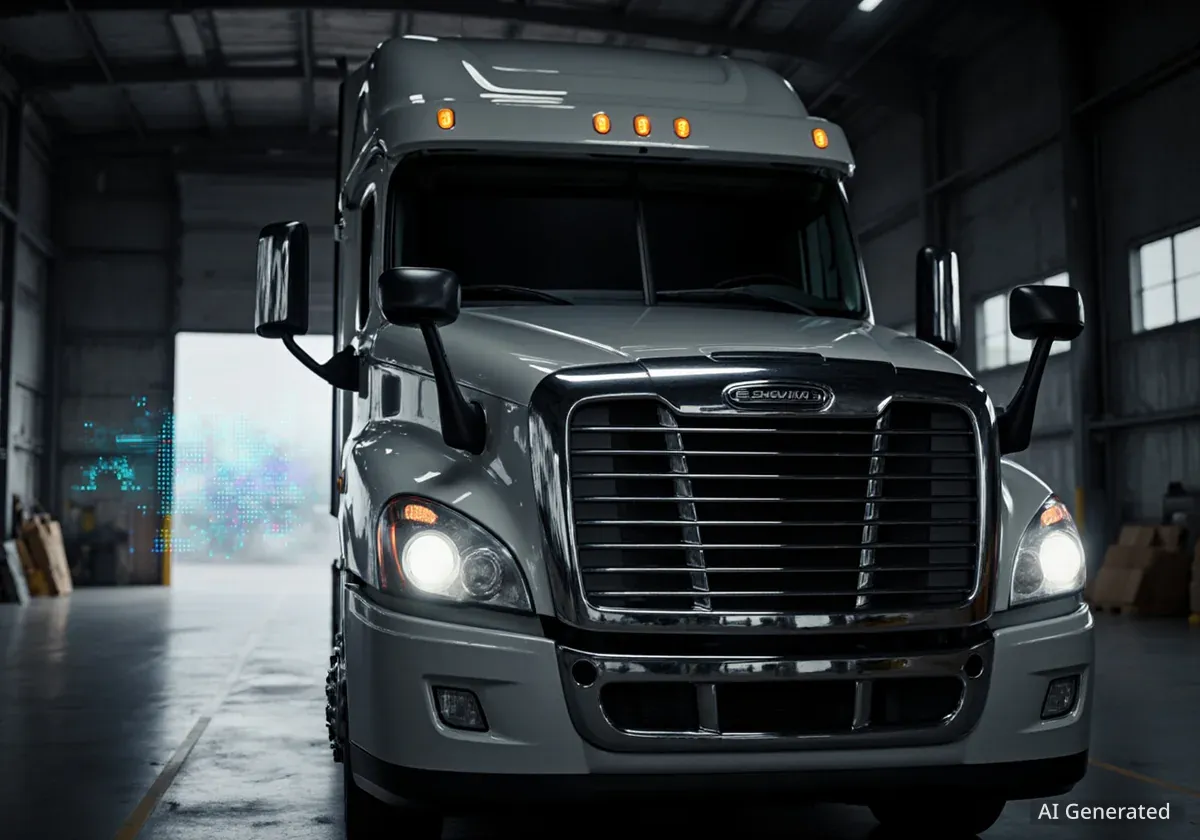





Shares in major trucking and logistics firms experienced a sharp decline on Thursday following the announcement of a new artificial intelligence platform designed to dramatically increase freight efficiency. The market downturn reflects growing investor anxiety that AI could fundamentally reshape the logistics industry, potentially reducing the need for services from established companies.
The technology at the center of the disruption, developed by AI firm Algorhythm Holdings, claims to significantly reduce waste in the trucking sector. This has prompted a market re-evaluation of traditional logistics businesses, with several industry leaders seeing double-digit percentage drops in their stock values.
Key Takeaways
- Major logistics stocks, including C.H. Robinson and RXO, fell sharply by 14.5% and 20.5% respectively.
- The sell-off was triggered by AI company Algorhythm Holdings, whose SemiCab platform promises to boost freight volume by up to 400% without new hires.
- The AI tool reportedly reduces "empty freight miles" by more than 70%, addressing a major source of inefficiency in the industry.
- The market reaction highlights a broader trend of investor concern over how AI will disrupt traditional business models across various sectors.
A Jolt to the Logistics Market
The financial markets delivered a swift verdict on the potential impact of new AI technology in the freight industry. On Thursday, investors reacted to news from Algorhythm Holdings, a company that has pivoted from in-car entertainment systems to logistics AI. Its stock, previously a penny stock, surged by 29.9%.
In stark contrast, established logistics giants faced significant losses. C.H. Robinson saw its shares fall by 14.5%, while RXO experienced a more severe drop of 20.5%. The negative sentiment spread across the sector, with other key players also affected. J.B. Hunt Transportation Services declined by approximately 5%, XPO lost nearly 6%, and Expeditors International of Washington fell by 13.2%.
This market activity signals a growing concern that AI-driven automation could level the playing field, allowing smaller operators to compete with industry leaders by optimizing operations and reducing overhead.
The Technology Driving the Change
The catalyst for the market shift is Algorhythm's SemiCab platform. According to the company, the AI-powered system is already being used by live customers and has demonstrated remarkable results. The platform enables operators to scale their freight volumes by 300% to 400% without needing to increase their workforce.
"What we’re proving with SemiCab is that when freight is managed as a coordinated network rather than isolated transactions, utilization improves dramatically," said Ajesh Kapoor, CEO of SemiCab. "The substantial reduction in empty miles that we are able to achieve for our customers represents a fundamental shift in how logistics economics work."
This efficiency gain directly targets one of the largest problems in the trucking industry: empty miles. These are miles driven by a truck without carrying any cargo, often on a return trip after a delivery.
Tackling Trillion-Dollar Inefficiency
The scale of the problem SemiCab aims to solve is immense. The platform claims to reduce these "empty freight miles" by over 70% for its clients. This is a critical metric for an industry struggling with operational waste.
The Cost of Empty Miles
Data from market intelligence firm Mordor Intelligence, cited by Algorhythm, suggests that trucks drive empty for nearly one out of every three miles. This inefficiency contributes to over $1 trillion in lost freight spending annually, representing a massive opportunity for optimization.
By coordinating shipments and creating a collaborative network, the AI platform can fill trucks that would otherwise be empty. This not only saves fuel and reduces costs for shippers but also increases revenue for carriers. The market's reaction suggests that investors believe this level of efficiency could lead to a consolidation of freight volume, requiring fewer trucks and brokerage services overall to move the same amount of goods.
A New Debate in Logistics
The development has ignited what some analysts are calling an "emerging debate" around the role of automation in logistics. Baird analyst Daniel Moore noted that open-source automation tools like these could "help equalize the technology playing field for smaller operators."
Despite the market's sharp reaction, Moore suggested that the underlying theme is not entirely new. "Automation is not a new theme," he stated, reiterating his outperform ratings on C.H. Robinson and Expeditors. This perspective implies that larger companies may have the resources to adapt and integrate similar technologies into their own operations over time.
However, the immediate sell-off indicates that many investors are not waiting to see how incumbents will respond. The fear is that nimble, AI-native companies can capture market share before the giants can pivot their massive, complex operations.
Algorhythm's Strategic Pivot
Algorhythm Holdings' entry into the freight market is the result of a significant business transformation. The company was previously known for developing in-car karaoke systems. In 2025, it sold its Singing Machine business to Stingray for $4.5 million, signaling a complete change in direction toward its current focus on AI-driven logistics solutions.
Broader Industry Pressures
The disruption from AI is not the only challenge facing the trucking industry. Investors are also monitoring regulatory changes that could impact the labor market for drivers. This week, U.S. Transportation Secretary Sean P. Duffy announced a ruling aimed at preventing "unqualified foreign drivers" from obtaining commercial driver's licenses.
The new government reforms are intended to address safety concerns by ensuring that non-U.S. citizen drivers undergo consular and interagency screening before being licensed to operate commercial trucks and buses. While aimed at improving safety, such regulations could also affect the available pool of drivers, adding another layer of complexity for logistics companies already grappling with technological disruption and labor shortages.
The convergence of advanced AI and new regulations creates a volatile environment for the trucking and logistics sector. While AI promises unprecedented efficiency, it also brings uncertainty, forcing a rapid and sometimes painful re-evaluation of long-standing business models.