

OpenAI has released a series of internal communications and journal entries that it claims contradict the narrative presented in a recent lawsuit by co-founder Elon Musk. The documents suggest Musk was not only aware of but also supported the company's transition to a for-profit structure, a central point of contention in the legal dispute.
The released materials aim to reframe the history of OpenAI's structural evolution, asserting that discussions about a for-profit entity began as early as 2017 with Musk's participation. According to the company, the relationship soured not over the principle of a for-profit model, but over issues of control and a proposed merger with Tesla.
Key Takeaways
- OpenAI has published internal documents to counter Elon Musk's lawsuit.
- The company claims Musk supported a for-profit structure as early as 2017.
- Disagreements reportedly centered on Musk's desire for majority control and a potential merger with Tesla.
- Journal entries from co-founder Greg Brockman are presented with additional context to challenge their use in Musk's legal filing.
- Musk allegedly told the team they had a "0% chance" of success without him before he departed in 2018 to pursue AGI at Tesla.
The Disputed Origins of OpenAI's For-Profit Arm
The core of the conflict revolves around OpenAI's transformation from a non-profit research lab into the commercial powerhouse it is today. In his lawsuit, Elon Musk alleges that the company betrayed its founding mission of developing artificial general intelligence for the benefit of humanity. However, OpenAI now presents a different version of events.
According to the company, the founders, including Musk, collectively agreed in 2017 that the immense computational resources required for AGI development were beyond the fundraising capacity of a traditional non-profit. This realization prompted discussions about creating a for-profit arm to attract necessary capital.
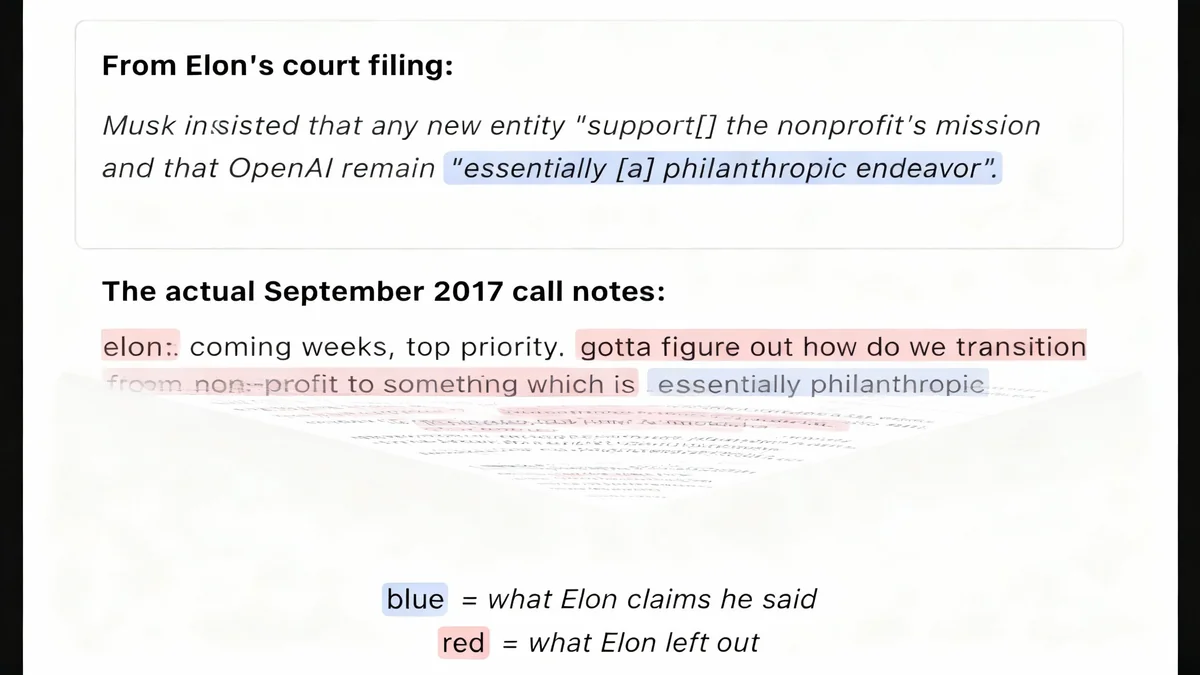
OpenAI released excerpts from September 2017 call notes which appear to show Musk actively participating in these plans. In the conversation, Musk is quoted as saying, "gotta figure out how do we transition from non-profit to something which is essentially philanthropic endeavor and is B-corp or C-corp or something."
This suggests that the idea of a hybrid structure was not a later deviation from the mission, but an early strategy considered by the entire founding team. The company argues this directly refutes the claim that its current structure is a betrayal of its original principles.
A Battle for Control
As discussions about the new structure progressed, the central point of friction became control. OpenAI alleges that negotiations with Musk broke down when he demanded majority equity, absolute control over the new entity, and a seat for it within his automotive company, Tesla.
The company stated that Musk's proposal to merge OpenAI into Tesla was a significant concern for the other co-founders. They feared it would compromise their mission and lock them into a strategy solely dependent on Tesla's objectives.
The Tesla Connection
Even before the structural negotiations, OpenAI claims its resources were leveraged for Musk's other ventures. In early 2017, key personnel, including Ilya Sutskever and Greg Brockman, were asked to dedicate significant time to improving Tesla's Autopilot program. This eventually led to top researcher Andrej Karpathy being recruited from OpenAI to join Tesla full-time.
This context is presented to support the idea that the founders were wary of Musk's intentions and his desire to integrate OpenAI's work with his commercial enterprises. The refusal to cede control and merge with Tesla, OpenAI claims, was the true reason for the eventual split, not a disagreement over the for-profit model itself.
Reinterpreting Private Journals
A key piece of evidence in Musk's lawsuit comes from the private journal entries of OpenAI co-founder Greg Brockman. Musk's filing uses selected quotes to suggest the other founders were secretly planning to create a for-profit entity and were dishonest with him.
OpenAI has responded by publishing longer excerpts from those same journal entries, arguing the quotes were taken out of context. For example, a November 6, 2017, entry quoted by Musk reads, "conclusion is we truly want the b-corp."
However, the full entry shared by OpenAI reveals a more nuanced situation. The founders were weighing their options, which they ranked in order of preference:
- A B-corp with an appropriate control structure.
- The non-profit, but only if it could secure massive funding.
- Quitting to start their own venture.
The journal entries indicate that staying a non-profit was preferable to being absorbed by Tesla. One note states, "we would have preferred the b-corp, but we prefer the non-profit to tesla."
A Question of Morality
Another quote used in Musk's filing from Brockman's journal states, "it’d be wrong to steal the non-profit from [Musk]. to convert to a b-corp without him. that’d be pretty morally bankrupt." OpenAI claims this shows their commitment to working with Musk, not deceiving him. They felt it would be wrong to proceed with a for-profit conversion without his involvement, highlighting their desire for a collaborative path forward that Musk's demands for control made impossible.
The company argues that Brockman's concerns about being seen as dishonest were not about a secret plot, but about the potential perception if they accepted Musk's terms to remain a non-profit and then were forced to pivot to a for-profit model later due to funding shortfalls.
The Final Split
By early 2018, the impasse had become permanent. According to OpenAI, Musk had concluded that the organization could not raise sufficient capital on its own and was on a "path of certain failure relative to Google."
In February 2018, Elon Musk officially resigned from OpenAI. The company claims that on his way out, he was supportive of them attempting to find their own path to raising billions of dollars, even if he was personally skeptical of their success. He reportedly told them he would instead focus on building AGI within Tesla.
"He was super supportive of us trying, and said, go ahead... if you can do it then i want to learn from you," Brockman wrote in his journal, recounting a conversation with Musk about fundraising. Musk reportedly added that he believed raising the necessary billions was impossible, stating, "no one’s gonna give you this amount of money."
OpenAI frames Musk's departure not as a protest against the company's direction, but as a result of his failed bid for control and his belief that his own efforts at Tesla would be more fruitful. The company characterizes Musk's current lawsuit and public criticism as part of a broader strategy to gain a competitive advantage for his own AI company, xAI, which he launched years later.
The dispute highlights the fundamental tensions that have defined the race for AGI: the conflict between open, mission-driven research and the immense capital requirements that push organizations toward commercialization and corporate control.