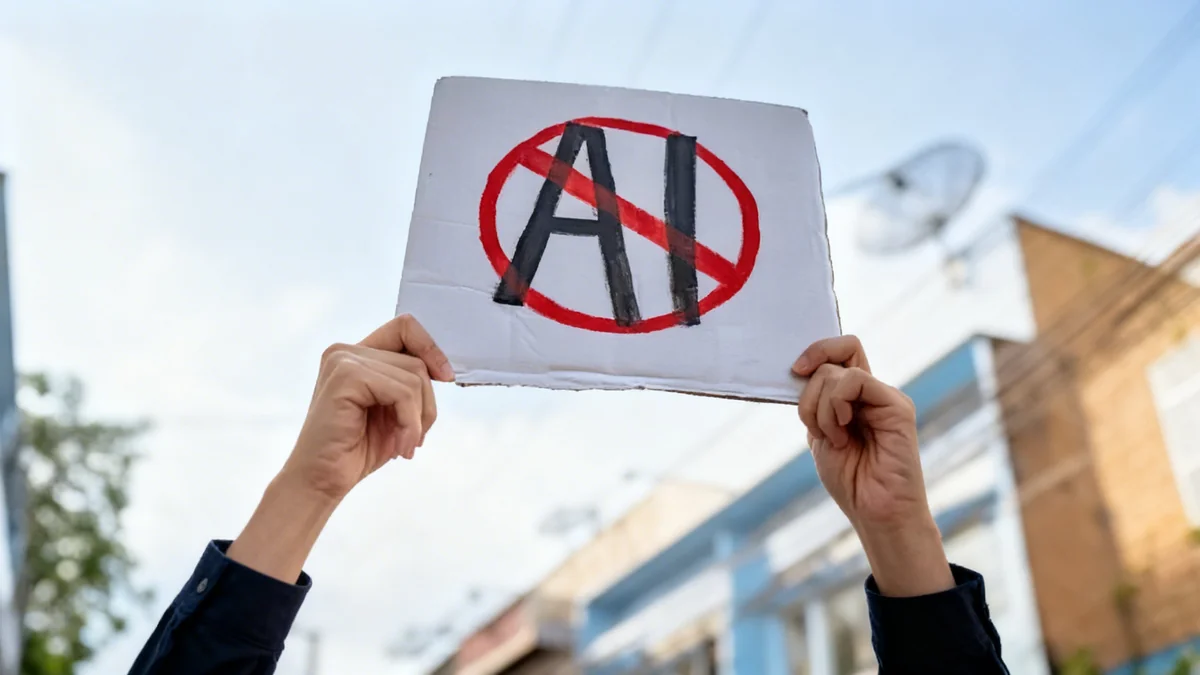


A global movement is gaining momentum to certify products and creative works as "human-made," a direct response to the rapid rise of generative artificial intelligence. Organizations across various sectors are now developing labels to signal that content, from books to films, was created without the use of AI, sparking a debate over authenticity and consumer trust in a new technological era.
This push for transparency comes as industries grapple with AI's ability to automate tasks once exclusive to human creators. As at least eight separate initiatives emerge, the central challenge is establishing a single, universally recognized standard that consumers can easily understand and trust, similar to the well-established "Fair Trade" certification.
Key Takeaways
- Multiple organizations are creating "AI-Free" or "Human-Made" labels to certify products.
- The movement is strongest in creative industries like publishing and film, where AI's role is controversial.
- A major hurdle is the lack of a universal definition for what constitutes "human-made" versus AI-assisted work.
- Experts warn that competing standards could lead to consumer confusion rather than clarity.
A Fragmented Push for Authenticity
Initiatives with names like "Proudly Human," "Not By AI," and "AI-Free" are appearing on websites, marketing materials, and even in film credits. These efforts, originating from companies and non-profits in the US, UK, and Australia, aim to give consumers a clear choice and potentially create a premium market for human-created content.
However, the rapid emergence of multiple competing labels threatens to undermine the core goal of clarity. Dr. Amna Khan, a consumer expert from Manchester Metropolitan University, notes that this fragmentation is a significant problem. "AI is creating significant disruption and competing definitions of what is 'human made' are confusing consumers," she stated. According to Dr. Khan, establishing a universal definition is "essential to build trust, clarification and confidence."
What is Generative AI?
Generative AI refers to artificial intelligence models capable of creating new content, such as text, images, music, or code. These tools, trained on vast datasets of existing human work, can produce sophisticated outputs from simple text prompts, blurring the lines of authorship and creativity.
The Challenge of Defining 'AI-Free'
A central complication in this movement is determining where to draw the line. AI is already integrated into many common tools, from grammar checkers in word processors to enhancement features in photo editing software. This makes a purely "AI-free" product difficult to define and verify.
"AI is now so ubiquitous and so integrated into different platforms and services, that it's truly complicated to establish what 'AI free' means," explains AI Research Scientist Sasha Luccioni. She suggests a more nuanced approach is needed.
"I think that AI is a spectrum, and we need more comprehensive certification systems, rather than a binary with AI/AI-free approach."
Some organizations are focusing specifically on generative AI. For instance, the distributor The Mise en scène Company added a "No AI was used" stamp to a recent film poster and published its own classification system. "We support the AI industry... but we think that as a result of AI content there is an economic premium put on human-made content," said CEO Paul Yates, highlighting the business case for such a distinction.
Creative Industries on the Front Line
The arts and entertainment sectors have become the primary battleground for the human-versus-AI debate. The ability of AI to generate entire books, songs, and even films at a fraction of the traditional cost and time has sent shockwaves through these industries.
AI in Entertainment
Some studios, like Bollywood's Itelliflicks, openly embrace and promote their use of generative AI in filmmaking. In contrast, other creators are actively pushing back. The 2024 thriller Heretic, starring Hugh Grant, included a disclaimer in its credits stating, "No generative AI was used in the making of this film."
The publishing world is also deeply engaged. Publishing house Faber and Faber has started using a "Human Written" stamp on some books at the request of authors like Sarah Hall, who described the use of copyrighted books to train AI models as "creative larceny at scale."
Verification and Auditing
The credibility of any label depends on its verification process. The approaches vary widely:
- Self-Certification: Some services, like no-ai-icon.com, allow anyone to download and use their badges for free or a small fee with minimal oversight.
- Vetting and Auditing: Other organizations have implemented more rigorous systems. UK-based Books by People charges publishers and requires them to complete questionnaires about their creative processes. They also perform periodic checks on book samples.
- Comprehensive Audits: An Australian company, Proudly Human, employs an even stricter process. Its auditors conduct checks at every stage of a book's publication to ensure no generative AI was used. The company plans to expand its certification to music, film, and photography.
Alan Finkel, who heads Proudly Human, believes robust verification is non-negotiable. "A certification of 'human origin' is needed but self certification is not good enough," he argued. "We have a full verification process to make sure that its truly human originated material."
The Road Ahead
As AI tools become more sophisticated and integrated into daily life, the demand for transparency is likely to grow. Consumers, creators, and companies are all navigating a new landscape where the origin of content is no longer a given.
The success of the "human-made" movement will hinge on whether these disparate groups can coalesce around a single, trustworthy standard. Without a unified approach, the effort to provide clarity could inadvertently create more confusion, leaving consumers to wonder what labels like "AI-Free" or "Human-Made" truly mean.