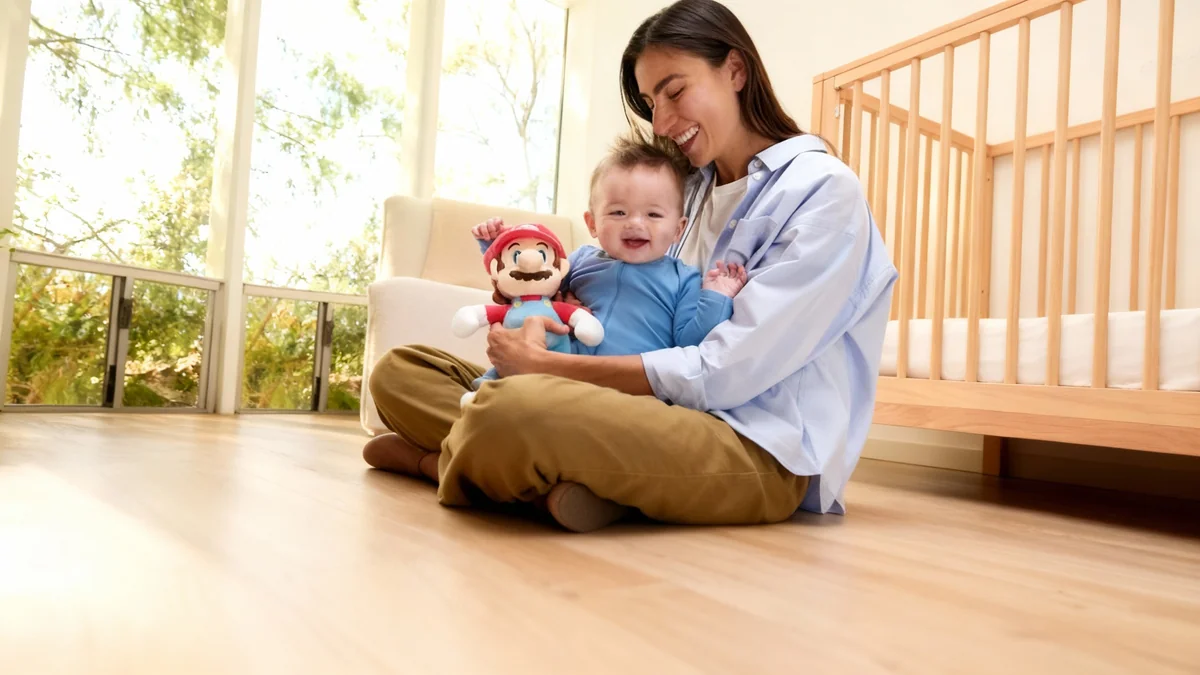



Nintendo has officially refuted claims that it used artificial intelligence to generate images for its new 'My Mario' children's toy line. The denial comes after a promotional photo featuring a model with a uniquely angled thumb triggered widespread online speculation about the use of generative AI in the company's marketing materials.
The incident underscores a growing challenge in the digital age: the public's increasing difficulty in distinguishing authentic photography from AI-generated content. A model who participated in the photoshoot has since come forward to confirm the campaign used real people and families, highlighting the human element behind the controversial images.
Key Takeaways
- Nintendo has confirmed that no generative AI was used to create images for its 'My Mario' toy advertising campaign.
- Online speculation was fueled by a photograph where a model's thumb appeared to be at an unusual, double-jointed angle.
- Model Brittoni O'myah Sinclair, who worked on the project with her family, verified that all participants were real people who went through a casting process.
- The controversy reflects a broader societal trend of assuming digital content is AI-generated, even when it is authentic.
An Image Ignites Online Speculation
The debate began last week when users on social media platforms started dissecting a promotional image from Nintendo's new 'My Mario' toy collection. The photo, which depicted a parent and child playing with the toys, drew attention for what some described as an anatomical anomaly.
Specifically, the thumb of one of the adult models was bent back at an angle that many viewers found unnatural. This single detail was enough to launch a wave of accusations, with numerous posts and several news reports concluding that the image was likely a product of generative AI.
The assumption spread rapidly, fueled by the increasing sophistication of AI image generators that can now produce photorealistic scenes. For many online commentators, the slightly unusual hand position was a tell-tale sign of digital fabrication, a common artifact found in earlier AI-generated images.
The Challenge of Authenticity
The incident is part of a larger conversation about the role of AI in media and entertainment. As AI tools become more powerful and accessible, the line between real and synthetic content blurs. This has led to a climate of skepticism where authentic photographs can be misidentified as fakes, a phenomenon sometimes referred to as 'AI-pessimism'.
Models and Company Confirm Authenticity
In response to the growing controversy, Nintendo issued a clear statement confirming that no AI was used in the creation of the marketing photos. The company maintained that the images were the result of a traditional photoshoot involving real human models.
This position was strongly supported by one of the models cast for the campaign, Brittoni O'myah Sinclair. While not the individual in the specific photo under scrutiny, she worked on the same project and provided insight into the production process.
"Everything is real. All the models were casted, and most of us worked with our real families. We had to do auditions, and call backs to book this job."
Sinclair confirmed that she saw the model from the controversial photo on set and that they were, in fact, a real person. Her testimony provides a crucial first-hand account, pushing back against the digital rumors and grounding the campaign in human reality.
A Question of Perception and Biology
The core of the issue appears to be a simple misunderstanding of human anatomy. Many individuals possess hypermobility in their joints, allowing them to bend their thumbs and other fingers in ways that might seem unusual to others. This condition is often referred to as being "double-jointed."
Social media users quickly came forward to defend the model, with some posting photos of their own double-jointed thumbs to demonstrate that the pose was entirely possible and natural for some people.
Hypermobility is Common
Joint hypermobility, the condition that allows for an extended range of movement in joints, is relatively common. Studies suggest that it affects between 10% and 25% of the general population, meaning millions of people have joints that can move beyond the typical range.
One user on social media commented on the situation, stating, "As a person born w/ double-jointed thumbs myself, it honestly baffles me how quick ppl are to assume an image is genAI just because a person bends their joints in a way they're not used to."
The Broader AI Debate in Entertainment
Nintendo's situation is not an isolated event. The entertainment and gaming industries are currently grappling with the ethical and practical implications of using generative AI. Public and professional opinions on the matter are deeply divided.
Several recent events highlight this tension:
- Epic Games: The creator of Fortnite faced criticism over art that fans believed was AI-generated, though at least one piece was later proven to be hand-drawn by an artist.
- Larian Studios: The developer of the acclaimed Baldur's Gate 3 announced it would not use AI tools for concept art on an upcoming project following significant pushback from its community.
The debate extends to the highest levels of the industry. Dan Houser, a co-founder of Rockstar Games, recently compared the unchecked proliferation of AI to "mad cow disease." In contrast, the CEO of Genvid, a company behind interactive series like Silent Hill: Ascension, has argued that "consumers generally do not care" about the use of generative AI in their entertainment.
This incident with Nintendo's 'My Mario' campaign serves as a powerful case study. It demonstrates how quickly the public can jump to conclusions in the age of AI and the real-world consequences for companies and individuals caught in the crossfire. Even with a traditional, human-led creative process, the mere suspicion of AI was enough to create a significant public relations challenge, forcing the company and its partners to prove their own authenticity.