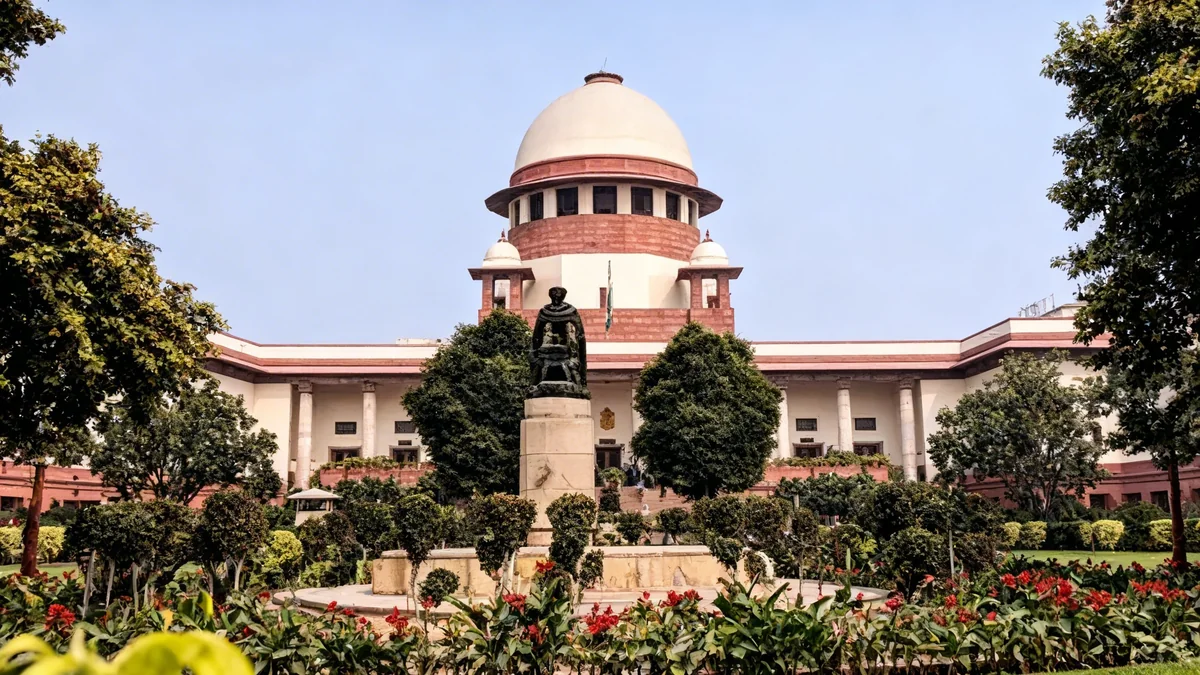





India's Supreme Court has intervened in a legal case after a lower court judge based a ruling on entirely fabricated legal precedents generated by artificial intelligence. The nation's highest court described the incident as a matter of "institutional concern," raising serious questions about the integrity of the judicial process in the age of generative AI.
The case, which originated from a property dispute in the southern state of Andhra Pradesh, has now escalated to the highest judicial level, prompting a formal examination of the role of AI in legal decision-making.
Key Takeaways
- A junior judge in Andhra Pradesh used four non-existent legal citations created by an AI tool in an official ruling.
- India's Supreme Court has stayed the lower court's order, calling the use of fake AI judgments an act of "misconduct."
- The incident has prompted the Supreme Court to issue notices to the country's top legal officers to address the issue.
- This case highlights a growing global problem, with similar instances of AI-generated misinformation appearing in courts in the United States and the United Kingdom.
Details of the Disputed Ruling
The controversy began in August of last year during a property dispute case in a trial court in the city of Vijaywada. A junior civil judge was tasked with ruling on an objection raised by the defendants regarding an official survey of the property in question.
In dismissing their objection, the judge cited four previous legal judgments to support her decision. However, the defendants later discovered that all four of these cited cases were completely fictitious, having been invented by a generative AI program.
The Problem with Generative AI
Generative artificial intelligence systems are known for their ability to create convincing but false information, a phenomenon often called "hallucination." These systems can invent facts, sources, and in this case, entire legal precedents, presenting them as authentic.
The defendants challenged the ruling, escalating the matter to the state's high court. They argued that a decision based on non-existent legal grounds was invalid.
Contrasting Responses from Higher Courts
The Andhra Pradesh High Court acknowledged that the citations were indeed fake. However, it took a lenient view of the situation, concluding that the junior judge had made the error in "good faith."
In its own order, the high court stated that the judge was using an AI tool for the first time and genuinely believed the information was accurate. The court noted the judge expressed that her mistake occurred "solely due to the reliance on an automatic source."
Despite the fabricated citations, the high court upheld the original decision, reasoning that the trial court had applied the correct legal principles. The high court's order noted that "mere mentioning of incorrect or non-existent rulings/citations in the order cannot be a ground to set aside the order." It also added a warning about the need to prioritize "the exercise of actual intelligence over artificial intelligence."
"This case assumes considerable institutional concern, not because of the decision that was taken on the merits of the case, but about the process of adjudication and determination." - Supreme Court of India
Unsatisfied with this outcome, the defendants appealed again, bringing the case before the Supreme Court of India. The nation's top court adopted a much sterner position.
Supreme Court Flags "Institutional Concern"
Last Friday, the Supreme Court took decisive action by staying the lower court's order. The justices framed the issue not as a simple mistake but as a serious threat to the legal system.
The court declared that using AI-generated fake judgments was not just "an error in decision making" but constituted an act of "misconduct." The justices emphasized that the incident has a "direct bearing on integrity of adjudicatory process."
Formal Inquiry Initiated
To address the gravity of the situation, the Supreme Court has issued official notices to India's Attorney General, the Solicitor General, and the Bar Council of India, signaling a comprehensive review of the use of AI in the country's legal framework.
This move indicates that the court intends to establish clear guidelines and safeguards to prevent such occurrences in the future. The case is now set for a more detailed examination.
A Growing Global Challenge
India is not alone in grappling with the disruptive influence of AI in the courtroom. Legal systems worldwide are confronting similar challenges as legal professionals experiment with new technologies.
- In the United States, two federal judges were recently criticized for errors in their rulings that were traced back to the use of AI tools.
- In the United Kingdom, the High Court of England and Wales issued a warning to lawyers in June 2023 against using AI-generated material after several cases cited fictitious rulings.
India's Supreme Court has been proactive on this front. Last year, it published a white paper on the role of artificial intelligence in the judiciary. The document outlined best practices and stressed the critical need for human oversight and robust institutional safeguards.
Just last month, the court also expressed concern over the trend of lawyers using AI to draft petitions, with a justice reportedly calling the practice "absolutely uncalled for." This latest case involving a judge's ruling, however, elevates the issue to a new level of urgency, forcing a direct confrontation with the potential for AI to undermine the very foundation of legal precedent.