



The year 2026 is emerging as a critical period in global affairs, marked by escalating military tensions, unresolved conflicts, and a technological race that could reshape the international order. From a significant U.S. military deployment in the Caribbean to a high-stakes presidential summit over the future of Taiwan, multiple geopolitical situations are approaching decisive moments.
While diplomatic efforts continue on several fronts, including ceasefire talks for Ukraine, the underlying dynamics suggest a year of transformation rather than transition. Key regions are experiencing pressures that could lead to major shifts in power, stability, and long-standing policies.
Key Takeaways
- The U.S. has initiated its largest military buildup in the Caribbean since the Cold War, centered on Venezuela.
- Russia's war in Ukraine is set to enter its fifth year, with the potential for either exhaustion or further escalation.
- The future of Taiwan may be determined by an upcoming summit between the U.S. and China.
- Israel faces pivotal elections that could reshape its domestic politics and foreign relations, particularly with Saudi Arabia.
- Iran is in a weakened state, facing internal pressures and the possibility of renewed external conflict.
- Security agencies are warning of a resurgence in global terrorism threats, with incidents on the rise.
- The competition over Artificial Intelligence between the U.S. and China is intensifying, with major economic and military implications.
A New Doctrine in the Western Hemisphere
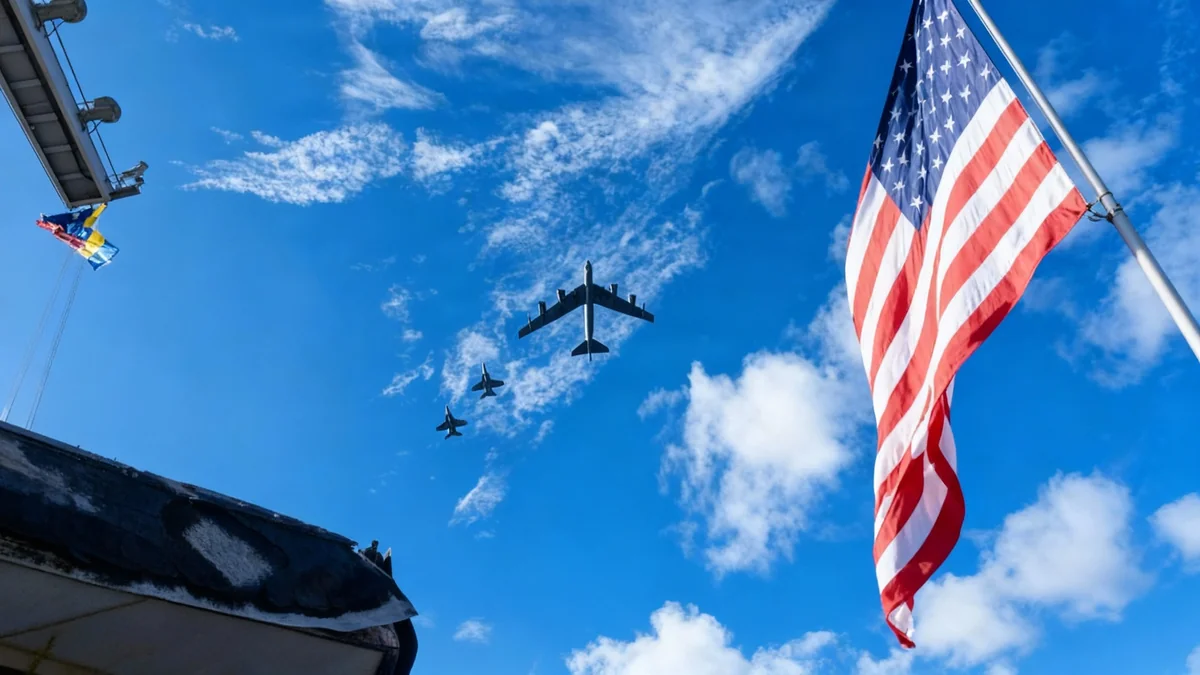
The Trump administration has positioned an unprecedented military force in the Caribbean and western Atlantic, creating a tense standoff with Venezuela. This deployment includes an aircraft carrier strike group, multiple destroyers, stealth bombers, and special operations units.
The stated objective of this operation has been to counter illicit drug trafficking, leading to nearly 30 strikes conducted without congressional authorization. However, recent actions suggest a broader agenda. The administration has imposed a military blockade on illicit oil shipments and seized several oil tankers, escalating the situation significantly.
This assertive posture is being framed as a “Trump Corollary” to the Monroe Doctrine, signaling a U.S. commitment to act as the predominant power in the Western Hemisphere. The policy appears aimed at forcing Venezuelan leader Nicolas Maduro from power, though he has shown no indication of leaving voluntarily. How this situation resolves in 2026 will be a major test of this new doctrine and could set a precedent for U.S. foreign policy for the remainder of the presidential term.
Europe's Enduring Conflict Enters Year Five
In February, the war in Ukraine will enter its fifth year. What began as an attempt by Russia to quickly seize Kyiv has devolved into a grinding war of attrition in the country's east. The conflict has been a strategic failure for Russia, which has reportedly suffered over one million casualties, yet President Vladimir Putin shows no signs of de-escalating.
The Human Cost
After four full years of conflict, Russia's forces have sustained over 1 million casualties. Despite this, Moscow continues to commit large numbers of troops to the front lines in eastern Ukraine, gaining limited territory at a high price.
The fifth year of a war is often a tipping point. Both sides could be nearing exhaustion, potentially opening a path to peace, or they could take greater risks to break the stalemate. Currently, neither Ukraine nor Russia appears capable of a decisive breakthrough on the battlefield.
The Trump administration is reportedly pursuing a peace deal that would offer Ukraine security guarantees in exchange for ceding territory. However, Putin has not signaled any willingness to accept such terms. The crucial factor in 2026 may not be developments on the front lines, but rather decisions made in Washington regarding the level of continued economic and military support for Ukraine.
The High-Stakes Standoff Over Taiwan
A planned summit in Beijing between President Trump and Chinese President Xi Jinping is set to address the future of Taiwan, one of the most volatile issues in international security. For decades, the U.S. has maintained a policy of “strategic ambiguity,” recognizing Taiwan as part of China while providing the island with security assistance.
This policy is being tested. The administration recently approved a historic $11 billion arms package for Taiwan, including advanced missiles, drones, and air defense systems. This move comes as China's military is preparing for a potential invasion of the island by 2027.
Why Taiwan Matters
Taiwan is a global hub for semiconductor manufacturing, producing the majority of the advanced chips that power everything from smartphones to cars. A conflict over the island could trigger a global economic disruption estimated at nearly $10 trillion.
The administration's new National Security Strategy (NSS) adds another layer of uncertainty. The document describes the U.S. as a “hemispheric power” and states, “The days of the United States propping up the entire world order like Atlas are over.” This language appears to align with the vision of a world divided into spheres of influence, a view shared by China and Russia. The outcome of the Beijing summit will reveal whether the U.S. intends to uphold its long-standing commitment to Taiwan or prioritize a broader deal with China.
Middle East at a Crossroads
Israel's Pivotal Elections
Israel is approaching a critical political juncture. After a year of significant military successes that saw the release of hostages from Gaza and the weakening of Hamas and Hezbollah, the country has struggled to achieve lasting political stability. Governing with a narrow, right-wing coalition has deepened divisions within Israeli society.
Parliamentary elections must be held by October 27, 2026, and could happen sooner. The outcome will be pivotal. A new unity government could pave the way for diplomatic breakthroughs, including a normalization deal with Saudi Arabia as part of an expanded Abraham Accords. However, a continuation of the current political deadlock could forfeit this historic opportunity.
Iran's Year of Reckoning
Iran experienced a disastrous 2025 and faces an even more challenging 2026. The country's strategy of using regional proxies like Hezbollah and Hamas backfired dramatically. Many of its proxy leaders are dead, its air defenses have been damaged, and its nuclear program has been set back.
Iran is hobbled militarily and economically. A water shortage may result in evacuations and rationing in Tehran. On top of that, its Supreme Leader, Ali Khamenei, is 86 years old, reportedly ill, and there is no named successor.
With its leadership in question and its population increasingly restless, the clerical system is under immense pressure. A weakened regime could become unpredictable, potentially lashing out with terrorist attacks or other reckless actions. The internal situation in Iran will be a major source of instability in the region throughout the year.
The Resurging Threat of Global Terrorism
After years of decline, the threat of global terrorism is making a comeback. Between 2014 and 2020, the number of terror attacks worldwide dropped by nearly 60%, largely due to the successful international coalition campaign against ISIS. That trend has reversed.
From 2022 to 2025, fueled in part by the Hamas attacks in Israel, terrorist incidents and related deaths have been rising. Recent events, including a massacre in Australia and a disrupted bomb plot in Los Angeles, highlight the recharging of global extremist networks.
Last week, ISIS killed two American troops in Syria for the first time since 2019. The head of the UK's internal security service recently described the ISIS threat there as “huge,” and EU officials have labeled it the “most prominent threat” once again. Reversing this trend will require renewed international cooperation on law enforcement and intelligence sharing.
The Unseen Battlefield: The AI Revolution
The competition over artificial intelligence has rapidly become a central issue in global politics. Both the United States and China view AI dominance as an existential contest, comparable to the Cold War space race, due to its vast military and economic implications.
In 2025, China demonstrated its progress by launching DeepSeek R1, a new AI model that challenged leading American systems at a fraction of the cost. The event briefly rattled financial markets and served as a wake-up call about how quickly technological advantages can disappear.
The U.S. is facing its own challenges, including a shortage of electricity generation needed to power the growing number of AI data centers. As geopolitical rivalry intensifies and policy debates remain unsettled, the rapid advancement of AI is set to be one of the most consequential forces shaping the world in 2026 and beyond.