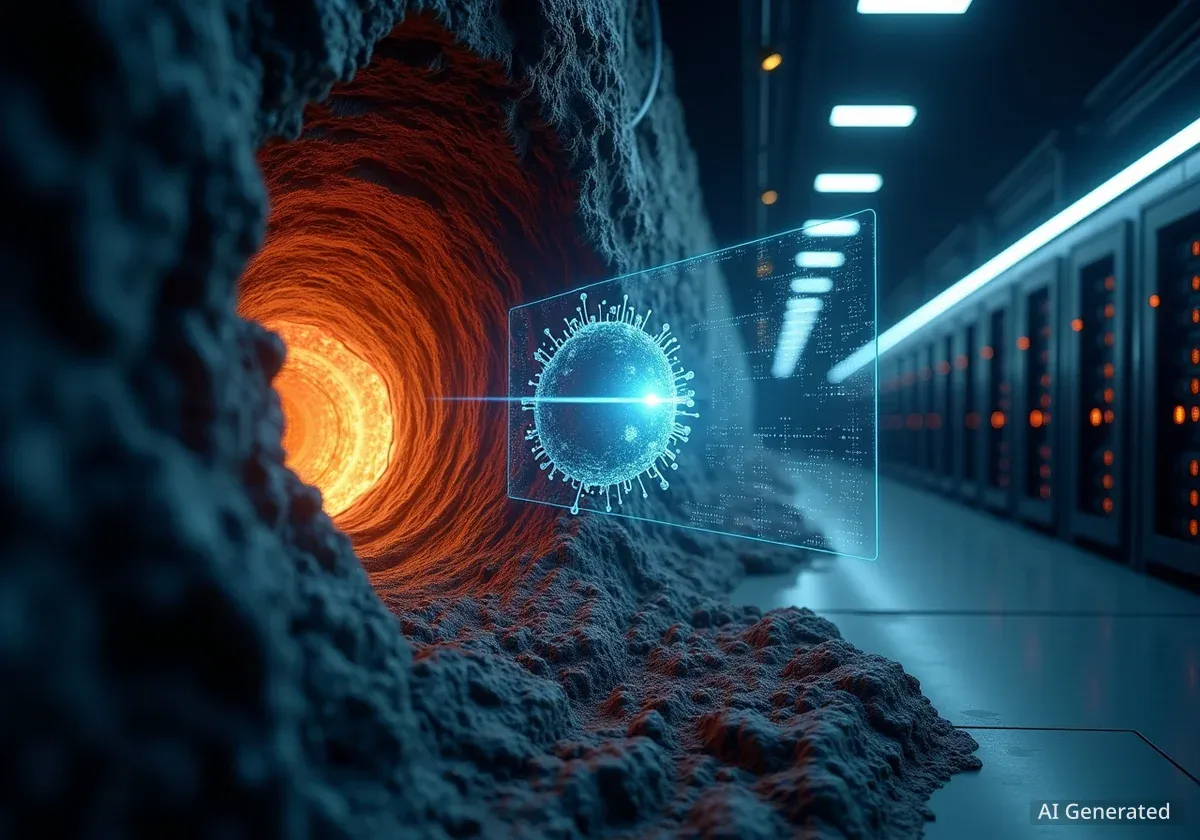


Recent scientific advancements have revealed several significant discoveries, including a massive gravity anomaly deep within the Earth that went undetected for nearly two decades. In parallel, researchers have developed artificial intelligence capable of designing entirely new viruses, while astronomers are getting closer to understanding the origins of an ancient interstellar comet.
Key Takeaways
- A gravity signal as long as the African continent was identified in satellite data from 2007, suggesting a major geological event near Earth's core.
- Researchers successfully used an AI model to create novel viruses that target bacteria, raising both therapeutic possibilities and biosecurity concerns.
- Astronomers have traced the interstellar comet 3I/ATLAS to the outer regions of the Milky Way, suggesting it may be billions of years older than our sun.
- Extreme weather events in the United States caused a record-breaking $100 billion in damages by June 2025, highlighting the economic impact of climate change.
A Mysterious Signal from Earth's Core
Scientists analyzing historical satellite data have uncovered a massive gravity anomaly that occurred deep within the planet in 2007. The signal, which spanned a distance comparable to the length of Africa, was detected alongside a simultaneous event known as a geomagnetic jerk—a rapid change in the Earth's magnetic field.
The anomaly and the jerk persisted for approximately two years. However, the discovery was only made 18 years later after a careful review of data collected by the GRACE (Gravity Recovery and Climate Experiment) satellites, which were operational between 2002 and 2017.
What are Geomagnetic Jerks?
Geomagnetic jerks are sudden, unpredictable changes in the flow of liquid iron within Earth's outer core. These events alter the planet's magnetic field over short periods, typically a few years, and are a key area of study for understanding the dynamics of Earth's interior.
Researchers believe the event was caused by a previously unknown geological process. The leading hypothesis points to a rapid redistribution of mass in our planet's deep mantle, close to the core-mantle boundary. This massive shift of material would be significant enough to affect both the gravitational and magnetic fields.
Further investigation is required to fully comprehend the mechanisms behind this deep-Earth process. Understanding these events is crucial for modeling the planet's interior dynamics and their potential influence on surface geology and the magnetic field that protects Earth from solar radiation.
Artificial Intelligence Enters Virology
In a development with significant implications for medicine and biosecurity, scientists have created an artificial intelligence system that can design completely new viruses from scratch. The AI-generated viruses are a type of bacteriophage, which are viruses that specifically infect and destroy bacteria.
The research team took specific precautions to ensure their AI models could not design pathogens capable of infecting humans, animals, or plants. The primary goal of the project is to create a new tool in the fight against antibiotic-resistant bacteria, often called "superbugs."
A Potential Weapon Against Superbugs
According to the World Health Organization, antimicrobial resistance is one of the top 10 global public health threats. Bacteriophages offer a potential alternative to traditional antibiotics, as they can be engineered to target specific harmful bacteria without affecting beneficial ones.
While the discovery holds promise for developing new therapies, it also raises serious ethical and security questions. Experts are concerned that similar AI technology could be repurposed by malicious actors to create devastating bioweapons.
"If you're still left with the lingering feeling that this is a preamble to an apocalyptic movie, there's a risk it could be," noted the original report, highlighting the dual-use nature of the technology.
Although current technological limitations mean the threat is not immediate, the rapid advancement of AI has prompted calls for stronger regulation and oversight. The scientific community is now debating how to establish biosecurity measures that can keep pace with AI's evolving capabilities.
Tracing a Visitor from Interstellar Space
Astronomers are making progress in determining the origin of comet 3I/ATLAS, an interstellar object first detected in late June 2025. Analysis suggests the comet originated from the far reaches of the Milky Way galaxy and could be a relic from its earliest formation.
This would make the comet potentially billions of years older than the sun and our solar system. It offers a rare opportunity to study primordial material from another part of the galaxy.
The comet has also exhibited unusual properties. Observations revealed it was ejecting water vapor "like a fire hose" while still very far from the sun, a behavior not typically seen in comets from our own solar system until they are much closer to a heat source.
- Origin: Far corners of the Milky Way galaxy.
- Estimated Age: Potentially billions of years older than the sun.
- Unusual Activity: Ejecting large amounts of water far from any significant heat source.
To get a better look, the European Space Agency (ESA) has tasked its Mars Express spacecraft with capturing close-up images of the comet's bright coma, the cloud of gas and dust surrounding its nucleus. These observations will provide valuable data on its composition and structure.
Economic Impact of a Changing Climate
Beyond discoveries in space and deep within the Earth, a stark reality of our planet's current state has been quantified. In the first half of 2025, extreme weather events in the United States caused damages exceeding $100 billion, setting a new record for economic losses in such a short period.
The costs were driven by a series of devastating natural disasters, including widespread wildfires, powerful tornadoes, prolonged heatwaves, and severe flooding. According to the National Oceanic and Atmospheric Administration (NOAA), this trend reflects the increasing frequency and intensity of weather events linked to climate change.
Scientists have warned that these economic impacts are likely to worsen without significant action to curb greenhouse gas emissions. The record-breaking damages underscore the tangible financial consequences of a warming planet, affecting infrastructure, agriculture, and communities across the country.