

We are living through a period of unprecedented technological acceleration, yet the final destination remains a profound mystery. As artificial intelligence evolves at a pace that outstrips our ability to comprehend its full implications, society finds itself in a moment of deep uncertainty, similar to historical eras of great discovery where the map was still being drawn.
The spectrum of possibilities for AI's impact is incredibly wide, ranging from modest enhancements to daily life to transformations that could redefine humanity itself. This uncertainty creates a challenging environment for policymakers, business leaders, and the public, who must navigate a future that is still being written in real-time.
Key Takeaways
- The future impact of artificial intelligence is largely unknown, with potential outcomes ranging from minor societal adjustments to fundamental, world-altering changes.
- This period of uncertainty mirrors other major historical shifts, such as the discovery of new continents or the dawn of the industrial age, where the full consequences were not understood for generations.
- Experts are divided, with predictions spanning from AI as a simple tool to AI as a transformative force that could reshape economies, cultures, and even the definition of intelligence.
- Navigating this ambiguity requires a focus on adaptability and responsible development rather than attempting to predict a single, definitive future.
A Moment of Historical Ambiguity
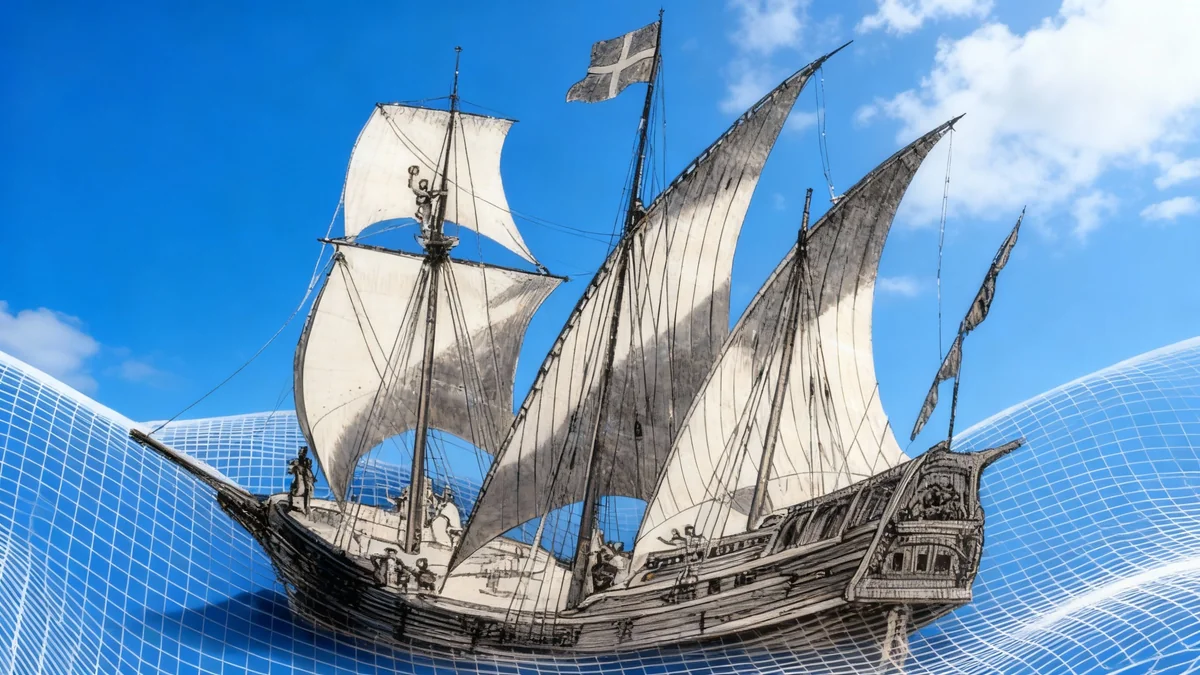
History is filled with moments when a new discovery or invention arrived, but its true significance was not immediately clear. Think of the early 1500s, after Christopher Columbus reached the Americas. For Europeans at the time, this "New World" was an enigma. Was it a small set of islands, a gateway to Asia, or an entirely new continent with unimaginable resources and challenges?
The reality, of course, was far more complex and consequential than most could have imagined. It set in motion centuries of change, redrawing global maps, shifting economic power, and creating new empires while dismantling others. The initial discovery was just the first step into a vast unknown.
Today, many analysts see our relationship with artificial intelligence in a similar light. We have made the initial discovery. We have built systems that can generate text, create images, and solve complex problems. Yet, we stand at the shore of a vast new continent of possibility, with little understanding of its true scale or nature.
The Analogy of Discovery
Historical parallels help frame our current uncertainty. In his book "Conquistadores," historian Fernando Cervantes details how the Spanish initially struggled to comprehend the scale of the Americas. Their understanding was limited by their existing worldview. Similarly, our understanding of AI is constrained by our current definitions of intelligence, consciousness, and technology. The most transformative aspects of AI may be things we can't yet conceive of.
The Spectrum of AI's Future
The debate over AI's future is not a simple binary of utopia versus dystopia. Instead, it encompasses a wide spectrum of potential outcomes, each with its own advocates and evidence.
The Practical and Incremental View
One perspective holds that AI will primarily be a powerful tool that augments human capabilities. In this scenario, AI functions as an advanced assistant, optimizing supply chains, accelerating scientific research, and personalizing education. It becomes deeply integrated into our economic and social systems but doesn't fundamentally alter the structure of society. It's a powerful new technology, but one that follows the path of the internet or the smartphone—transformative, but not eschatological.
The Superpower Catalyst
A more dramatic possibility is that AI will act as a catalyst for geopolitical and economic dominance. The nation or corporation that achieves a decisive lead in artificial general intelligence (AGI) could gain an insurmountable advantage. This could lead to a new global power structure, where economic productivity and military strength are dictated by AI capabilities. This view sees AI not just as a tool, but as the ultimate source of strategic power in the 21st century.
"We are in a moment where the possibilities feel limitless, but our vision is not. We might be gaining a modest commercial edge, or we might be setting in motion a sequence of events that will reshape civilization as we know it."
The World-Altering Transformation
At the far end of the spectrum lies the most profound and unsettling possibility: that AI will trigger a fundamental change in the human condition. This includes scenarios where AGI surpasses human intelligence, leading to an era of unimaginable progress in science and medicine. It also includes existential risks, where an uncontrollable superintelligence could pose a threat to humanity's survival. This view suggests that we are not just inventing a new tool, but potentially creating a new form of life or intelligence that will share the planet with us.
A Range of Possibilities
- Modest Outcome: AI becomes a sophisticated productivity tool, like the personal computer.
- Geopolitical Shift: AI leadership determines the next global superpower.
- Eschatological Event: AI fundamentally changes life on Earth, for better or worse.
Why We Should Pay Closer Attention
The profound uncertainty surrounding AI is not a reason for inaction or dismissal. On the contrary, it is a call for heightened attention and careful consideration. Because the range of outcomes is so vast, treating AI as just another tech trend could be a historic miscalculation.
During past technological revolutions, societies often failed to grasp the long-term consequences until it was too late to shape them effectively. The industrial revolution brought immense wealth and progress, but also social dislocation, pollution, and new forms of inequality that took over a century to address.
With AI, the pace of change is compressed. We may not have decades to adapt. The decisions being made today in research labs, corporate boardrooms, and government committees could have outsized consequences for the future. Understanding the full spectrum of possibilities, from the mundane to the world-changing, is the first step toward navigating this uncharted territory responsibly.
As we continue to explore this new frontier, it is crucial to remain open to the possibility that our initial assumptions are wrong. The true nature of artificial intelligence may be something that, like a newly discovered continent, can only be understood through careful, prolonged, and humble exploration.