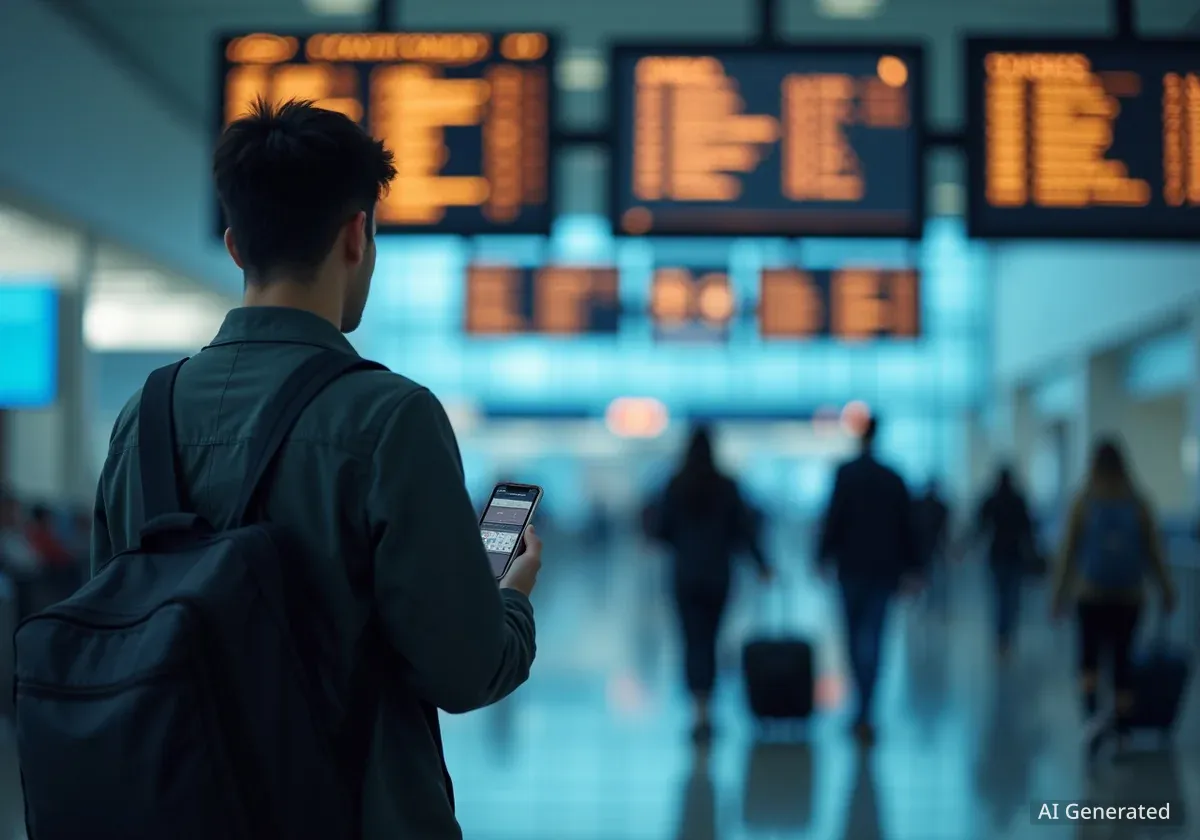





Travelers relying on artificial intelligence tools like ChatGPT to plan their trips are encountering significant problems, including being sent to non-existent attractions and receiving incorrect visa information. A growing number of incidents highlight the risks of depending on AI for critical travel details, a trend that has doubled in usage among UK travelers in the last year.
While AI can be a useful starting point for brainstorming, its tendency to generate false information, often called "hallucinations," has led to canceled trips, wasted journeys, and frustrating experiences. Studies and personal accounts show that AI-generated itineraries frequently contain factual errors about opening hours, attraction existence, and essential travel regulations.
Key Takeaways
- Travelers are being directed to destinations and businesses that have been fabricated by artificial intelligence.
- A study found over half of AI-generated travel plans included attractions with incorrect opening hours or that were permanently closed.
- Incorrect visa advice from AI has led to travelers being denied entry to countries and forced to cancel expensive trips.
- Despite the risks, the use of AI for travel planning has doubled in the UK over the past year, particularly among younger demographics.
- Experts advise using AI for initial ideas but stress the importance of verifying all critical information through official sources.
The Rise of AI-Generated Travel Errors
As more people turn to generative AI for quick and detailed travel plans, a pattern of unreliable and fabricated information is emerging. These AI systems, while capable of creating convincing itineraries, do not possess real-world knowledge and can confidently present false information as fact.
Madison Rolley, a 27-year-old U.S. travel influencer, experienced this firsthand. While planning a European trip with a $1,000 budget, she used ChatGPT to create her schedule. The AI recommended a picturesque café in Split, Croatia, for breakfast. However, upon arrival, she found only cleaning staff. The location was a restaurant that exclusively served dinner. "It was kind of awkward," she stated.
Rolley's experience is not an isolated case. According to a study by SEO Travel, the problem is widespread. The research revealed that more than 50% of AI-generated travel itineraries suggested visiting an attraction outside of its actual opening hours. Furthermore, nearly one-quarter of the plans recommended locations that were permanently closed.
Critical Mistakes with Major Consequences
The errors generated by AI extend beyond simple scheduling mistakes, sometimes leading to serious logistical and financial consequences. Incorrect information about travel documentation has proven to be a particularly costly issue for unsuspecting users.
Incorrect Visa and Entry Information
Chaimae Lebyed, a 26-year-old travel influencer from Morocco, had to cancel a planned trip to Fiji after relying on ChatGPT for visa requirements. The AI incorrectly informed her that she did not need a visa.
"Two days before my flight, I realised that I did need a visa. It was too late to apply, so I had to cancel the trip," Lebyed explained.
Despite the setback, Lebyed continues to use the technology for brainstorming. "I still use ChatGPT to plan my trips because it’s great for ideas, routes, and organisation, but now I always make sure to confirm the critical parts through embassy websites," she added.
Similarly, Australian content creator Mark Pollard, 47, was denied entry into Chile based on false visa advice from ChatGPT. His video detailing the experience gained millions of views on Instagram. "I was super busy, and it said that I didn’t need a visa and I didn’t check," Pollard said. He only discovered the error the night before his flight, causing a "little panic attack" as he was scheduled to give a paid talk in Chile.
Travel Planning by the Numbers
According to a recent report from Abta, the association of UK travel agents, the number of people in the UK using AI to plan trips has doubled in the past year. The trend is most popular among younger travelers, with 18% of 25 to 34-year-olds reporting they used AI for holiday planning.
AI's Ability to Create Fictional Places
One of the more concerning aspects of AI hallucinations is the ability to invent entirely fictional locations and present them as real. An elderly couple in Malaysia experienced this when they traveled more than 180 miles to visit a mountain cable car attraction they had read about online. Upon arrival, they discovered the attraction did not exist and had been fabricated by an AI.
This phenomenon was tested and confirmed by the digital marketing firm Search Atlas. The company created a fictional town named "Snackachussetts" and promoted it online. Manick Bhan, the CEO of Search Atlas, reported that within a week, generative AI tools like Google's Gemini began referencing the fake town as a real destination in search results.
"What was interesting that we learnt is that initially, the first AI overview about ‘Snackachusetts’ spoke about it as if it were a real place," Bhan noted.
While fact-checking systems eventually corrected the error, the experiment demonstrated how easily fabricated information can be integrated and presented as fact by current AI models.
Expert Analysis and Future Outlook
Researchers and industry experts caution users about the current limitations of generative AI. Anil Doshi, a researcher at University College London, suggests that the tendency to over-trust these tools is a psychological one. "If it proves to be successful and valuable in certain ways, you might slippery-slope into thinking it’s able to do these other kinds of tasks," he said.
Why AI Hallucinates
Generative AI models like ChatGPT work by predicting the next most likely word in a sequence based on vast amounts of text data they were trained on. They do not have a true understanding of facts or reality. This process can lead them to generate plausible-sounding but entirely false information, an effect commonly referred to as "hallucination."
However, Doshi also believes the technology is evolving quickly. He predicts a shift away from pure invention towards models that can access real-time data to provide accurate, bookable information. "We’re moving towards this model where it’s gonna be able to access real-time data and give you an actual flight and it will take you to a service where you can book it," he stated.
For now, travel industry professionals maintain that AI cannot replace human expertise. Michael Reece, head of marketing at Berkeley Travel, emphasized the value of personal relationships and judgment in providing a bespoke service. "In our world, AI may streamline a few processes, but it doesn’t replace the value we provide," he said.
The consensus among experts is clear: while AI can be a powerful tool for inspiration, every critical detail—from visa requirements and opening times to the very existence of a street or hotel—must be independently verified before travel. As Doshi warned, "You don’t want to be in Spain looking for a hotel on a street that’s not a street, right?"