




The United States' rapid expansion in artificial intelligence, a sector that has become a primary driver of its economic growth, is unexpectedly dependent on two key European choke points: a single Dutch technology company and the European Union's stringent data privacy regulations. These factors represent significant, though complex, leverage for European leaders in an increasingly tense global technology landscape.
While the U.S. government and Silicon Valley giants pour billions into AI development, their entire supply chain hinges on technology and market access controlled from across the Atlantic. This dependency creates a delicate balance of power, where decisions made in Brussels and the Netherlands could have profound consequences for the world's largest economy and its most valuable companies.
Key Takeaways
- The U.S. AI industry relies on advanced microchips from companies like Nvidia.
- These chips can only be manufactured using specialized lithography machines from a single Dutch company, ASML, which holds a global monopoly.
- The EU's data protection laws (GDPR) conflict with the data-intensive training methods used for many U.S. AI models.
- Strict enforcement of these two levers—export controls on technology and enforcement of data laws—could significantly slow U.S. AI development.
The Unseen Monopoly Powering AI
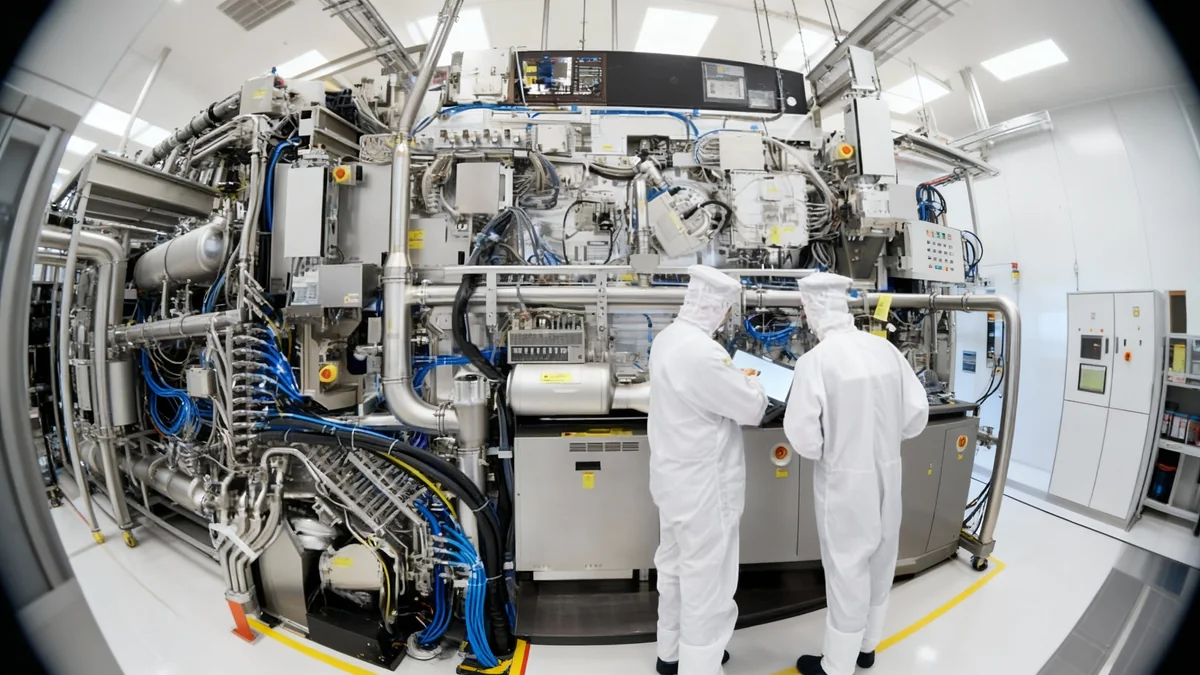
At the heart of the global AI revolution is a little-known but indispensable piece of equipment. The most advanced AI chips, designed by American giants like Nvidia, require a manufacturing process of almost unimaginable precision. This process is only possible with extreme ultraviolet (EUV) lithography machines.
Only one company in the world manufactures these machines: ASML, based in Veldhoven, Netherlands. This technological monopoly gives the Dutch firm, and by extension Europe, a critical role in the production of nearly every advanced semiconductor on the planet. Companies like Taiwan's TSMC, which manufactures the majority of Nvidia's top-tier chips, are entirely dependent on ASML's technology.
What is Lithography?
In semiconductor manufacturing, lithography is the process of using light to print complex patterns onto silicon wafers. These patterns become the intricate circuits of a microchip. ASML's EUV machines use a very short wavelength of light to create features that are just a few nanometers wide, allowing for billions of transistors to be packed onto a single chip.
Should European governments decide to implement export controls on this technology, the ripple effects would be immediate and severe. A slowdown or halt in the delivery of ASML machines to chip fabrication plants would create a bottleneck, directly impacting the ability of U.S. companies to produce the hardware that fuels the AI boom.
Data as the Second Point of Pressure
Beyond the hardware, the fuel for modern AI models is data. For years, major U.S. tech companies have trained their algorithms on vast datasets, often including personal information gathered from users across the globe. However, this practice is in direct conflict with the EU's General Data Protection Regulation (GDPR).
The GDPR requires companies to have a clear legal basis for processing personal data and to be transparent about how that data is used. Internal corporate documents made public in U.S. court cases have revealed that some large tech firms struggle to track precisely how user data flows through their internal systems. This lack of control is fundamentally incompatible with European law.
Economic Stakes
In the first half of 2024, investment in artificial intelligence accounted for a staggering 92% of the United States' GDP growth. Without the contribution from the AI sector, the U.S. economy would have grown by only 0.1% during that period, highlighting its immense reliance on the technology's continued expansion.
If European regulators, particularly in Ireland where many U.S. tech giants have their European headquarters, were to strictly enforce these rules, the consequences would be significant. U.S. companies could be forced to:
- Re-engineer their core systems to comply with data handling requirements.
- Stop training their AI models on European user data.
- Face substantial fines and potentially be barred from accessing the lucrative European market of over 450 million consumers.
This would not only disrupt current operations but could also force a fundamental rethinking of how AI models are developed, potentially putting U.S. firms at a disadvantage.
A High-Stakes Geopolitical Chess Game
The existence of these two choke points—hardware and data—transforms a commercial and technological issue into a potent geopolitical one. While deploying these levers would not be simple, their potential impact makes them a powerful tool in international negotiations.
The ASML Dilemma
Restricting ASML's exports would be a difficult decision for Europe. It would cause significant economic pain for the Netherlands and could disrupt global supply chains, affecting European companies as well. However, analysts suggest the impact on the U.S. AI sector, which is currently experiencing a period of intense, frothy investment, would be far greater.
"The U.S. feverish investment in AI and the datacenters it relies on will hit a wall if European export controls slow or stop exports," noted one policy analysis. "Via this lever, Europe has the means to decide whether and by how much the U.S. economy expands or contracts."
The Data Enforcement Path
Enforcing existing data laws is seen as a more straightforward option. It would not require new legislation, only the political will to apply the rules already on the books. A crackdown on lax enforcement would send a clear signal that access to the European market is conditional on respecting its laws, a move that could force a rapid change in behavior from Silicon Valley.
As geopolitical tensions rise, the strategic value of Europe's unique position in the technology supply chain is becoming increasingly apparent. The decisions made in the coming months and years regarding ASML's machines and GDPR enforcement could play a decisive role in shaping the future of artificial intelligence and the global economic balance of power.