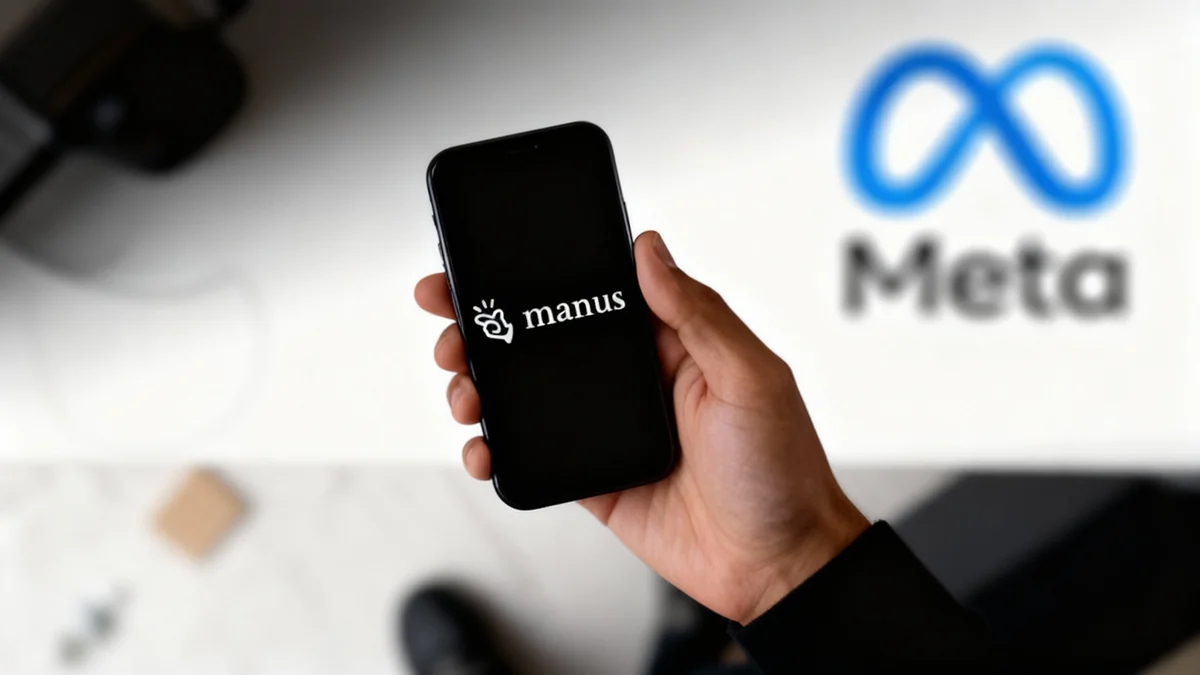



Chinese officials have initiated a review of Meta's recent $2 billion acquisition of the artificial intelligence startup Manus, examining potential violations of technology export controls. The move introduces a new layer of geopolitical complexity to a deal involving a US tech giant and an AI firm with deep Chinese roots.
The review, which is in its preliminary stages, could give Beijing significant leverage over the transaction, highlighting the escalating tech rivalry between the United States and China.
Key Takeaways
- China's commerce ministry is assessing Meta's $2 billion purchase of AI startup Manus for potential export control violations.
- The deal is under scrutiny because Manus, a company with Chinese founders and development history, relocated its core team to Singapore before the sale.
- This review could allow Beijing to influence or even block the transaction, echoing past interventions like the attempted forced sale of TikTok.
- The situation underscores the growing trend of "Singapore washing," where Chinese tech firms move to the city-state to navigate geopolitical tensions.
Geopolitical Chess Match Over AI Technology
The acquisition of Manus by Meta, announced last week, has drawn the attention of regulators in Beijing. Officials are now determining whether the company's relocation of staff and proprietary technology from China to Singapore required a government-issued export license.
According to sources familiar with the matter, while a formal investigation has not been launched, the possibility of requiring a license provides Beijing with a mechanism to exert influence. In an extreme scenario, this could be used to compel the parties to abandon the deal entirely.
This approach is not without precedent. China previously used similar regulatory tools to intervene during the Trump administration's efforts to force the sale of TikTok's US operations.
The Rise of "Singapore Washing"
The Manus deal has raised concerns in Beijing that other innovative Chinese startups might follow a similar path, moving their operations abroad to sidestep domestic regulations and geopolitical friction.
This practice has become so common it's been dubbed "Singapore washing," where companies establish a presence in the city-state to present a more neutral, global image and avoid the sensitivities tied to a Chinese headquarters.
While many such companies maintain operations in China, the core team behind Manus completed its move to Singapore in the summer of 2025. This physical relocation presents a challenge for Chinese authorities seeking to assert jurisdiction.
A Complex Corporate Structure
Manus is officially operated by a Singapore-based entity named Butterfly Effect Pte. However, its technology was developed, at least in part, by a sister company, Beijing Butterfly Effect Technology. This Beijing entity was established in 2022 by Manus's founders, including CEO Xiao Hong, and remains registered in the city, though its offices were reportedly empty when visited in August.
Navigating a Two-Sided Regulatory Gauntlet
The startup's journey from China to Singapore appears to have been influenced by regulations from both superpowers. The relocation followed a financing round led by the prominent US venture capital firm Benchmark, which reportedly triggered inquiries from the U.S. Treasury Department regarding new rules that restrict American investment in Chinese AI companies.
This pressure from Washington may have accelerated Manus's decision to disentangle itself from its Chinese origins. Cui Fan, a professor at the University of International Business and Economics, commented on the situation in a public social media post.
"Manus’s step-by-step disentanglement from China was undeniably propelled by US investment restrictions," Cui wrote, suggesting that any Chinese review should focus on whether export-controlled technologies were developed while the team was in China.
He further warned that simply relocating does not guarantee a bypass of regulatory frameworks. "Believing that quickly severing ties with China can bypass both US and Chinese regulatory regimes may be overly simplistic," Cui added, noting that confirmed unauthorized exports could lead to legal consequences, including potential criminal liability.
A Tale of Two Ecosystems
In the United States, some analysts view Meta's acquisition as a strategic victory for American policy. They argue it demonstrates the effectiveness of restrictions designed to curb the flow of US capital and technology to China's AI sector.
"The Manus acquisition shows that US restrictions on investment and AI chip exports are causing two distinct AI ecosystems to develop — the US AI ecosystem and the Chinese AI ecosystem," said Chris McGuire, a senior fellow at the Council on Foreign Relations. "Manus’ defection shows that the US ecosystem is currently more attractive."
Uncertain Future for the $2 Billion Deal
With Meta's core products like Facebook, Instagram, and WhatsApp already blocked in China, the company has little direct business to lose from Beijing's disapproval. The primary risk lies in the potential unraveling of the $2 billion deal to acquire Manus and its AI agent software, which Meta plans to integrate into its own product suite.
The product developed by Manus, an AI-powered assistant, is not considered a core strategic technology by some observers in China, which could reduce the urgency for a heavy-handed intervention from Beijing.
However, the symbolic nature of the deal—a promising AI startup with Chinese origins being absorbed by a US tech behemoth—places it squarely in the crosshairs of the ongoing technological competition between the two nations. The outcome of China's review will be closely watched as a bellwether for future cross-border tech transactions.
Meta, Manus, and China's commerce ministry have not yet issued public comments on the review.