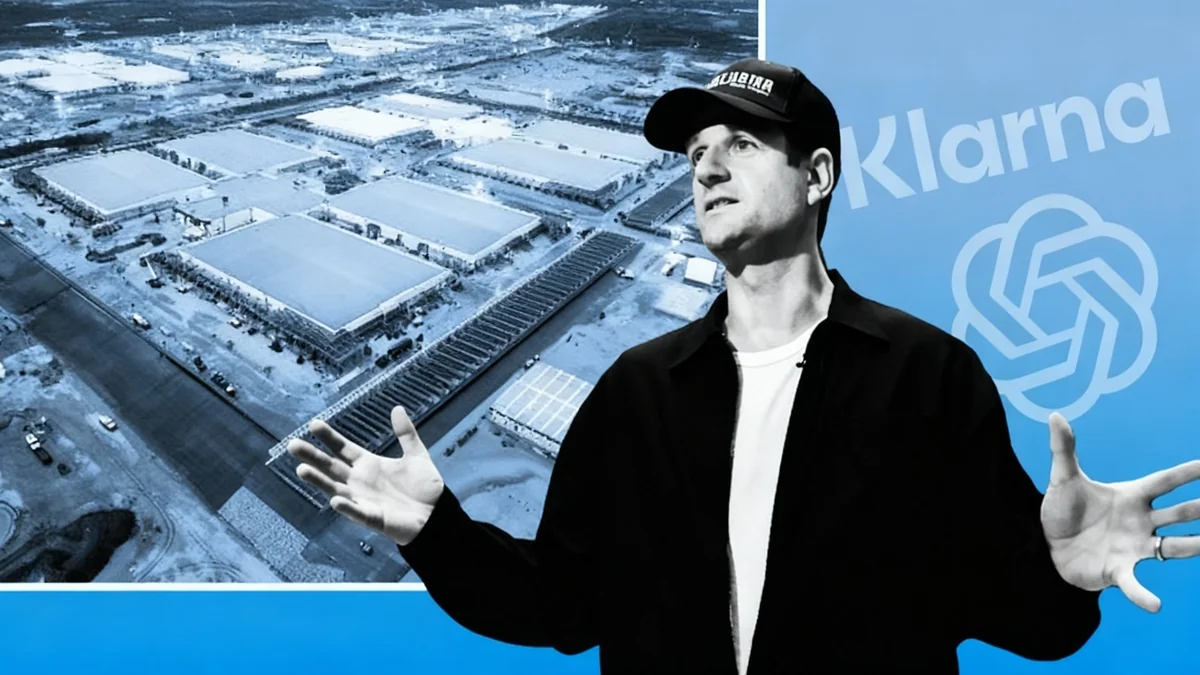



Sebastian Siemiatkowski, the chief executive of fintech giant Klarna and a prominent investor in artificial intelligence, has voiced significant concerns over the colossal sums being invested into data centers to power AI models. Despite being an advocate for AI, he described himself as “nervous” about the scale of the financial commitments, questioning whether the trillion-dollar infrastructure build-out is a sustainable investment.
Key Takeaways
- Klarna CEO Sebastian Siemiatkowski, an active AI investor, is concerned about the massive spending on AI data centers.
- Just four tech companies—Alphabet, Amazon, Meta, and Microsoft—reported a combined $112 billion in capital expenditure in the third quarter alone.
- OpenAI has reportedly made commitments valued at $1.5 trillion to secure computing resources for its AI development.
- Siemiatkowski believes AI models will become more efficient, potentially making the current level of infrastructure investment excessive.
- These concerns echo wider market fears about an AI bubble, with parallels drawn to investor Michael Burry's skepticism of current market valuations.
An Insider's Cautionary Note on the AI Gold Rush
A leading figure in the technology and finance sector is raising alarms about the unprecedented spending spree fueling the artificial intelligence revolution. Sebastian Siemiatkowski, co-founder and CEO of Klarna, has publicly challenged the wisdom behind pouring trillions of dollars into the physical infrastructure required for advanced AI.
Through his family office, Flat Capital, Siemiatkowski holds shares in several key AI players, including OpenAI, Perplexity, xAI, and Cerebras. His position as both an investor and a user of AI makes his warning particularly notable. Klarna itself has heavily integrated AI into its operations, using the technology to handle two-thirds of its customer service inquiries and significantly reduce its workforce.
Despite his belief in the technology's potential, Siemiatkowski expressed unease about the sheer volume of capital being allocated to servers and data centers.
“I think [OpenAI] can be very successful as a company but at the same time I’m very nervous about the size of these investments in these data centres,” he stated. “That’s the particular thing that I am concerned about.”
The Trillion-Dollar Question
The scale of investment is staggering. In the third quarter alone, four of the world's largest tech companies—Alphabet, Amazon, Meta, and Microsoft—announced a combined capital expenditure of $112 billion, much of it directed towards AI capabilities. The sector is also taking on hundreds of billions in debt to finance this expansion.
One of the most prominent examples is OpenAI, which has reportedly made commitments totaling $1.5 trillion to secure access to the necessary computing power for its future models. While the popularity of services like ChatGPT demonstrates widespread adoption, Siemiatkowski questions the underlying financial logic.
“That’s a different thing than asking myself ‘is it worth putting a $1tn worth into servers’,” he explained. “I am concerned that piling that kind of money into data centres may turn out to be not worth it.”
A Market Fueled by AI Enthusiasm
The boom in AI has been a primary driver of the U.S. stock market this year. The valuation of companies central to the AI supply chain, such as chipmaker Nvidia with its market capitalization of approximately $4.5 trillion, has surged. This rapid growth has drawn comparisons to previous tech bubbles, prompting some investors to question if valuations have become detached from fundamental value.
The Argument for Efficiency Over Expansion
At the heart of Siemiatkowski’s argument is the belief that the current infrastructure build-out may be based on a flawed assumption. He suggests that AI models will become significantly more efficient over time, requiring less raw computing power than companies are currently planning for.
He described AI models as the “most effective compression technology ever invented,” implying that future breakthroughs will focus on optimizing performance rather than simply adding more hardware. This perspective suggests that the current race to build massive data centers could result in an oversupply of expensive, specialized infrastructure.
Recent developments lend some support to this view. In January, Chinese AI company DeepSeek gained attention by unveiling models that were both low-cost and power-efficient, demonstrating that cutting-edge performance does not always require more resources.
Global Pension Funds on the Line
Siemiatkowski highlighted a critical concern: the risk is not limited to wealthy tech investors. Because of the dominance of AI-related stocks in market indexes, a significant portion of global pension funds is now indirectly invested in the AI infrastructure boom. “Your pension right now is going into that theory that it is a good investment,” he warned, stressing the need for more thoughtful analysis beyond the current hype.
Echoes of Broader Market Skepticism
Siemiatkowski is not alone in his concerns. His comments align with a growing sentiment of caution among some market observers. Over the past month, a stock sell-off has impacted U.S. companies closely tied to the AI boom, partly driven by investor anxiety over the immense capital expenditures.
He also drew a parallel to Michael Burry, the investor famous for predicting the 2008 housing crisis, who recently closed his hedge fund, citing a stock market that had become disconnected from fundamentals. Burry's fund, Scion Capital, held short positions against both Nvidia and Palantir, two major AI-related companies.
“I partially agree with Michael Burry,” Siemiatkowski said, acknowledging the difficulty in timing market corrections. He noted that he has raised these concerns directly with executives at the tech companies he invests in.
According to Siemiatkowski, the private response is often more aligned with his thinking than public statements suggest. “People have an incentive to say I’m wrong . . . and I feel, behind [closed] doors, people are more concerned about what I’m saying than they are in public,” he said. This suggests a potential disconnect between the public narrative of unrestrained growth and private anxieties about the sustainability of the current AI investment frenzy.