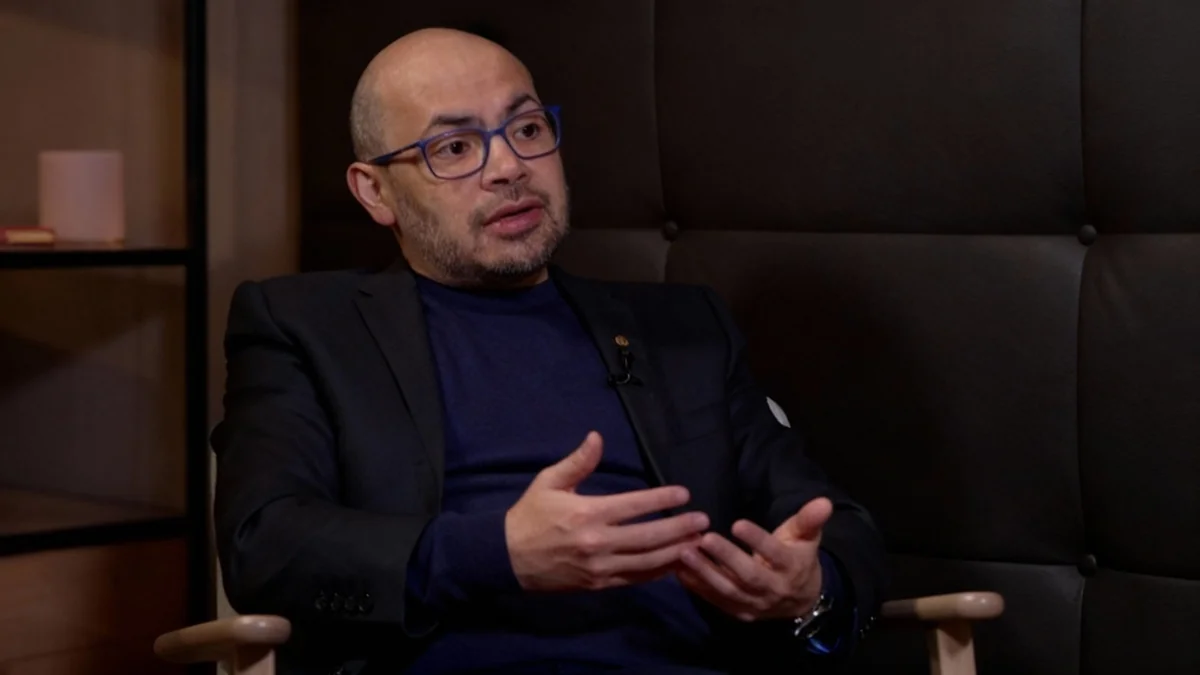



The head of Google DeepMind, Sir Demis Hassabis, has voiced concerns that the artificial intelligence sector is showing signs of an investment bubble. Speaking at the World Economic Forum in Davos, the Nobel laureate cautioned that some financial backing in the industry has become disconnected from tangible results.
Despite this warning, Hassabis expressed confidence in Google's position, stating the tech giant is well-equipped to handle any potential market corrections due to its established business and advanced AI integration.
Key Takeaways
- Sir Demis Hassabis identifies "bubble-like" characteristics in the current AI investment landscape.
- He points to multibillion-dollar funding for startups without products as "unsustainable."
- Hassabis believes Google is insulated from a potential market downturn due to its strong core business and AI integration.
- He asserts that Western companies, particularly in the US, maintain a lead of about six months over Chinese AI labs in frontier innovation.
- The DeepMind chief emphasizes the need for responsible AI development and focusing on applications for science and medicine.
Unsustainable Valuations Raise Red Flags
A wave of massive investment has flooded the artificial intelligence industry, but a leading figure is now urging caution. Sir Demis Hassabis described some of the current financial activities as detached from commercial reality.
He specifically highlighted the trend of enormous early-stage funding for companies that are yet to develop a product or technology. This, he suggested, points to an overheated market that may be due for a shift.
“Multibillion-dollar seed rounds in new start-ups that don’t have a product or technology or anything yet do seem a little bit unsustainable,” Hassabis stated during a discussion in Davos.
This perspective contrasts with the generally optimistic tone from other tech leaders at the forum, who have largely dismissed concerns of over-investment. The rush of venture capital has led to staggering valuations for nascent companies, sometimes within months of their founding.
The AI Investment Boom
The launch of advanced generative AI models like OpenAI's ChatGPT in late 2022 triggered an unprecedented surge in investment. Venture capitalists and corporate funds have since poured billions into a wide range of AI startups, from those building foundational models to others creating niche applications, driving valuations to historic highs.
Hassabis indicated that this period of intense investment might lead to “corrections in some parts of the market.” His comments serve as a significant cautionary note from one of the architects of the modern AI revolution.
Google's Strategy in a Volatile Market
While warning of a potential bubble, Hassabis was clear that Google and its parent company, Alphabet, are in a strong position to weather any storm. He argued that the company's established infrastructure and diverse product ecosystem provide a stable foundation.
The integration of powerful AI models, such as the latest Gemini 3, into Google's existing products is driving strong demand and creating tangible value.
“If the bubble bursts we will be fine,” he said. “We’ve got an amazing business that we can add AI features to and get more productivity out of.”
This strategy appears to be paying off. After an initial period of adjustment following the release of ChatGPT, Google has regained significant momentum. Its AI models are now considered highly competitive, and the company is closing the gap in chatbot user adoption.
Alphabet's Market Power
The momentum in its AI division has helped propel parent company Alphabet's valuation past $4 trillion. This makes it the second-largest company in the world by market capitalization, trailing only chipmaker Nvidia, which is also a major beneficiary of the AI boom.
Hassabis emphasized that AI will prove to be “the most transformative technology probably ever invented,” reinforcing Google's long-term commitment to the field regardless of short-term market fluctuations.
The Global AI Race: West vs. East
Hassabis also provided his assessment of the competitive landscape between Western and Chinese technology firms in the race for AI supremacy. He suggested that US-based companies currently hold an advantage in pushing the boundaries of AI research.
He characterized some reactions in the West to advancements from Chinese labs as an overreaction. Citing the example of the Chinese model DeepSeek, which gained attention for its capabilities and low cost, Hassabis argued that the fundamental innovation is still led by the US.
“The Chinese labs haven’t proven they can innovate beyond the frontier yet,” he noted, estimating that US tech companies maintain a lead of “six months or so.”
However, he acknowledged a key difference in strategy. Hassabis admitted that Chinese companies are “more focused on the near-term applications” in a search for immediate revenue. This contrasts with the research-heavy approach of groups like DeepMind, OpenAI, and Anthropic, which remain focused on the long-term goal of achieving artificial general intelligence (AGI).
- US/Western Approach: Focus on research-heavy, frontier capabilities to achieve AGI.
- Chinese Approach: Focus on near-term applications and commercialization for immediate revenue.
This strategic divergence highlights the different paths being taken in the global competition to dominate the next era of technology.
A Renewed Focus on Safety and Practical Benefits
Amid the debate over investment and international competition, Hassabis stressed the critical importance of developing AI safely and responsibly. Recent controversies involving AI, including lawsuits and misuse of models to generate harmful content, have brought the risks to the forefront of public discussion.
He stated it is imperative for the industry to demonstrate the positive impact of artificial intelligence to the public.
“For us, that’s doubling down on our AI for science and AI for medicine work and things like that, which are kind of unequivocal goods in the world,” he explained.
This focus on tangible benefits also extends to consumer products. Hassabis believes AI could finally be the key to realizing the vision of smart glasses, a concept Google first explored over a decade ago with limited success.
“Maybe we were a bit too ahead of our time,” he admitted. “What was missing was a killer app for that. I think a universal digital assistant that helps you in your everyday life could well be that killer app.”
As a central figure in Google's AI strategy, Hassabis remains focused on the scientific and research aspects of his role, dismissing speculation about potentially succeeding Alphabet's current chief. “I love being close to the science and the research,” he concluded.