



A wave of uncertainty swept through global markets on Tuesday, pushing stocks lower and causing Bitcoin to reach its lowest point since November 2024. The downturn was primarily driven by growing concerns over artificial intelligence's impact on software companies and escalating geopolitical tensions in the Middle East.
Investors reacted to new AI developments and international incidents, creating a nervous atmosphere across financial sectors. While technology stocks saw significant declines, traditional safe-haven assets like gold and silver experienced notable gains.
Key Takeaways
- US stocks, especially tech and software, experienced significant declines.
- Bitcoin slumped to its lowest level since November 2024, down 40% from its October peak.
- Artificial intelligence advancements fueled fears of disruption in the software industry.
- Geopolitical tensions involving the US and Iran contributed to market instability.
- Gold and silver surged, highlighting their role as safe-haven investments.
Technology Sector Leads Market Decline
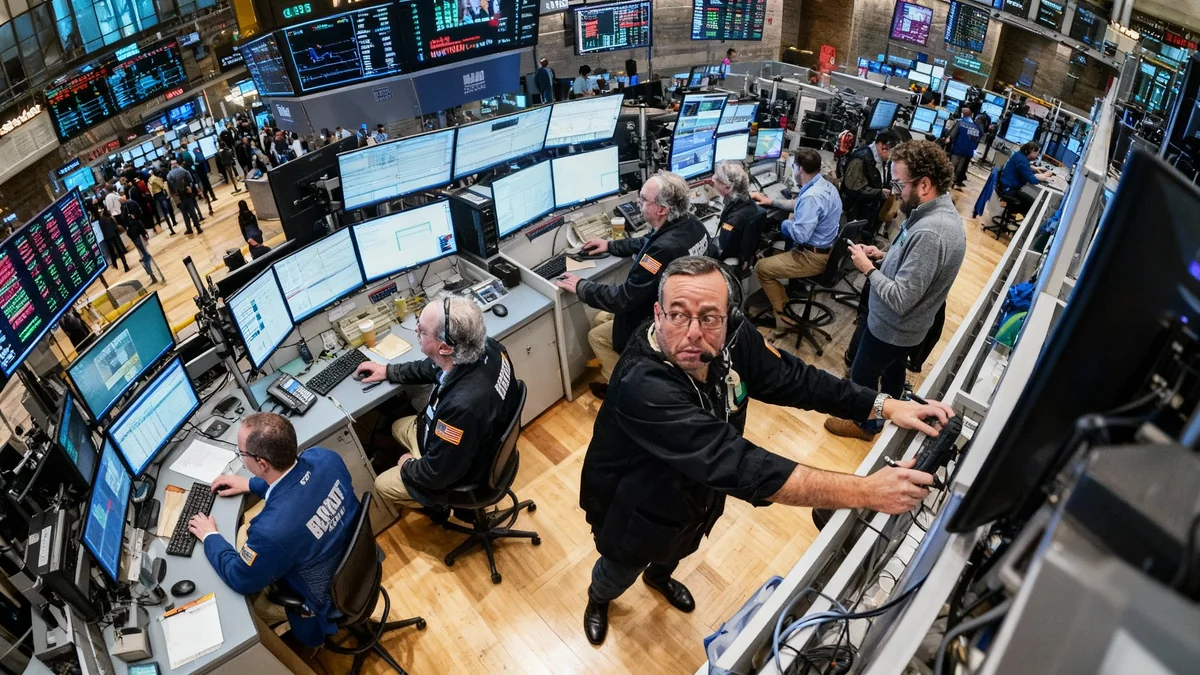
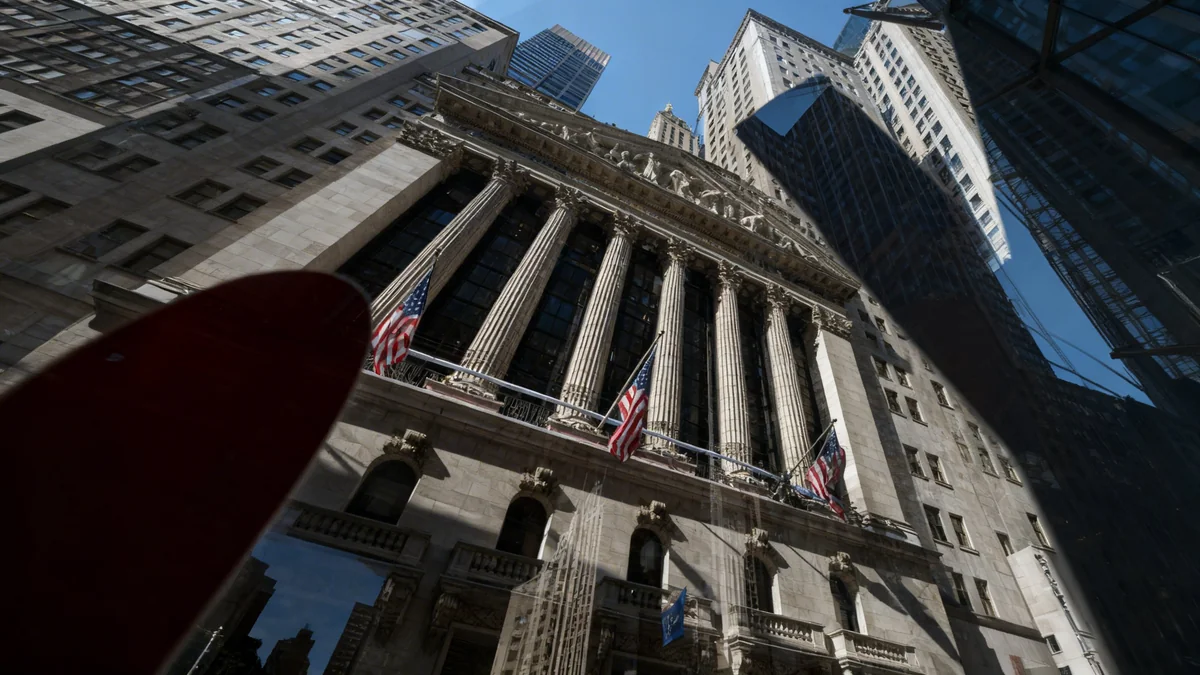
Wall Street saw a broad market retreat, with technology and software companies bearing the brunt of the sell-off. The Dow Jones Industrial Average closed lower by 167 points, or 0.34%, after an earlier dip of 575 points. The S&P 500, a broader market indicator, fell 0.84%.
The tech-heavy Nasdaq Composite recorded its worst day in two weeks, sinking 1.43%. This decline reflects ongoing investor anxieties about the rapid evolution of artificial intelligence and its potential to reshape established business models.
Market Snapshot
- Dow Jones: Down 0.34%
- S&P 500: Down 0.84%
- Nasdaq: Down 1.43%
- Bitcoin: Briefly fell to nearly $73,000
AI Disrupts Software Valuations
Recent developments in the AI industry have stoked fears among investors. AI startup Anthropic announced new capabilities for its Claude chatbot, including tasks related to legal work. This news immediately raised concerns about potential disruptions for software companies serving the legal sector.
Shares of software giant Salesforce (CRM) fell 6.85%, making it the second-worst performing stock in the Dow this year. Other tech stalwarts also felt the pressure; Microsoft (MSFT) dropped 2.87% and Amazon (AMZN) declined 1.79%.
"It’s notable that rotation is also happening within tech itself, as investors flee software because of continued AI-disruption fears, and move toward other momentum winners, like memory," stated Daniel Skelly, head of Morgan Stanley’s wealth management market research and strategy team.
Even Nvidia (NVDA), a key player in the AI hardware market, fell 2.84%, underscoring a broader cautious sentiment regarding the profitability of AI investments. Microsoft shares had previously dropped 10% after reporting lower-than-expected cloud sales growth and increased AI spending, highlighting investor scrutiny over AI expenditures versus returns.
Bitcoin Plunges Amid Market Uncertainty
The cryptocurrency market also experienced significant volatility. Bitcoin, the world's largest cryptocurrency by market value, slumped nearly 7% at one point, falling just below $73,000. This marked its lowest level since November 2024.
Despite a slight rebound to around $76,800, Bitcoin remains down roughly 40% from its record high above $126,000 in October. This decline comes even as the current administration has expressed pro-crypto policies, aiming to make the United States a "crypto capital."
Bitcoin vs. Gold: Store of Value Debate
Historically, gold has been considered a safe haven during economic uncertainty. Recent data indicates that gold has outpaced Bitcoin over the past five years. This divergence suggests that many investors currently view gold as the more reliable store-of-value asset.
Gerry O’Shea, head of global market insights at Hashdex, noted that Bitcoin’s divergence from gold signals investors' preference for gold, especially during times of currency debasement and geopolitical turmoil. He anticipates continued near-term volatility for Bitcoin as the industry seeks greater regulatory clarity and integration into mainstream finance.
Geopolitical Tensions Fuel Further Instability
Beyond the tech sector, rising geopolitical tensions contributed to the market's nervous mood. Reports emerged that the United States shot down an Iranian drone approaching a US aircraft carrier, escalating concerns in the Middle East.
This incident led to a surge in Wall Street’s fear gauge, the VIX, which was up 10% and briefly traded at 20 points – a level signaling elevated market volatility. The CNN Fear and Greed Index also dropped from "greed" into "fear," reflecting the shift in investor sentiment.
Oil, Gold, and Silver React
As tensions flared, oil futures rose. Brent crude, the international benchmark, gained 1.6% to $67.33 a barrel, while West Texas Intermediate (WTI), the US benchmark, increased 1.7% to $63.21 a barrel. These price movements reflect concerns about potential disruptions to global oil supplies.
Conversely, traditional safe-haven assets saw significant gains. Gold futures climbed 6.7% to $4,965 a troy ounce, extending recent volatility. Silver futures soared an impressive 10% to approximately $85 a troy ounce. These surges underscore investors' flight to safety during periods of heightened global uncertainty.
Amidst the broader market downturn, Walmart shares (WMT) bucked the trend, gaining 2.94% and pushing the company's market value above the $1 trillion mark for the first time. This highlights how some sectors can perform well even when overall market sentiment is negative.