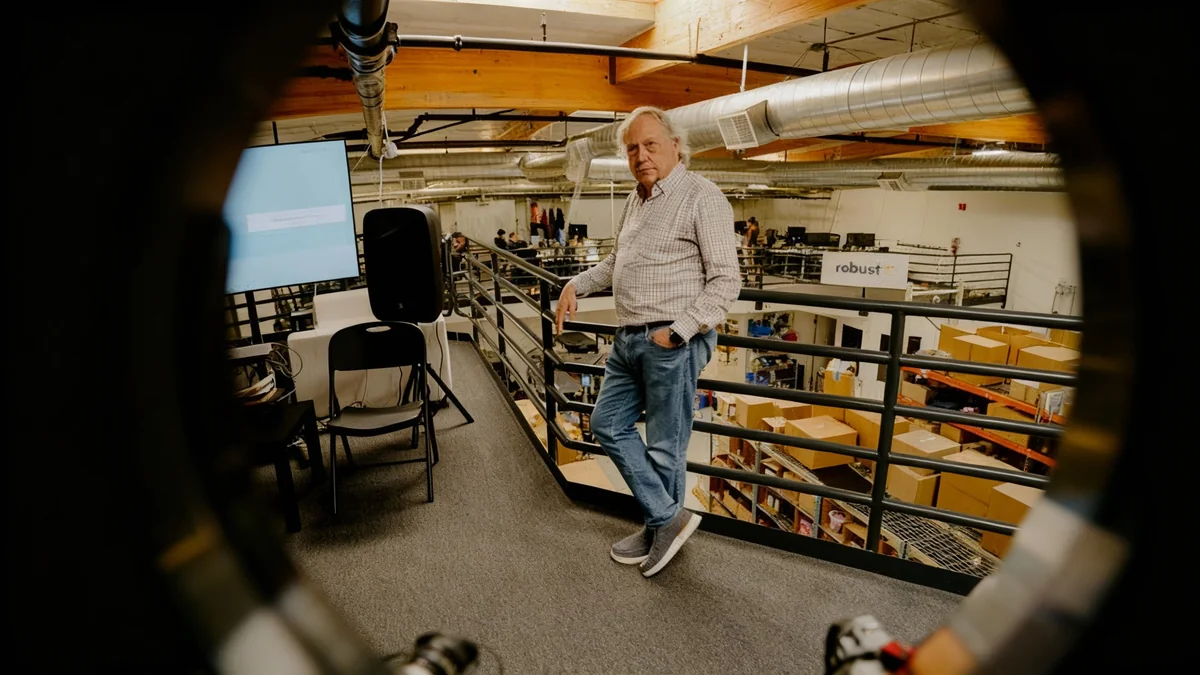

Rodney Brooks, a pivotal figure in modern robotics and the inventor of the Roomba, has expressed significant concerns about the current direction of the field. Brooks argues that the industry's widespread focus on developing humanoid robots, particularly within Silicon Valley, is a misstep that could hinder genuine progress.
His critique suggests that the pursuit of human-like machines is not only impractical but also distracts from more effective approaches to robotics, echoing his past successes by challenging conventional thinking.
Key Takeaways
- Rodney Brooks, creator of the Roomba, believes the humanoid robot trend is flawed.
- He advocates for simpler, more functional robots over complex human-like designs.
- Brooks's past success came from mimicking insect biology, not human intelligence.
- He argues that current computing limitations make true humanoid intelligence impractical.
- The focus on humanoids may divert resources from more impactful robotic applications.
The Godfather of Robotics Speaks Out
Rodney Brooks is widely recognized for his groundbreaking work in robotics. His approach in the 1980s revolutionized the field. At that time, computing power was limited, restricting the complexity of robots. Brooks observed insects, noting their simple brains but complex behaviors.
He realized that trying to control every robot action through intricate code was not the most effective strategy. Instead, mimicking animal biology, which relies on distributed intelligence and reactive behaviors, offered a more promising path.
Did You Know?
Rodney Brooks co-founded iRobot, the company behind the highly successful Roomba robot vacuum cleaner. The Roomba embodies his philosophy of simple, task-specific robotics.
This insight led to significant breakthroughs, changing how roboticists approached design and programming. His work ultimately paved the way for more autonomous and adaptable machines, leading him to predict a future where robots would be commonplace.
"I like to look at what everyone is doing, find some common thing that they’re all assuming implicitly, and negate that thing."
Challenging the Humanoid Obsession
Brooks now applies this same critical thinking to the current wave of humanoid robot development. He sees a common, implicit assumption that robots must look and act like humans to be useful or advanced. He believes this assumption is fundamentally flawed.
According to Brooks, the ambition to create fully functional humanoid robots with human-level intelligence faces insurmountable challenges with today's technology. The sheer complexity of replicating human movement, perception, and decision-making in a robot is immense.
A Look Back
In the 1997 film "Fast, Cheap, and Out of Control," Brooks discussed his early work. He highlighted the struggle to control nature, a theme he sees recurring in the current push for humanoids. His early success came from understanding limitations and finding simpler solutions.
The resources poured into developing humanoids, Brooks argues, could be better spent on creating robots designed for specific tasks. These simpler, more specialized machines could provide immediate, tangible benefits.
Lessons from Nature and Simplicity
Brooks's philosophy has always centered on simplicity and biological inspiration. His early work involved observing insects, creatures with relatively small brains but remarkable abilities to navigate complex environments. He learned that intelligence does not always require massive computing power.
Instead, it can emerge from simple interactions between a robot's body, its sensors, and its environment. This approach, known as behavior-based robotics, contrasts sharply with the top-down, centralized control systems that dominated early robotics.
The Roomba is a prime example of this philosophy in action. It does not possess advanced AI or human-like dexterity. Instead, it uses simple rules and sensors to navigate a room, clean floors, and avoid obstacles effectively. Its success comes from its ability to perform a specific task reliably and affordably.
- Roomba's Design: Relies on simple, reactive behaviors.
- Task Focus: Designed for a single, clear purpose.
- Cost-Effectiveness: Achieved widespread adoption due to affordability.
The Future of Robotics: A Different Path
Brooks suggests that the robotics field has strayed from this path of practical, task-oriented design. He implies that the allure of creating a robot that mirrors human form is a distraction, perhaps driven by science fiction ideals rather than engineering realities.
Focusing on humanoids, he believes, risks repeating past mistakes where complex, over-engineered robots failed to deliver on their promises. True progress, according to Brooks, lies in understanding the limitations of current technology and designing robots that can genuinely solve problems.
This does not mean abandoning all research into advanced AI or complex robot forms. However, it suggests a need for a more pragmatic approach. Robotics should prioritize functionality and utility over anthropomorphic aesthetics.
Brooks's perspective serves as a crucial reminder for the robotics community. It encourages a return to foundational principles that emphasize efficiency, practical application, and a deep understanding of what robots can realistically achieve given current technological constraints. The goal should be robots that work effectively, not just look impressive.