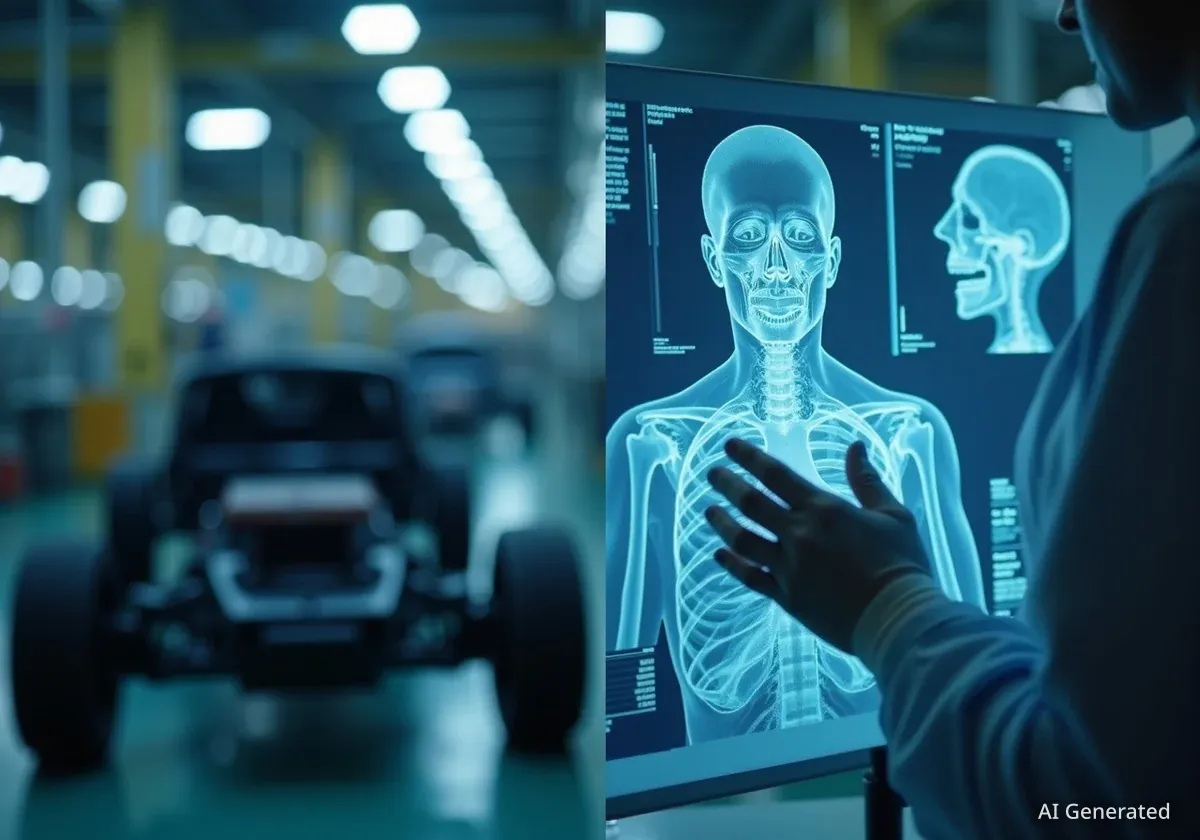





The U.S. automotive industry is currently navigating significant challenges due to fluctuating government policies on electric vehicles, according to Ford CEO Jim Farley. In contrast, the medical field is experiencing a rapid technological shift, with a new report showing a substantial increase in the adoption of artificial intelligence by physicians to manage complex research and improve patient care.
Key Takeaways
- Ford CEO Jim Farley describes the U.S. auto industry's situation as an "awkward moment" following reversals on EV tax credits.
- Farley highlights a need for one million more workers in America's "essential economy," which currently employs 95 million people.
- A recent American Medical Association survey reveals that 60% of doctors now use AI in their practices, a significant jump from 38% in 2023.
- AI tools like OpenEvidence, valued at $3.5 billion, are being used as "mind extenders" to help physicians stay current with medical literature.
Navigating Policy Uncertainty in the Automotive Sector
The American auto industry is facing a period of instability driven by conflicting government directives. Major manufacturers like Ford made substantial investments in electric vehicle (EV) production, encouraged by policies from the Biden administration. However, a subsequent reversal of EV tax credits under the Trump administration has created significant operational and strategic questions.
Ford CEO Jim Farley addressed this situation, labeling it an "awkward moment" for companies that have committed billions to new battery plants and manufacturing facilities. The core issue now revolves around the future of these significant capital investments.
"What do we do with those assets?" Farley stated, acknowledging the complexity of the situation. He assured stakeholders that, despite the uncertainty, "we'll make the right decision for the company."
The "Essential Economy" Labor Gap
Farley placed these industry-specific challenges within a larger economic context he calls the "essential economy." This sector includes workers who build, move, and repair things—the foundational pillars of the nation's industrial base. According to Ford's analysis, this segment of the workforce comprises approximately 95 million Americans.
Labor Shortage
Despite its large size, the essential economy faces a critical labor shortage, with an estimated need for at least one million additional workers to meet current demands and support future growth.
Farley argues that strengthening this essential economy is a prerequisite for successfully integrating advanced technologies like artificial intelligence across society. A robust industrial and manufacturing base, he suggests, provides the stability needed for broader technological advancement.
What is the Essential Economy?
The term "essential economy" refers to industries and jobs critical to the physical functioning of the country. This includes manufacturing, logistics, transportation, construction, and maintenance services. These roles are often hands-on and form the backbone of the supply chain and infrastructure.
AI Transforms Medical Practices
While the auto industry grapples with policy-driven hurdles, the healthcare sector is embracing a technological revolution. Artificial intelligence is no longer a futuristic concept but a practical tool being integrated into daily medical practice at an accelerated pace.
The adoption of AI among physicians has seen a remarkable increase. According to a survey by the American Medical Association (AMA), three out of every five doctors, or 60%, reported using AI in their work last year. This figure represents a substantial rise from the 38% who reported using AI in 2023.
This rapid growth indicates a clear trend: physicians are actively seeking tools to help them manage the overwhelming volume of new medical information and streamline administrative tasks, ultimately aiming to improve patient outcomes.
A Tool for Modern Physicians
One of the primary drivers of AI adoption in medicine is its ability to help doctors stay current with the latest scientific research. The sheer volume of published studies makes it nearly impossible for a practicing physician to keep up manually. This is where AI-powered platforms are making a significant impact.
Daniel Nadler, founder of the AI model OpenEvidence, explained that the technology serves as a powerful assistant. OpenEvidence, which was valued at $3.5 billion in a July fundraising round, provides a free, ad-supported service that synthesizes medical literature for clinicians.
Nadler emphasizes that AI is not a replacement for a doctor's expertise. Instead, he describes the technology as a "mind extender," a tool that enhances a physician's ability to access and process information efficiently.
This perspective is crucial, as it frames AI as a support system that empowers medical professionals rather than a technology that seeks to supplant them. The goal is to augment human skill with computational power, leading to more informed clinical decisions.
Two Sectors on Divergent Paths
The current economic landscape reveals a tale of two distinct sectors. On one hand, the established automotive industry is contending with external pressures from shifting political winds, forcing it to reconsider long-term strategies. The focus is on asset management and navigating a future made uncertain by policy reversals.
On the other hand, the healthcare industry is proactively integrating cutting-edge technology to solve long-standing challenges. The rapid adoption of AI demonstrates a sector embracing innovation to enhance efficiency and knowledge management. This divergence highlights how different industries are responding to the unique opportunities and obstacles of the modern economy.