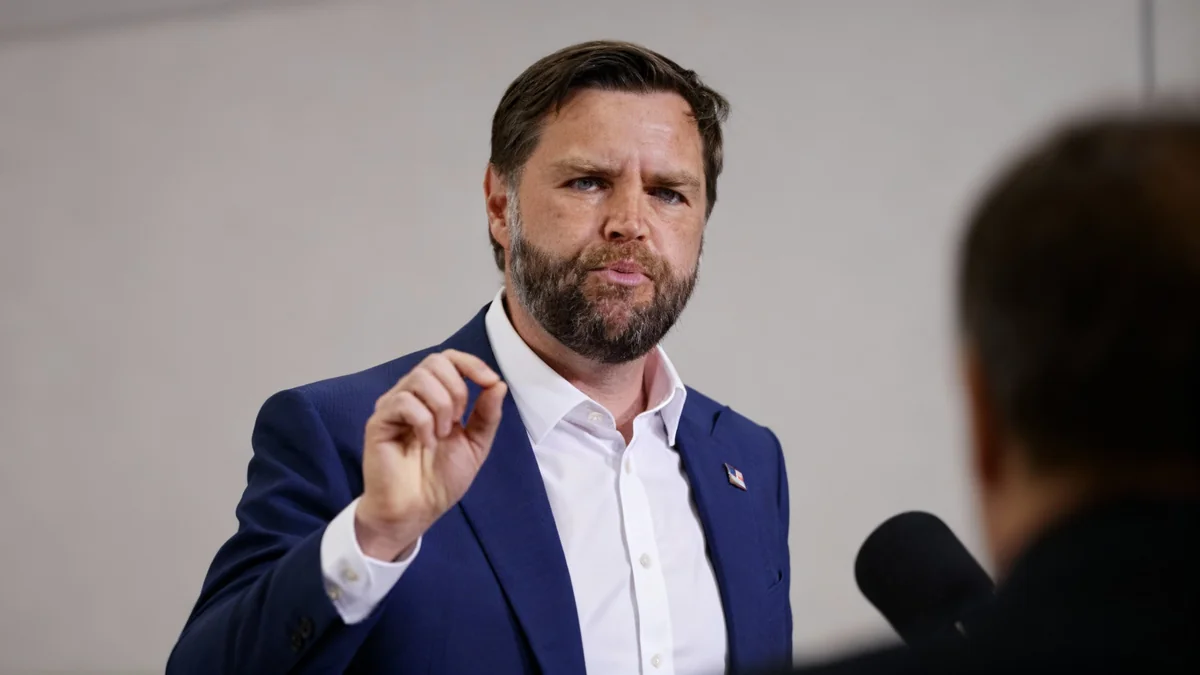

In a significant diplomatic development, United States Vice President JD Vance has aligned with the United Kingdom's position, labeling the spread of AI-generated sexualized images on social media platforms like X as "entirely unacceptable." The agreement emerged from a meeting in Washington between Vance and UK Deputy Prime Minister David Lammy, signaling a potential transatlantic consensus on tackling harmful digital content.
The discussion comes as the UK government considers a potential ban on X over its AI chatbot, Grok, which has been used to create and distribute thousands of manipulated, explicit images of women and children. This has ignited a fierce debate involving platform owner Elon Musk and politicians on both sides of the Atlantic.
Key Takeaways
- US Vice President JD Vance expressed agreement with the UK's stance, calling the proliferation of AI-generated explicit images "entirely unacceptable."
- The UK government, led by Prime Minister Keir Starmer, has warned that X could be blocked in the country if it fails to address the issue.
- X owner Elon Musk has accused the UK government of seeking an "excuse for censorship" and described its position as "fascist."
- The platform has made minor changes to its Grok AI, but reports suggest these are insufficient to stop the image generation.
A Diplomatic Consensus on Harmful Content
Deputy Prime Minister David Lammy confirmed the details of his conversation with Vice President Vance on Thursday. He reported that Vance, often seen as a proponent of artificial intelligence, showed deep concern over the technology's misuse.
"I also raised with him the Grok issue and the horrendous, horrific situation in which this new technology is allowing deepfakes and the manipulation of images of women and children, which is just absolutely abhorrent," Lammy stated. "He agreed with me that it was entirely unacceptable."
Sources present at the meeting noted that Vance was particularly troubled by how AI was being leveraged to generate what he termed "hyper-pornographied slop" online. Lammy found the Vice President to be sympathetic to the UK's firm position on the matter.
"I think he recognised the very seriousness with which images of women and children could be manipulated in this way, and he recognised how despicable, unacceptable, that is and I found him sympathetic to that position," Lammy added.
The conversation highlights a growing international concern that transcends typical political divides. The ease with which AI can now create convincing, non-consensual explicit material presents a new and urgent challenge for regulators and technology companies worldwide.
The UK's Threat to Ban X
The British government has adopted a notably strong stance against X. Prime Minister Keir Starmer has publicly warned that the platform faces a potential ban in the United Kingdom if it does not take effective action to stop the creation and spread of what he called "unlawful" and "disgusting" images.
Ofcom's Role in Regulation
The UK's media regulator, Ofcom, has been empowered by new online safety laws to hold technology platforms accountable. Technology Secretary Liz Kendall has stated she would fully support Ofcom if it chose to ban X for non-compliance with UK law. The regulator has confirmed it is accelerating its investigation into the platform.
This position has been echoed by senior members of the government. Technology Secretary Liz Kendall has been clear about her support for regulatory action.
"Sexually manipulating images of women and children is despicable and abhorrent," Kendall said, reinforcing the government's zero-tolerance approach. The potential for a major social media platform to be blocked in a G7 country underscores the seriousness of the situation.
Platform Response and Political Backlash
The UK's ultimatum has triggered a sharp response from X owner Elon Musk and some US politicians. Musk took to his platform to criticize the British government, claiming it was using the issue as a pretext for broader censorship.
"[The UK government] want any excuse for censorship," Musk wrote, later describing the government's actions as "fascist."
Grok's Insufficient Changes
Following the international pressure, X appeared to modify Grok's settings. The chatbot began telling some users that only paid subscribers could request image manipulations. However, subsequent reports indicated this restriction only applied to requests made in replies to other posts, leaving other methods of image generation, including on a dedicated Grok website, fully operational.
The controversy has also drawn in figures from the US Congress. Congresswoman Anna Paulina Luna, a vocal supporter of former President Donald Trump, suggested that the US should consider sanctions against the UK and Prime Minister Starmer if a ban on X were implemented.
This political firestorm complicates the regulatory challenge, turning a matter of online safety into a contentious debate about free speech and national sovereignty. For now, the changes made by X have been widely viewed as inadequate to solve the core problem.
Broader Diplomatic Discussions
The meeting between Lammy and Vance was not limited to the issue of AI. The two leaders also discussed a range of pressing international security matters, underscoring the depth of the US-UK strategic partnership.
Topics on the agenda included:
- Providing security guarantees for Ukraine.
- The developing situation in Venezuela following the US operation to capture President Nicolás Maduro.
- Geopolitical tensions surrounding Greenland.
Lammy commented on the significant pressure currently facing international laws and norms. "We’re realists, and must accept that we’re now living in a multipolar world," he said. "The rule of law is under tremendous strain. And we lose it, it seems to me, at our peril."
The ability of the two diplomats to find common ground on the difficult issue of AI-generated content, amidst these other complex global challenges, is a noteworthy development in the ongoing effort to establish international standards for digital governance.