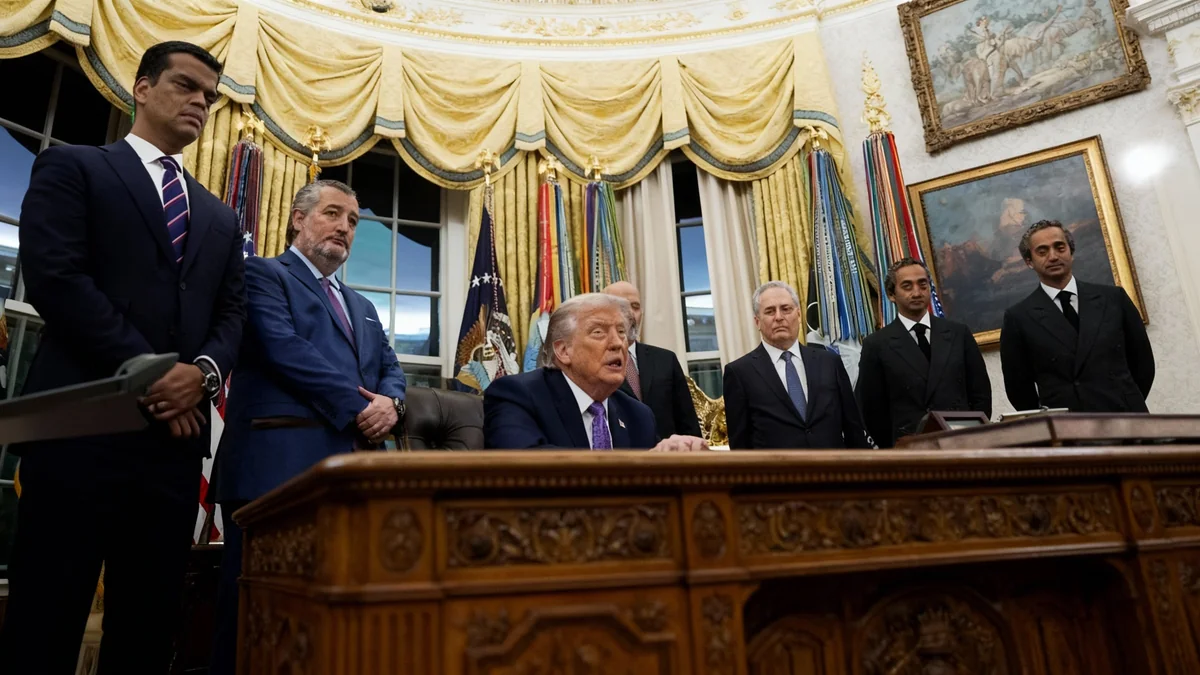



President Donald Trump signed an executive order Thursday aimed at creating a single, national framework for artificial intelligence regulation. The move intends to preempt individual states from enforcing their own rules on the rapidly developing technology.
The order directs federal agencies to take action against what the administration calls potentially crippling state-level regulations, setting the stage for a significant shift in how AI is governed across the United States. The action has ignited a debate between technology industry leaders who favor a unified approach and critics who fear a rollback of consumer protections.
Key Takeaways
- President Trump signed an executive order to establish a single national framework for AI governance.
- The order aims to block states from enforcing their own, often stricter, AI regulations.
- The move is supported by some tech leaders who fear a patchwork of state laws will hinder innovation.
- Critics argue the order removes important safeguards and could face legal challenges.
- The action highlights a growing debate within the Republican party over the extent of federal versus state authority on technology.
A Push for a Unified National Standard
During a ceremony in the Oval Office, the administration positioned the executive order as a necessary step to ensure the United States remains a global leader in artificial intelligence. The primary goal is to prevent a complex and contradictory web of state laws that could slow down development and deployment.
"This is an executive order that orders aspects of your administration to take decisive action to ensure that AI can operate within a single national framework in this country, as opposed to being subject to state level regulation that could potentially cripple the industry," explained White House aide Will Scharf during the signing.
The directive empowers federal bodies to challenge state regulations deemed overly burdensome, with a clear objective of fostering a more predictable business environment for AI companies. This approach reflects concerns voiced by many in Silicon Valley that navigating 50 different sets of rules is unworkable.
Federal Framework in the Works
David Sacks, the White House's crypto and AI czar, clarified that the ultimate goal is to work with Congress to establish a comprehensive federal framework. He described the executive order as an interim tool.
"In the meantime, this EO gives your administration tools to push back on the most onerous and excessive state regulations," Sacks stated.
However, Sacks noted that the administration will not challenge all state-level AI laws. He specifically mentioned that rules concerning child safety and AI would not be targeted. In a social media post, he reiterated the point, stating the order "does not mean the Administration will challenge every State AI law."
Previous Legislative Efforts
This executive action follows previous unsuccessful attempts to limit state authority on AI through legislation. In July, the U.S. Senate voted almost unanimously to remove a proposed 10-year moratorium on state AI regulation enforcement from a broader domestic policy bill. A similar effort to add the moratorium to the National Defense Authorization Act also failed.
Industry Support and Widespread Concern
The debate over how to regulate AI has created distinct divisions, not just between political parties but within them. Tech industry leaders have long advocated for a unified federal approach, arguing it is essential for global competitiveness.
Figures like OpenAI CEO Sam Altman have warned that a fragmented regulatory landscape could stifle American innovation. The concern is that it would allow other nations, particularly China, to gain a strategic advantage in a technology critical to both economic prosperity and national security.
Collin McCune, who heads government affairs at the venture capital firm Andreessen Horowitz, praised the president's move.
"States have an important role in addressing harms and protecting people, but they can’t provide the long-term clarity or national direction that only Congress can deliver," McCune wrote on X, calling the order an "incredibly important first step."
Fears of a Regulatory Vacuum
On the other side of the issue, consumer advocates and some legal experts worry that the executive order will dismantle necessary protections without providing a federal alternative. With little comprehensive federal oversight currently in place, states have begun to address specific AI-related harms.
State-Level AI Legislation
In the absence of federal laws, several states have already enacted their own AI regulations. These laws target issues such as the use of AI in hiring decisions to prevent discrimination and the creation of misleading deepfakes, particularly in the context of elections.
Critics argue that blocking these state laws could leave citizens vulnerable. Brad Carson, president of the advocacy group Americans for Responsible Innovation, issued a sharp rebuke of the order.
"[The order] directly attacks the state-passed safeguards that we’ve seen vocal public support for over the past year, all without any replacement at the federal level," Carson said in a statement. He predicted that the executive order will "hit a brick wall in the courts."
A Political Fault Line
The executive order also highlights a significant ideological split within the conservative movement. While figures in the administration like David Sacks and Vice President JD Vance advocate for a lighter federal touch to encourage innovation, others champion states' rights to regulate new technologies.
Prominent Republicans, including Florida Governor Ron DeSantis and former White House chief strategist Steve Bannon, have been vocal supporters of state-level guardrails. They argue that local governments are better positioned to respond quickly to the challenges posed by fast-moving technologies like AI.
This internal disagreement underscores the complexity of regulating a technology that touches everything from personal communications to healthcare and law enforcement. As the administration moves to implement this new national strategy, the tension between fostering innovation and ensuring public safety will remain at the center of the national conversation.