

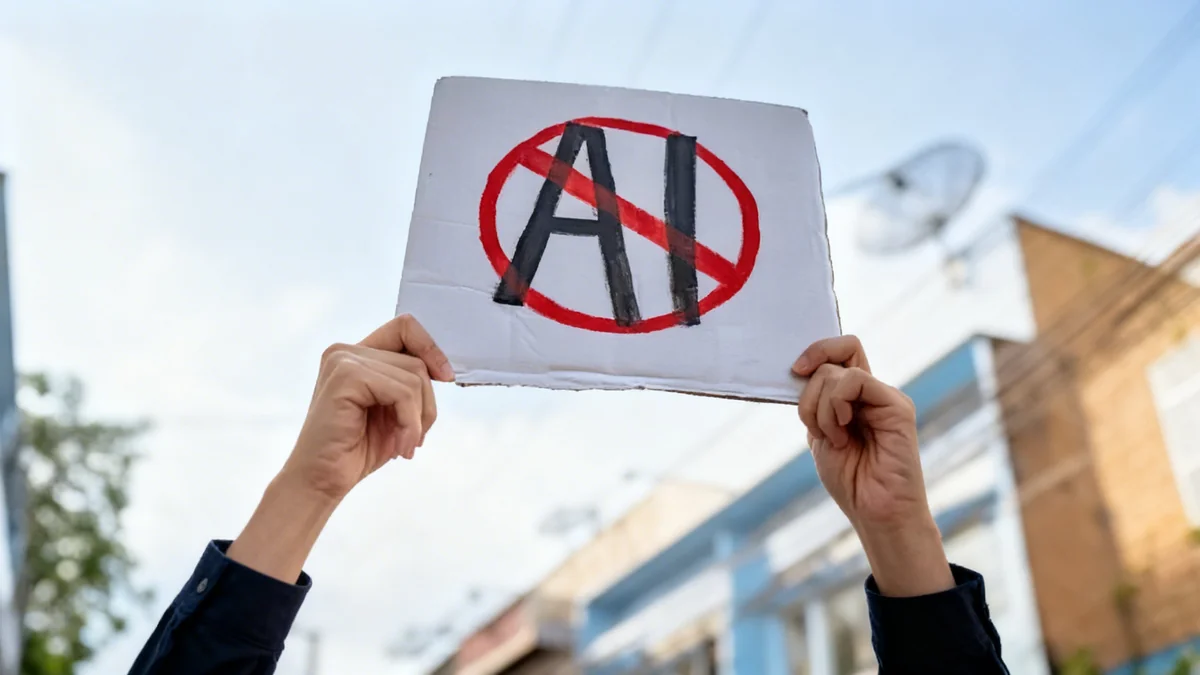



The prevailing narrative of a high-stakes AI “arms race” between the United States and China is a dangerous oversimplification that risks becoming a self-fulfilling prophecy, according to journalist and author Yi-Ling Liu. In a recent analysis, Liu argues this framing, often promoted by tech industry leaders, could lead to a rollback of critical safety regulations in a rush to innovate at any cost.
Key Takeaways
- Journalist Yi-Ling Liu warns the US-China AI competition narrative is a potentially self-fulfilling prophecy.
- The idea of a zero-sum "race" is being used to advocate for deregulation and fewer safety checks on powerful AI models.
- A growing "China envy" in Silicon Valley reflects American anxieties about its own progress more than Chinese technological leaps.
- Liu suggests scientific and civil society dialogues between the two nations as an alternative to escalating competition.
The Myth of the AI Race
While Washington and Silicon Valley frequently frame the development of artificial intelligence as a modern-day space race, Liu suggests the reality is more complex. The idea that both nations are sprinting toward artificial general intelligence (AGI) is not strongly supported by evidence, particularly regarding AGI as a stated national priority for China.
The narrative gained significant traction after the launch of the Chinese open-source AI model DeepSeek-R1, which was dubbed a “Sputnik moment” in some US circles. However, Liu questions the origins and motives behind this story.
"One of the biggest risks of furthering this particular narrative is making it a self-fulfilling prophecy, creating a story where it didn’t exist in the first place," Liu stated. She urges a closer look at "who are the people who are creating this narrative? To what extent is this narrative created by industry players who are trying to achieve their own corporate goals?"
The primary danger, she explains, is that the fear of falling behind is used to justify dismantling essential safeguards. This could lead to a reckless acceleration in AI development without proper oversight.
Deregulation in the Name of Competition
The core of the issue lies in the pressure to eliminate regulatory friction. The argument often presented is, “If we don’t move as fast as possible, China is going to beat us.”
This mindset, according to Liu, directly threatens several areas of governance:
- Safety Evaluations: Calls to reduce or eliminate safety benchmarks for frontier AI models to speed up deployment.
- Lab Accountability: A push to absolve AI labs of responsibility for the safety policies they implement.
- Bio-Risks: The potential to ignore risks of models becoming potential biohazards in the pursuit of a competitive edge.
- Intellectual Property: The weakening of IP rights for artists and writers, justified by claims that China operates with fewer restrictions.
A Push Against Protections
Liu warns that the competitive framing creates an environment where accelerating development is prioritized over all else. "The biggest risk is this rolling back of regulation and accelerating ahead without safety parameters in the name of trying to beat the other," she said.
Silicon Valley's "China Envy"
Adding fuel to the competitive fire is a phenomenon Liu describes as a wave of “China envy” sweeping through American policy and tech circles. This trend sees US pundits, CEOs, and influencers traveling to China and chronicling its technological and infrastructural achievements, often through a lens of American stagnation.
This obsession with China’s ability to build high-speed rail, drones, and massive buildings is less about a sudden transformation in China and more about a shift in American self-perception. "It’s more what has shifted in Americans’ perspective of China," Liu noted.
This sentiment is rooted in a growing awareness in the U.S. of its own challenges in building physical infrastructure and a perceived erosion of its political systems. China becomes a "rhetorical mirror onto which Americans started to project their fears and aspirations."
A History of Envy
This is not a new phenomenon. Years ago, Mark Zuckerberg was described as having “WeChat envy,” aspiring to build Facebook into a similar all-encompassing platform. Today, figures like Elon Musk express admiration for the speed at which China can build and innovate, reflecting a frustration with regulatory hurdles in the West.
An Alternative Path Forward
Instead of an arms race, Liu advocates for a more collaborative approach. She points to the potential of “track-two dialogues” as a crucial tool for de-escalation and mutual understanding.
Unlike official government-to-government “track-one” talks, track-two dialogues bring together non-governmental figures with influence:
- Scientists from both countries
- Civil society organizations
- Academics and policy experts
The goal of these meetings would be to establish common ground before jumping to conclusions that drive policy. "It’s very important to bring these two parties together to discuss, for example, red lines that won’t be crossed or established, like a common set of safety standards for models," Liu explained.
Global Implications and Misconceptions
The current trajectory has global consequences. As the U.S. potentially becomes a less reliable international partner, other countries may be forced to increase their dependency on Chinese technology, from electric vehicles and hardware to digital infrastructure.
Liu also stresses the importance of moving past monolithic views of China. She points out that it is often treated as a two-dimensional projection of American fears or desires, ignoring the complex realities within the country.
"It is possible that China is a technological powerhouse... but also economically stagnant, and its people are struggling with employment," she remarked. Understanding these contradictions is key to forming effective and realistic policy, rather than reacting to a simplified narrative of an all-powerful competitor.